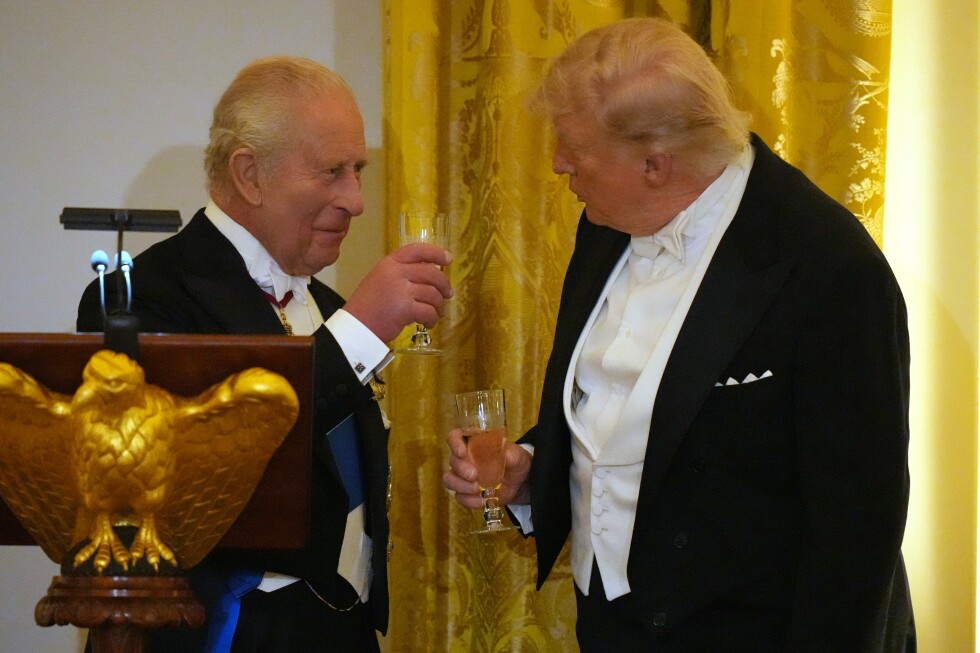
LONDON – When King Charles III and Queen Camilla kicked off their high-stakes 2025 state visit to the United States, British officials were bracing for missteps. The trip came as U.S. President Donald Trump openly aired frustration with UK Prime Minister Keir Starmer over the prime minister’s refusal to back American military actions in the ongoing Iran conflict. London’s core hope was that Charles’ warm personal rapport with Trump — a known admirer of the British monarchy — could smooth frayed bilateral ties and repair the growing diplomatic rift between the two allies.
No one expected a major controversy, but few discounted the risk presented by Trump’s well-documented habit of ditching established diplomatic protocol. That risk became reality on the first night of the visit, during a formal state dinner held in the king and queen’s honor. Speaking to the assembled audience, Trump made an unusual disclosure: during a private closed-door meeting with King Charles earlier that day, he claimed the British monarch had explicitly agreed with his stance that Iran must never be permitted to develop a nuclear weapon.
“We’re doing a little Middle East work right now … and we’re doing very well,” Trump told guests. “We have militarily defeated that particular opponent, and we’re never going to let that opponent ever — Charles agrees with me, even more than I do — we’re never going to let that opponent have a nuclear weapon.”
While the core of Trump’s claim aligns with the long-held public position of both the British government and a majority of the British public, the off-the-cuff comment immediately sparked mild consternation among constitutional experts and political commentators across the United Kingdom. Longstanding unwritten constitutional convention holds that private conversations with the reigning monarch are never disclosed publicly. This norm exists for two key reasons: the British sovereign is required to remain strictly neutral and above partisan political debate, and crucially, the monarch has no right to enter public discourse to correct misquotations or clarify misattributed statements.
Craig Prescott, a leading scholar of constitutional law and royal studies at Royal Holloway, University of London, explained the significance of the breach. “Generally, as a matter of protocol, I think I would expect discussions between heads of state to be sort of behind the scenes, in those closed meetings, for those to be sort of kept private,” he noted. “And, you know, this was something that the U.K. government wanted to avoid.”
Buckingham Palace moved quickly to defuse tension, releasing a muted statement designed to contextualize Trump’s remarks without explicitly confirming or denying the president’s account. “The King is naturally mindful of his government’s long-standing and well-known position on the prevention of nuclear proliferation,” the palace said.
Crucially, observers across the board have stressed that the incident is far from a major diplomatic crisis. The stance Trump attributed to Charles matches the official UK policy on Iranian nuclear proliferation exactly, eliminating most risk of lasting damage. Multiple analysts have echoed Prescott’s observation that the breach of protocol could have been far more severe. For weeks ahead of the visit, officials had worried that Trump might make more inflammatory comments, or share sensitive private exchanges via social media that would put the king in an truly untenable position.
In fact, the first political segment of the state visit has been largely marked by success. Before the state dinner, King Charles delivered a widely praised address to a joint session of the U.S. Congress, where he celebrated the centuries-long special relationship between the United States and the United Kingdom while openly acknowledging ongoing differences on issues ranging from NATO burden-sharing to support for Ukraine and global climate action. The speech drew multiple standing ovations from lawmakers, and even critics have noted it won broad positive reception in Washington.
Now, the royal visit is shifting to lower-stakes territory as Charles and Camilla travel from Washington D.C. to New York City, where the official itinerary will center on celebrating the city’s creative industries, youth employment initiatives, and cultural exchange rather than high-stakes geopolitics. If Trump’s disclosure of the private conversation is the only controversy to emerge from the visit’s opening political phase, Prescott argues, the trip should still be considered a major win for both King Charles and the British government.
“If this is the only controversy arising out of this phase of the state visit, I think overall this has been an enormous success for the king and the British government, because the king was able to make some quite pointed remarks in Congress and it hasn’t really yielded any sort of negative reaction from the president,” Prescott said. “In a sense, you get the feeling that the king rather charmed Washington with his speech to Congress and, you know, his very witty speech at the state banquet.”