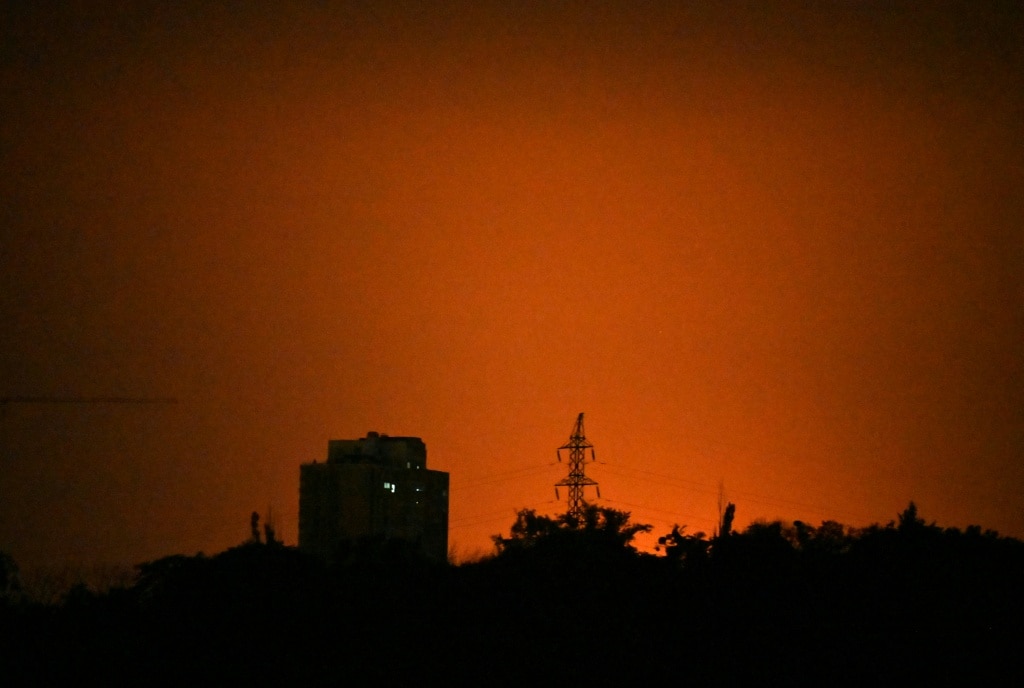
In an escalation of the ongoing air conflict between Russia and Ukraine, Moscow launched a massive barrage of ballistic missiles targeting Ukraine’s capital Kyiv overnight Sunday, leaving one civilian dead and 16 others injured. The attack marks one of the largest concentrated ballistic missile strikes on the capital in months, deepening civilian casualties amid a rapidly intensifying air campaign that has hit populated areas on both sides of the front line.
Eyewitnesses on the ground described a terrifying sequence of nonstop explosions that shook residential neighborhoods. “The missiles just kept coming one after another, the explosions were powerful, it was horrible,” 47-year-old Kyiv resident Ganna Zagorodnia told AFP. “I thought that life was just about to end.” When morning broke, AFP reporters observed widespread destruction across the city: charred facades on multi-story apartment blocks, shattered glass blown out hundreds of meters from blast sites, and crumpled, overturned vehicles littering residential streets.
Ukrainian President Volodymyr Zelensky confirmed the scale of the attack in a post on X, noting that Russian forces launched more than 40 missiles of multiple types, with the vast majority targeted at Kyiv. Of those, 25 were ballistic missiles—high-speed, difficult-to-intercept weapons that Russia frequently fires in rapid, overwhelming salvos to overwhelm air defense systems. Local authorities reported the strike hit six districts across Kyiv, damaging residential buildings, public supermarkets, and a local entertainment center.
Russia has repeatedly denied intentional targeting of civilian infrastructure, and in a statement following the attack, officials said the strikes hit legitimate military facilities and logistics nodes in Kyiv, as well as port assets used by the Ukrainian military in the Black Sea city of Odesa.
The attack comes as Ukraine faces a dual crisis: intensifying Russian pressure from the air and growing domestic political unrest triggered by a sudden shakeup of the country’s defense leadership. For three consecutive days, thousands of demonstrators have gathered in major Ukrainian cities to protest the dismissal of popular former defense minister Mykhailo Fedorov, a tech-focused official who earned broad public support during the war. Zelensky’s surprise reshuffle, announced amid reports that frontline fighting has stabilized, has sparked a rare public backlash against the wartime government.
On the military front, the latest bombardment has underscored Ukraine’s critical shortage of air defense interceptors, a gap Russia is actively exploiting to step up strikes on Kyiv. Zelensky emphasized the urgency of the situation, stating, “Protection against ballistic missiles is our constant and top priority right now. Interceptors are needed every day.” Since the outbreak of the U.S.-Israeli conflict in the Middle East, Ukraine has faced depleted stockpiles of interceptor missiles for its U.S.-made Patriot systems, the primary defense Ukraine relies on to shoot down incoming ballistic rounds. Over the past 35 days, Kyiv has now faced four large-scale ballistic missile attacks, with roughly one major barrage launched per week, according to Yuriy Ignat, Ukrainian Air Force communications chief.
The escalation of air operations is not limited to Ukrainian territory. Ukraine has ramped up its own long-range strike campaign against Russian infrastructure in recent months, hitting targets deep inside Russian borders in what Kyiv calls “long-range sanctions” in retaliation for years of Russian bombardments of Ukrainian cities. On Monday, Russian regional governor Alexander Khinshtein reported that a Ukrainian strike killed one civilian in the border region of Kursk. A separate drone attack hit the Caspian Pipeline Consortium terminal near Novorossiysk, a key Black Sea export hub for Kazakh oil that counts major Western energy firms Chevron and Shell as partial owners. The consortium confirmed two crude oil tankers were damaged in the strike, forcing a full halt to pumping operations. A day earlier, Ukrainian drone strikes destroyed two large e-commerce warehouses in the Moscow and Tambov regions, killing eight workers and sparking massive infernos that burned for hours. Ukraine’s cross-border campaign, which has primarily targeted Russian oil and energy infrastructure, has already contributed to a widespread fuel shortage in one of the world’s largest oil-producing nations.
Civilian casualties have spiked sharply amid this mutual escalation of air strikes. The United Nations reports June 2025 was the deadliest month for Ukrainian civilians since April 2022, with at least 293 civilian lives lost across the country. With frontline fighting largely locked in a stalemate and peace talks remaining completely frozen, the war—already the bloodiest European conflict since World War II—continues to exact a growing toll on civilian populations on both sides.