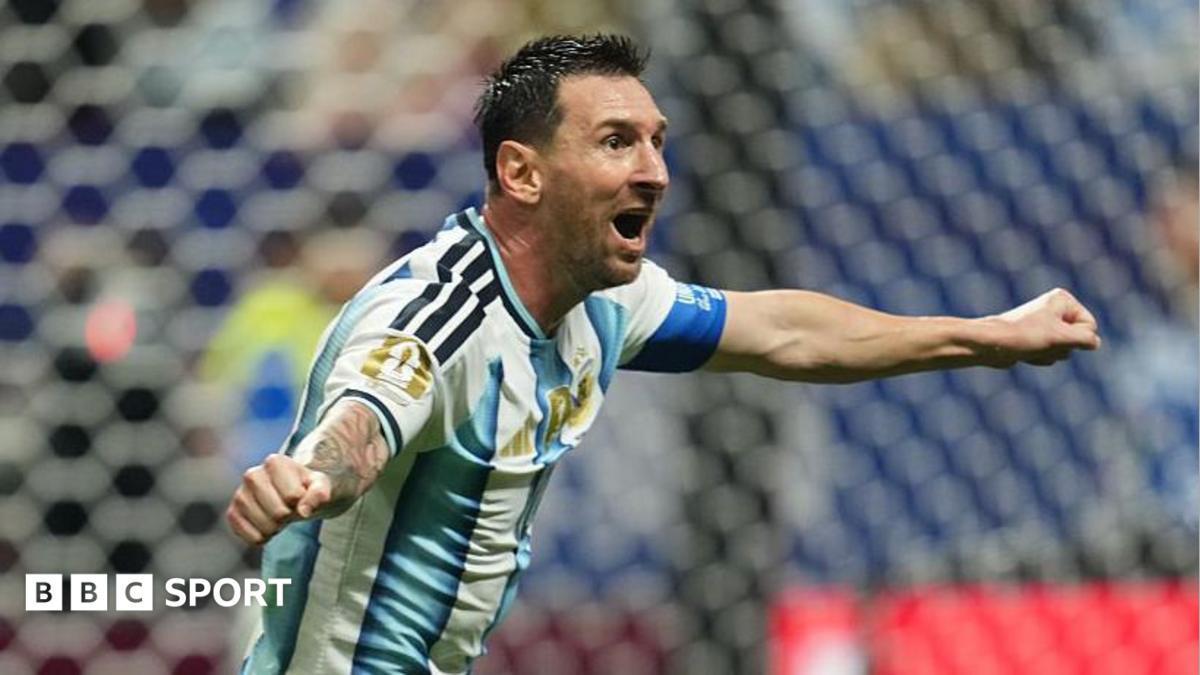
Argentina stands on the cusp of an unprecedented piece of football history, needing just one more victory in Sunday’s 2026 World Cup final to etch their name alongside the sport’s immortals. If head coach Lionel Scaloni’s side can overcome European champions Spain to claim the title, they will become only the third men’s national team ever to win consecutive World Cup trophies, joining an elite club that currently only includes 1930s Italy and 1950s Brazil.
For Argentina to cross that finish line, all eyes will once again fall on 39-year-old legend Lionel Messi, who has delivered another tournament for the ages to carry his side this far. Whether fans label him the undisputed greatest of all time or merely rank him among the top contenders, there is no arguing that the Argentine playmaker has redefined what elite attacking play looks like across a decades-long career that has rewritten the sport’s record books.
A Sunday victory would not only secure back-to-back World Cup titles for Argentina — it would also make Messi the first men’s captain in history to lift the World Cup trophy twice. After a string of underwhelming performances across his first four World Cup appearances, Messi exploded into form at the 2022 Qatar tournament, leading Argentina to their first crown in 36 years, and he has picked up right where he left off in North America four years later. Currently, he sits just one goal behind France’s Kylian Mbappe in the race to become the World Cup’s all-time leading men’s goalscorer, an extraordinary milestone for a player who briefly walked away from international football entirely back in 2016, only to reverse his retirement months later.
Sunday’s final will mark Messi’s 34th World Cup appearance, stretching across six tournaments, and a growing debate has emerged around whether this will mark his final outing in Argentina’s iconic blue and white stripes — or whether the legend has another World Cup run left in him, when the tournament celebrates its 100th anniversary in 2030.
If Messi does elect to continue his international career through 2030, he will make history again as the oldest outfield player to ever feature at a men’s World Cup, turning 43 before the tournament kicks off — a record that would only be broken if his long-time rival Cristiano Ronaldo chooses to extend his own Portugal career to join him. Beyond the record books, 2030 also offers a deeply sentimental draw for Messi: the centenary tournament will host at least one opening match on Argentine soil, offering the homegrown icon a chance to play a World Cup game in front of his own nation’s fans. That opportunity is one many close to Messi believe will be too tempting to turn down.
“Even if you hear it is the end, I doubt it but we’ll see. I just see him with the national side, simply because he enjoys it,” Spanish football expert Guillem Balague told BBC Sport. “I don’t see him being at Inter Miami in the MLS, still performing and then saying that’s it and he’s going to play out the rest of his career with Inter Miami. I feel that he hasn’t said the last word yet. He finishes games, 120-minute games, at 39. In the first 90 minutes against Cape Verde, he covered 6.5km and 62% of that is walking. You can add a bit more walking. The passion is still there. All of that means he’s not going to leave the national side.”
Messi’s 2026 World Cup campaign has been nothing short of sensational, with eight goals in seven matches and a string of match-winning displays that dragged Argentina through the knockout rounds. Scaloni, who has led Messi and his side to two consecutive finals, has no hesitation in anointing the 39-year-old as the greatest to ever play the game.
“He is history, a legend. I feel proud, he is the best footballer the world has ever seen and reaching a final at 39 is something unbelievable — and that is why I said we must enjoy him,” Scaloni told reporters. “With Diego Maradona, we still miss him but Messi is still with us so we must enjoy him. I have no idea if this is Leo’s last game, you will have to ask him. We haven’t discussed it.”
Messi’s remarkable late-career resurgence on the World Cup stage is one of the most unexpected stories in modern football: 15 of his 21 all-time World Cup goals have come after his 35th birthday, a statistic that defies conventional wisdom about athletic aging. This late-career hot streak has already seen Messi break multiple tournament records, and he adds more with each game he plays.
While he didn’t find the back of the net in Argentina’s semi-final comeback win over England, two late assists from Messi secured the victory, pushing his all-time World Cup assist total to 12 — 10 of which have come in knockout rounds, a new all-time record. Already the leader in World Cup appearances with 33, Messi is one of only two players (alongside Ronaldo) to feature at six men’s World Cups, the only player to win two World Cup Golden Balls, and the only player to score in every round of a World Cup on the way to lifting the trophy. He also holds the record for the longest consecutive run of scoring or assisting in World Cup matches, with 11 straight games dating back to 2022, and has scored in nine consecutive World Cup games, another unprecedented record. Sunday’s final will also see him become only the second player after Brazil’s Cafu to start three men’s World Cup finals.
It is worth noting that Messi already predicted his World Cup career would end after the 2022 tournament, telling reporters before that final: “I am very happy for finishing my journey in World Cups in a final, to play the last game in a final. That is really very gratifying. There are a lot of years from this year to the next one. I don’t think I will be able to do that. To finish this way is brilliant.”
That prediction, of course, did not come to pass. So regardless of any announcements that come after Sunday’s 2026 final, the football world will be waiting to see if Messi has one more magical chapter left in his World Cup story, on home soil in 2030.