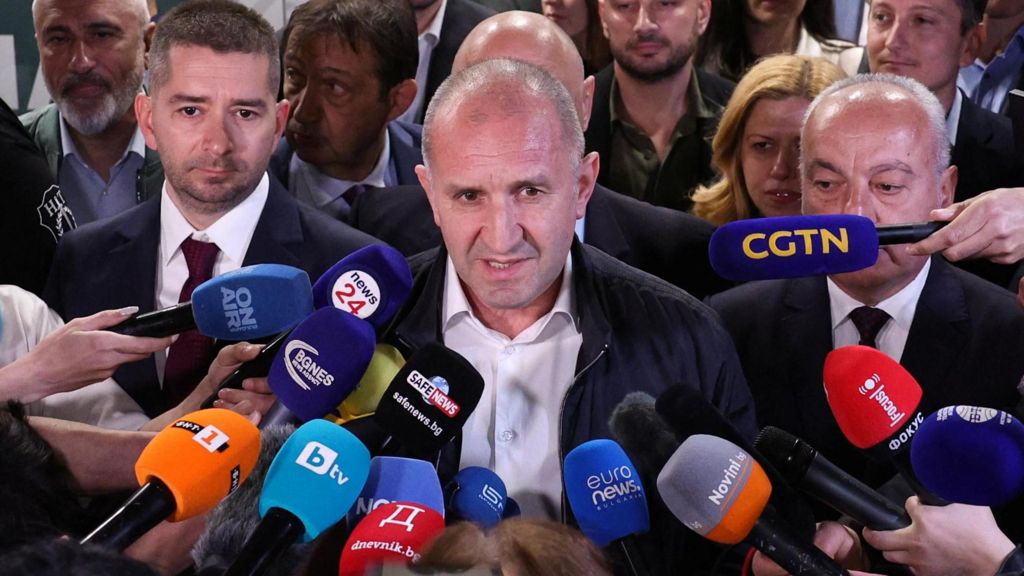
Bulgaria’s eighth general parliamentary election in five years has delivered a decisive early lead to former president Rumen Radev and his newly formed Progressive Bulgaria party, according to national exit polls released after voting closed Sunday.
Initial exit poll data puts Radev’s party at 37% of the vote, more than double the 16% support captured by its closest competitor — former prime minister Boiko Borisov’s long-dominant GERB party. Between three and four additional smaller political groups are on track to clear the 4% electoral threshold required to claim seats in the new unicameral parliament.
This snap election was triggered after the previous ruling coalition pushed through a deeply controversial budget proposal last December, which sparked large-scale public protests across the country that Radev — then serving as head of state — openly supported. In his first victory address to supporters Sunday evening, Radev framed the results as a clear rejection of Bulgaria’s established political order. “People rejected the self-satisfaction and arrogance of old parties and did not fall prey to lies and manipulation. I thank them for their trust,” he said, outlining a vision of “a strong Bulgaria in a strong Europe.”
He added that the European bloc currently demands “critical thinking, pragmatic actions and good results,” particularly when it comes to forging a new regional security architecture and rebuilding European industrial power and global competitiveness. “That will be the main contribution of Bulgaria to its European mission,” he said.
The 62-year-old incoming party leader, a former MiG-29 fighter pilot and ex-commander-in-chief of the Bulgarian Air Force, stepped down from his nine-year presidential post in January to launch his new political movement. Widely characterized as a pragmatic figure with soft pro-Russian leanings, Radev has repeatedly criticized EU sanctions on Moscow, called for sustained constructive dialogue with the Kremlin, and remains firmly opposed to direct Bulgarian military aid to Ukraine. His campaign centered heavily on domestic priorities: vowing to root out systemic corruption and end five years of fragile, short-lived coalition governments that have repeatedly collapsed and triggered repeated snap elections.
While Sunday’s projected result marks a historic upset for Bulgarian politics, it falls short of delivering Radev’s party a parliamentary majority to govern alone. Radev confirmed Sunday evening that he will immediately begin negotiations with other parties to form a stable governing coalition.
Beyond domestic policy, Radev’s victory has sparked analysis of his potential impact on European defense and Ukraine support. Bulgaria already acts as a key supplier of ammunition and explosives to Ukraine via third countries, most notably neighboring Romania, and the ongoing war has revitalized the country’s post-Soviet defense industry, which had struggled for decades after the collapse of the Eastern Bloc.
Since the 2022 Russian invasion of Ukraine, Radev has openly opposed the transfer of Bulgaria’s stockpiled Soviet-era weapons to Kyiv, arguing that such supplies only prolong a conflict that Ukraine cannot win — a position that aligns closely with that of Hungarian Prime Minister Viktor Orban. Yet despite this public stance, Radev has positioned Bulgaria to become a core part of Europe’s expanding defense production ecosystem. In October 2025, German defense giant Rheinmetall announced a €1 billion joint venture with Bulgarian state-owned arms manufacturer VMZ, based in the town of Sopot roughly two hours east of Sofia. The partnership will scale up production to 100,000 NATO-standard 155mm artillery shells annually, and also includes plans to construct a dedicated new gunpowder production facility in Sopot. Rheinmetall will hold a 51% controlling stake in the new venture, which forms part of a continent-wide push to ramp up military output after years of underinvestment.
Radev has already sought to claim credit for the deal, having invited Rheinmetall CEO Armin Papperger to Bulgaria in March 2025. During an August 2025 visit to Rheinmetall’s headquarters in Unterluss, Germany, he noted that “Bulgaria is becoming part of the European defence ecosystem.”
Political analysts expect Radev’s approach as prime minister will mirror that of Slovak Prime Minister Robert Fico: he will remain publicly critical of broad EU military support for Ukraine, but will not block private domestic defense manufacturers from producing and supplying arms to Kyiv through existing third-party supply chains.