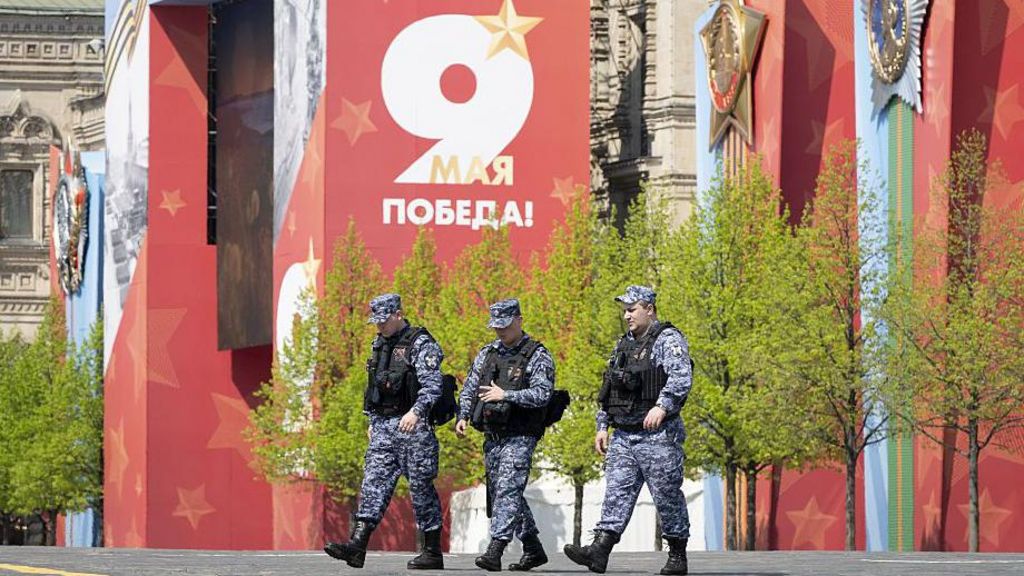
Moscow’s iconic Red Square is blanketed in symbols of celebration this week, with giant crimson banners emblazoned with the word *Pobeda* – Victory – hanging over its cobblestones, digital screens flashing the same national rallying cry, and interactive art installations drawing crowds of locals snapping selfies with the iconic word. Behind metal barricades sealing off the central parade route, uniformed soldiers run through final rehearsals for Russia’s most sacred national holiday: the annual May 9 parade commemorating the Soviet Union’s 1945 defeat of Nazi Germany. For nearly a quarter century under Vladimir Putin, this date has grown into the beating heart of Russian national identity, a cornerstone of the country’s ideological framework that ties modern Russia directly to the sacrifices and triumph of the Great Patriotic War.
But this year, a historic shift is underway: for the first time in nearly 20 years, the parade will proceed without its most dramatic centerpiece – heavy military hardware. No battle tanks, no intercontinental ballistic missiles, no armored fighting vehicles will roll across Red Square this year. Only marching infantry will take part, in a dramatic scaling back of the traditional event that experts and analysts say offers a clear window into the current reality of Russia’s more than four-year-long full-scale invasion of Ukraine.
The reasoning offered by Russian officials is straightforward: the country’s military equipment is already committed elsewhere. “Our tanks are busy right now,” ruling party MP Yevgeny Popov explained in an on-the-record interview. “They are fighting. We need them more on the battlefield than on Red Square.” When pressed on the fact that after more than four years of war, Russia has failed to achieve its original invasion goals and the parade cutback is widely seen as a sign of weakness, Popov pushed back, blaming Western and Ukrainian military support for the decision. “What other choice do we have? Nato countries, Ukraine and Great Britain’s weapons, your king and your prime minister, are threatening us.”
Beyond the immediate need for equipment at the front, Russian officials have also justified the scaled-back event citing rising domestic security threats. In the weeks leading up to May 9, Ukraine has stepped up long-range strikes deep inside Russian territory, bringing the war closer to Moscow than ever before. Just days before the parade, a drone managed to penetrate Moscow’s layered air defense systems and strike a luxury high-rise apartment building located just six kilometers from the Kremlin. While no fatalities were reported, the strike caused extensive damage to an upper floor of the building. A separate long-range missile and drone assault on the central Russian city of Cheboksary left two civilians dead and more than 30 others wounded.
Kremlin spokesperson Dmitry Peskov has framed the parade cutback as a necessary response to what he calls a “terrorist threat” from Ukraine. In a sharp warning to Kyiv, Russia’s defense ministry has threatened an overwhelming retaliatory response, promising a “massive missile strike” on central Kyiv if Ukraine launches any attacks on Moscow during the May 9 holiday.
On side streets near Red Square, public opinion on the absence of military hardware is divided, reflecting growing undercurrents of war fatigue across the country. Many Russians acknowledge the safety argument, but express discomfort with what the cutback signals to the world. “There is a safety issue,” said Muscovite Sergei. “But parading our military hardware shows our strength on the world stage. Perhaps we should be displaying something.” Another local, Yulia, added: “I understand it would be foolish to showcase hardware in case something happens during the parade. On the other hand, this means that we are afraid of something. And that’s not great, either.” For Vladimir, another resident, the change is just a pragmatic response to shifting circumstances. “The parade, of course, is a symbol. But if circumstances don’t allow it to take place in full, we’ll have to wait a year for that.”
Analysts note that the scaled-back parade is itself a powerful symbol of the current state of the war: more than four years after Putin launched the full-scale invasion of Ukraine, the conflict has already outlasted the entire four-year duration of the Soviet Union’s war against Nazi Germany, and a definitive Russian victory remains out of reach.
The shifting dynamic is also leaving its mark on Putin’s domestic standing. Recent polling, even from state-run Russian agencies, shows a gradual decline in the president’s approval rating. Late last year, Putin made frequent public appearances in military fatigues, projecting confidence as he met with top generals to discuss the war. In 2026, the “Commander-in-Chief” public persona has been far less visible. Conversations with ordinary Russians reveal growing fatigue with the ongoing conflict, rising anxiety over soaring cost of living, and widespread anger over repeated state-mandated internet restrictions implemented across the country in recent months.
Russian authorities have announced new mobile internet restrictions for central Moscow on Victory Day, framing the move as a necessary security measure to prevent drone attacks and sabotage. The restrictions mirror similar digital shutdowns that have been imposed in dozens of Russian cities and towns over the past year. When asked about the widespread public anger over the shutdowns, Popov dismissed the criticism: “It’s not your business, with all respect, what we are doing with our internet. It would be better to be with no internet than to be killed by a Ukrainian missile or drone.”
While the central Red Square parade has been scaled back, commemorations of the 1945 victory are still taking place across every region of Russia. Outside Moscow, in the upscale village of Rublyovo, schoolchildren gathered at the local Great Patriotic War memorial to lay red carnations in honor of the 27 million Soviet citizens who lost their lives in the conflict. Standing guard at the memorial were two masked combat veterans who recently returned from fighting in Ukraine, what the Kremlin still calls a “special military operation.” One of the veterans compared the current conflict to the 1941-1945 war against Nazi Germany. When pressed on the key difference – that in 1941 the Soviet Union was invaded, while in 2022 Russia launched an invasion of its neighbor – the veteran simply replied, “Russia is a country of victors. It always was and always will be.”
Yet even as the rhetoric of victory remains central to national messaging, four years into the full-scale invasion, that victory remains elusive for Russia on the battlefield.