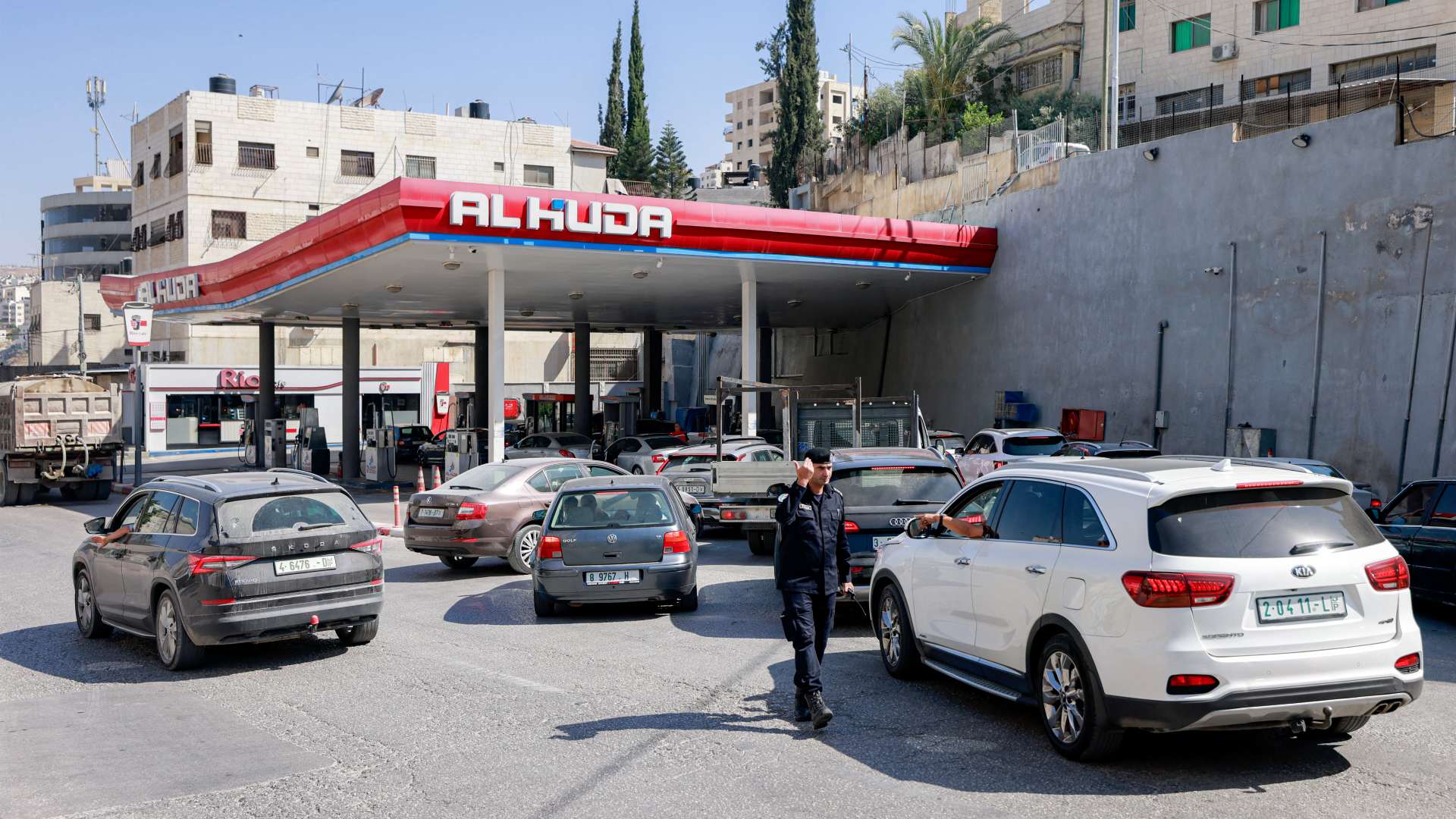
A high-profile West Bank petrol station conglomerate owned by one of the territory’s wealthiest business figures is now at the center of a sprawling financial misconduct investigation that alleges total unpaid obligations exceeding 1 billion Israeli shekels (equivalent to $325 million), per a leaked internal audit report obtained exclusively by Middle East Eye (MEE).
The sweeping probe has unfolded against a backdrop of crippling, widespread fuel shortages across the occupied Palestinian territory, which have left residents waiting for hours at petrol pumps and countless vehicles stranded on local roads. The fallout has already resulted in the multi-week pre-trial detention of Tarek al-Natsheh, chairman of the Al-Huda Group, alongside coordinated raids by Palestinian security forces on the company’s office locations, where investigators seized dozens of computers, full sets of financial accounting records, and stored fuel reserves.
Legal representatives for Natsheh, who is named in the audit as a primary beneficiary of alleged unregulated fuel smuggling operations, have repeatedly stated their client and the entire Al-Huda organization deny all wrongdoing, and stand fully prepared to remit any tax payments that are formally and legally verified as owed. The defence team has emphasized that all parties are fully cooperating with ongoing legal proceedings, but has publicly condemned the extended detention of Natsheh, arguing that “personal freedom should not be used as a means of pressure to accept figures whose accuracy has not been independently established.”
MEE reached out to Malek al-Awri, lead legal advisor for the Al-Huda defence team, for detailed comment ahead of publication, and he directed the outlet to a formal statement the defence previously provided to Palestinian local news outlet Watan newspaper the prior month. MEE also submitted a request for official comment to the Palestinian Authority (PA) Ministry of Finance, the government body that commissioned the full audit report in the first place.
The Al-Huda Group operates a sprawling portfolio of commercial assets across the West Bank, most notably its Al-Huda Fuel subsidiary that runs a network of 28 branded petrol stations serving communities across the territory. The chain of events that sparked the full investigation began on 10 July this year, when one of Al-Huda’s fuel tanker trucks was intercepted and seized by authorities in Jericho on suspicion it was carrying unregulated, smuggled petrol. The incident prompted PA Finance Minister Estephan Anton Salameh to immediately appoint an independent special audit committee to conduct a full review of all Al-Huda operational and financial records.
Dated to early September, the 35-page audit report reviewed by MEE formally calls for Al-Huda to transfer 1,003,189,811 shekels ($322.5 million) to the Palestinian public treasury, a sum the committee claims represents unpaid obligations stemming from documented financial misconduct, tax evasion, and unreported fuel smuggling activities dating back to 2020. The total sum breaks down into two distinct components: 712,736,591 shekels in unpaid VAT, fuel duty, and other tax liabilities calculated directly from the company’s own internal accounting records, plus an additional 290,453,220 shekels representing the committee’s best estimate of unreported revenue from smuggling operations for which full shipment volumes could not be fully verified. The audit committee explicitly noted this 1 billion shekel figure does not include any late payment interest or additional regulatory fines that may be levied once the investigation is finalized, and also recommended that authorities expand their probe to secure full access to the bank accounts of dozens of individuals and affiliated companies linked to Al-Huda operations.
Fuel distribution across the West Bank operates under a tightly regulated dual system overseen jointly by Israeli authorities and the PA. Under terms of the 1994 Oslo Accords, the PA-run General Petroleum Authority (GPA) is the sole entity legally permitted to import fuel into the territory, with nearly all supply purchased directly from Israeli fuel suppliers at market Israeli prices, and transported exclusively through Israeli-manned security checkpoints. Private retail operators including Al-Huda are legally required to purchase all their stock directly from the GPA, but independent industry estimates suggest nearly one-third of all petrol sold across the West Bank currently comes from unregulated, untaxed smuggling networks.
Auditors stated that the seized Al-Huda files included dozens of official GPA delivery receipts that did not match corresponding transaction records held by the PA petroleum authority. The driver of the tanker seized in Jericho on 10 July, whose name appeared repeatedly in the mismatched documents, confessed to investigators that he had participated in multiple prior smuggling runs earlier in 2026, and stated all those operations were ordered directly by Mazen al-Natsheh, Tarek al-Natsheh’s brother and the current general manager of Al-Huda Fuel Group. Mazen al-Natsheh was detained for questioning in August, and initially denied any knowledge or involvement in smuggling activity, before later admitting he had organized a small number of unregulated fuel deliveries to a Jericho petrol station, claiming the moves were a response to the territory’s unprecedented, life-disrupting fuel shortages. He told investigators the unregulated shipments were coordinated via a Palestinian holding Israeli identity documentation who could move freely across border checkpoints.
Tarek al-Natsheh voluntarily surrendered to PA authorities in Ramallah on 9 September, weeks after prosecutors issued an official arrest warrant for him in late July. During a public court hearing held on 22 October, local Palestinian media reported, a judge approved an additional 45-day extension to his pre-trial detention. The formal charges against him allege he collected a share of profits from a long-running smuggling scheme operating out of the Abu Khalil petrol station in Anata, a town in the central West Bank. The station owner provided a formal statement to prosecutors claiming Tarek al-Natsheh was a core partner in the smuggling operation, which launched shortly after the outbreak of the latest Gaza conflict and moved between 30,000 and 40,000 litres of untaxed petrol per month. The audit report also highlighted what it described as a “close and extensive financial relationship” linking Tarek al-Natsheh, Al-Huda Fuel Group, and multiple other known participants in West Bank fuel smuggling networks.
In his previously published statements to Watan newspaper, defence advisor Awri emphasized that the 1 billion shekel figure cited in the leaked audit does not represent an official, legally binding settled debt, and the entire case remains an active ongoing investigation. He noted the defence legal team has still not been formally served with a full copy of the audit report, or provided with full details of the accounting and legal justifications used to calculate the alleged owed sum. Awri added that the report’s conclusions remain fully open to “examination, debate, challenge, and judicial oversight”, and that the defence team has compiled substantial legal, technical, and accounting-based objections to the preliminary findings. “Our position is clear: we seek to establish the full financial truth, documented and based on sound, fair legal and accounting principles, that ensures the recovery of any funds rightfully owed to the public treasury, while simultaneously protecting the legal rights of the company and the individuals involved,” Awri told Watan. He also reaffirmed that the significant volume of physical and financial assets already seized from Al-Huda during the raids is more than sufficient to cover any claims that are eventually proven valid through proper, transparent judicial proceedings, and that the defence team fully respects the work of the public prosecution, judiciary, and finance ministry, and remains committed to cooperating with all formal legal processes to uncover the full facts and protect public funds.
The investigation has unfolded against a period of unprecedented financial strain for the Palestinian Authority, exacerbated by Israeli Finance Minister Bezalel Smotrich’s ongoing decision to withhold hundreds of millions of shekels in customs and excise tax revenues that Israel is legally required to transfer to the PA under Oslo Accords terms. In response to the dual crises of fuel shortages and strained public finances, PA President Mahmoud Abbas signed a decree in October establishing a new PA-run national petroleum company that will take full centralized control over all fuel import, transport, storage, and retail sale operations across the West Bank. Senior Palestinian political analyst Hani al-Masri, director general of the Masarat policy research centre, told MEE that fuel smuggling has long been a common feature of daily life in the West Bank, because Israeli authorities consistently allow far less total fuel to enter the territory than the population requires to function. “There is a daily, chronic shortage, so smuggling is inevitable,” Masri explained. “This case appears to be a dispute over who gets to control and benefit from that existing unregulated trade, and how the system will be formalized.” He added that major unanswered questions remain about the decision to order Tarek al-Natsheh’s extended detention, and that many undisclosed details of the full case have yet to come to light. A second member of the Al-Huda defence legal team, Jawad Obeidat, explicitly rejected widespread public speculation that the case has been subject to political interference, noting that “the public prosecution, with all due respect, is performing its role with full transparency and without any outside influence.”