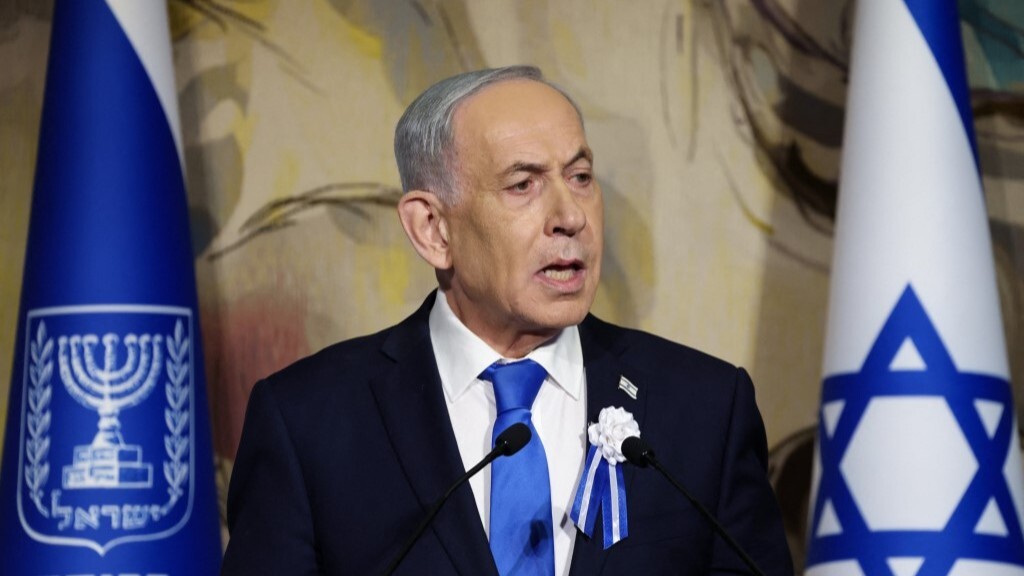
Jerusalem’s historic swearing-in of Israel’s 26th Knesset on Tuesday descended into bitter partisan furor after outgoing Prime Minister Benjamin Netanyahu delivered a widely denounced, hate-tinged address targeting Palestinian-led legislative factions, just two weeks after his long-dominant far-right electoral bloc suffered a surprise defeat driven by record-breaking voter turnout from Palestinian citizens of Israel. The newly convened parliament marks an unprecedented milestone for Arab political representation, with 19 lawmakers hailing from the progressive Joint List alliance and the conservative Islamist Ra’am party, a level of Palestinian legislative presence never before seen in Israel’s governing body. Netanyahu opened his address by framing Iran’s nuclear program as an existential threat to the Jewish state, claiming the only permanent solution to eliminate that danger was the full overthrow of Tehran’s ruling ayatollah regime. He proceeded to tout decades of Israeli military operations across occupied Palestinian territories, Syria, Lebanon, and Iran, before pivoting sharply to launch a sustained, unsubstantiated verbal assault on the two Palestinian-led factions. The prime minister explicitly clarified he did not hold all Palestinian citizens of Israel in contempt, noting a small subset of that demographic had cast ballots for his ruling Likud party, but proceeded to level sweeping accusations against Ra’am and the Joint List. He falsely alleged both factions openly advocate for the total destruction of the Jewish state, dismissing their long-documented, repeated public commitments to a negotiated two-state solution that guarantees Israel’s sovereign existence alongside an independent Palestinian state, even as both parties count Jewish progressive lawmakers among their ranks. In a fiery rhetorical appeal to his political rival, former military chief Gadi Eisenkot, Netanyahu insisted Israel must set aside all competing priorities to form a broad national unity government, warning any coalition backed even tangentially by the two Palestinian-led parties would amount to empowering “terror supporters and Israel-haters” whose core mission was to dismantle the Jewish state entirely. “Are you prepared to be dependent on those whose purpose is the destruction of the Jewish state?” he shouted at Eisenkot’s diverse centrist-left electoral bloc, falsely claiming Ra’am lawmakers publicly frame Hamas as nothing more than a charitable community organization. The address triggered immediate, furious backlash from across the political spectrum. Centre-right former prime minister Naftali Bennett, leader of the Together alliance, interrupted Netanyahu mid-speech to shout pointed questions about the lack of action on establishing a state commission of inquiry, designating Qatar an official enemy state, and the presence of Qatari-linked advisers on Netanyahu’s own staff. Centre-left Democrats party leader Yair Golan stormed out of the Knesset chamber before the speech concluded. Post-speech linguistic analysis from Israeli outlet Ynet revealed a stark rhetorical imbalance in Netanyahu’s remarks: he uttered the word “Jewish” 20 separate times, referenced “unity” a mere four times, and declined to name a single leader from Eisenkot’s opposing bloc, while invoking terms tied to Palestinians, Arabs, terrorism, and Islamist governance a total of 36 times. The address also prompted immediate diplomatic and procedural fallout: Eisenkot, who had earlier this week received the official presidential mandate to assemble a new governing coalition, announced he had abandoned all planned unity talks with Netanyahu’s Likud faction, issuing a scathing public statement on X condemning the address as “delusional, divisive, hate-filled and shameful” and arguing Netanyahu was no longer fit to hold office even for a single additional minute, as his incendiary rhetoric was actively eroding Israeli social cohesion and endangering national security. Ra’am party leader Mansour Abbas publicly expressed shock at Netanyahu’s choice to exploit a formal state ceremonial occasion to spread deliberate falsehoods, incite public hostility, and peddle harmful blood libels against Arab political factions. He reaffirmed his party’s commitment to a negotiated two-state framework, noting “We don’t want to establish an Islamist state or an Arab state. This is where the State of Israel was established, and we stand for peace and ending the decades-long conflict.” The Joint List released a statement dismissing the speech as “deranged, inciting and racist,” describing Netanyahu as a “bloodthirsty and criminal prime minister in a state of complete hysteria” and vowing to use every legislative tool at their disposal to oust him from power and consign his long-running tenure to the “dustbin of history.” Local investigative reporting from Haaretz further revealed that Netanyahu and his allied media figures had spent the two weeks following the election laying public groundwork to discredit the historic surge in Palestinian voter turnout, with loyalist Shin Bet chief David Zini launching a flurry of formal investigations into alleged election fraud and foreign electoral interference targeting Arab voting communities.