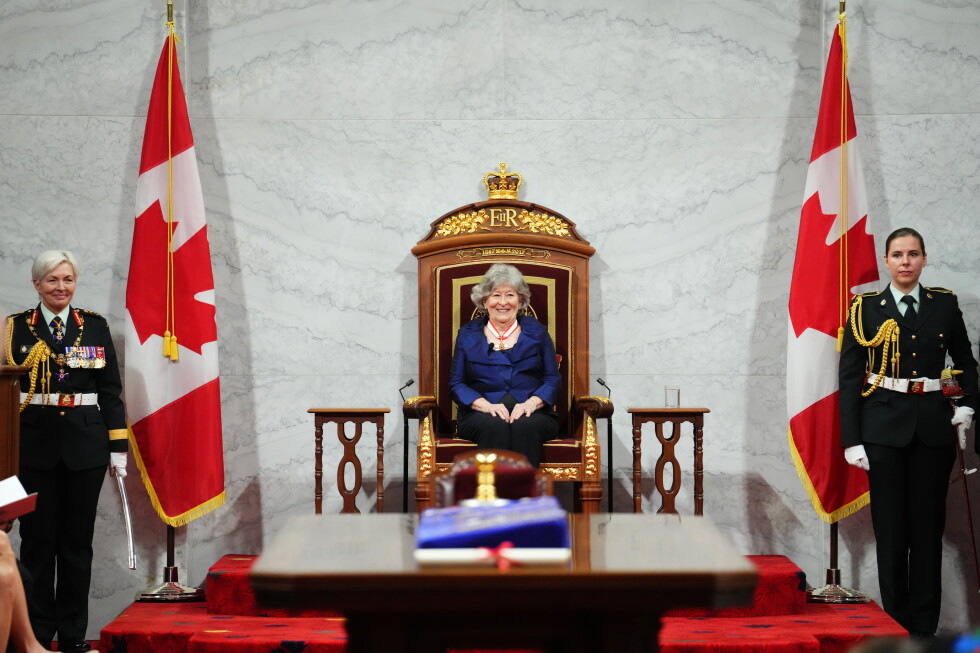
TORONTO – In a formal ceremonial event held Monday, retired Canadian Supreme Court Justice Louise Arbour officially took office as Canada’s 29th Governor General, the personal representative of King Charles III, Canada’s constitutional head of state. The 79-year-old trailblazing legal figure succeeds Mary Simon, who made history in 2021 as Canada’s first Indigenous Governor General, stepping into a role that carries formal constitutional obligations but functions largely as a symbolic and ceremonial position within the country’s parliamentary system.
The swearing-in ceremony, hosted on Parliament Hill in Ottawa, featured musical performances by the Central Band of the Canadian Armed Forces, including the traditional rendition of “God Save the King,” alongside the official raising of the Governor General’s flag to mark the transfer of office. Prior to the ceremony, Arbour held a private audience with King Charles III at Buckingham Palace last week to mark her appointment.
Unlike many holders of the role, Arbour brings a decades-long global career in law, human rights, and international justice to the viceregal post. Her judicial resume spans key positions across Canada’s legal system, including appointments to the Supreme Court of Ontario, the Ontario Court of Appeal, and ultimately the Supreme Court of Canada, where she served as a sitting justice before taking on landmark international roles. In 1996, the United Nations tapped Arbour to serve as Chief Prosecutor for the International Criminal Tribunals for the former Yugoslavia and Rwanda. It was in this role that she led historic prosecutorial efforts that secured two major milestones in international law: the world’s first conviction for genocide after the 1948 United Nations Genocide Convention was adopted, and the first-ever war crimes indictment issued against a sitting head of state. Later in her career, from 2017 to 2018, she also served as the United Nations Special Representative for International Migration.
In her inaugural address to the nation as the King’s representative, Arbour emphasized that peaceful coexistence across differing perspectives and identities is the cornerstone of a functional, rules-based democratic society. She also turned her attention to one of the most pressing modern technological issues: the rapid expansion of artificial intelligence. Arbour issued a stark caution against growing overreliance on AI tools, noting that widespread instant access to massive volumes of information has created a dangerous temptation to overlook source credibility.
“The lines between knowledge and belief, between truth and falsehood, between facts and assumptions are increasingly blurred,” Arbour told the assembled audience. “AI could be threatening not only the way we live and work, but also the control we exercise over our own destiny.”
She also highlighted Canada’s unique global standing, noting that while the nation accounts for less than 0.5% of the world’s total population, it holds nearly 7% of global land area and 20% of the world’s total freshwater reserves. “The world looks at us with justifiable envy,” she said.
As a former British colony and current member of the Commonwealth of Nations, Canada has retained its constitutional monarchy structure after gaining full sovereignty. Following the United States’ successful war of independence from Britain, Canada remained under British colonial rule until 1867, when it gained self-governance while retaining the British monarch as its formal head of state, a structure that remains in place today.