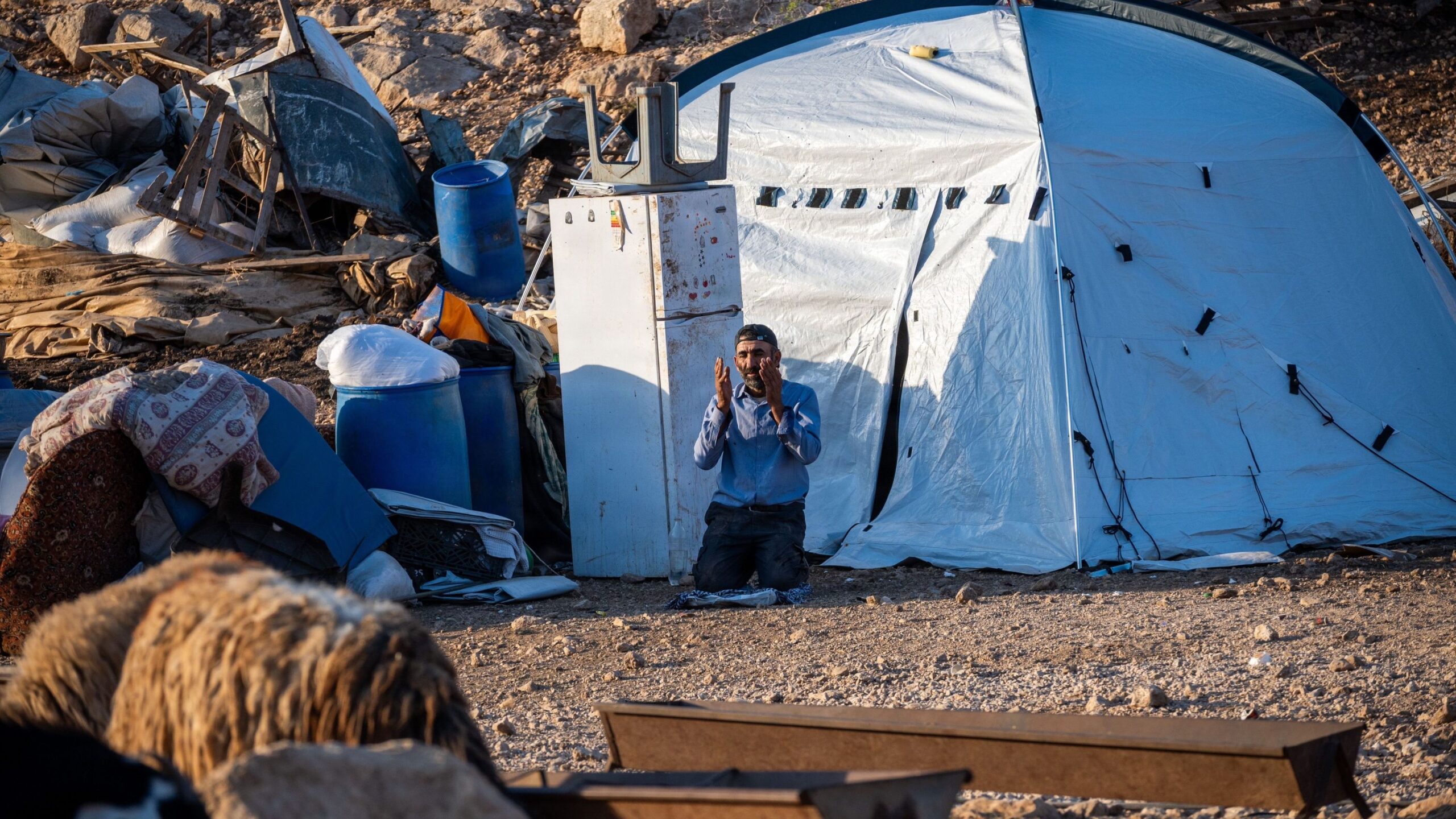
In a dawn unannounced operation on Sunday, Israeli military forces backed by heavy bulldozers carried out the full demolition of every standing structure in Khirbet Samra, a small Palestinian herding community tucked in the occupied West Bank’s northern Jordan Valley, local residents confirmed to independent regional outlet Middle East Eye. The operation left no asset untouched: beyond residential family homes, the bulldozers flattened sheep pens, young livestock shelters, hay and fodder storage units, outdoor bathrooms, water tanks, solar power panels, and even concrete livestock feeding troughs. In a deliberate step to block residents from salvaging any reusable materials, military crews proceeded to bury all resulting rubble under excavated earth. Dhiab Daraghmeh, a long-term Khirbet Samra resident, recounted that soldiers gave families a mere 10-minute window to gather personal belongings before demolition commenced, leaving nearly all their household goods — furniture, kitchenware, refrigerators, cooking gas cylinders, and critical supplies — destroyed in the wreckage. Roughly 10 tons of barley stockpiled for livestock feed was buried under the debris, with individual feeding troughs alone valued at an estimated 1,500 Israeli shekels ($451) each. The 21 remaining residents who have refused prior displacement now rely on emergency tents supplied by human rights organizations for shelter, after more than half the original community was forced to relocate to the nearby city of Tubas following a wave of settler violence three months prior. Daraghmeh noted that on June 11, 2025, Israeli settlers killed 50 of his sheep in one of dozens of targeted attacks that have plagued the community since 2017. For three consecutive days after the Sunday demolition, families have endured frigid nighttime temperatures and scorching daytime heat with no proper shelter, and face mounting alarm over the survival of newborn lambs that cannot withstand the harsh upcoming winter conditions. Ayman Daraghmeh, another resident, shared that soldiers denied their last-minute request to access drinking water shortly before bulldozers moved in, and destroyed a 16-year-old tree he had planted as a sapling that had become a beloved shared gathering spot for his children and family. The community’s displacement risks are part of a broader, years-long systematic campaign to expel Palestinian herding populations from the northern Jordan Valley: settlers have seized local water wells, blocked access to traditional grazing and rain-fed agricultural lands by grazing their own livestock on the territory, and established a nearby unauthorized outpost two years ago that sparked a sharp escalation in harassment, including regular army raids, arbitrary detentions, and threats against residents who attempt to rebuild any structures. Data from a November 18, 2026, humanitarian report released by the United Nations Office for the Coordination of Humanitarian Affairs (OCHA) confirms that 6,800 Palestinians, including 3,200 children, have been displaced across the occupied West Bank since the start of 2023 due to settler violence and associated land access restrictions, with 51 of 137 targeted communities completely emptied of inhabitants. In 2026 alone, 2,894 Palestinians were displaced, with 44% of those displacements occurring in the Jordan Valley. Mahdi Daraghmeh, head of the Al-Maleh and Bedouin Communities Council, noted that six entire Bedouin communities in the region have been fully depopulated in the last two years, displacing roughly 200 families. Despite the total loss of their property and the ongoing military and settler pressure, the remaining 21 Khirbet Samra residents have stated they will not abandon their ancestral land, which their families have owned and inhabited for generations, long before Israeli authorities designated swathes of the Jordan Valley as restricted “nature reserves” or military zones to push previous generations of the community to resettle at their current site.