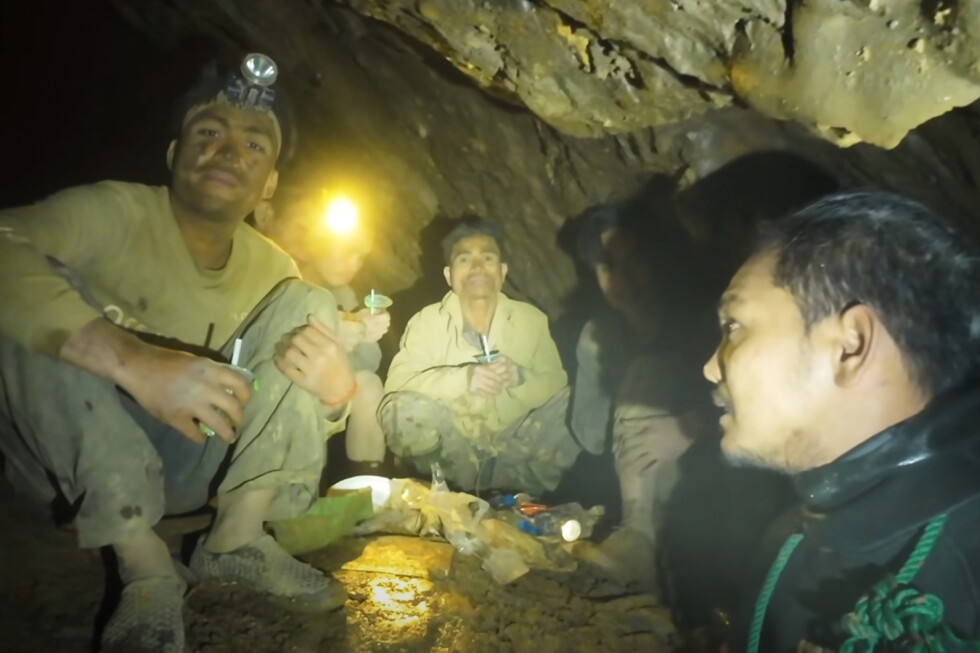
In a remote, rugged stretch of central Laos, an international team of rescue specialists is racing against harsh conditions to pull four surviving trapped villagers out of a flooded cave system, 10 days after flash floods cut off their exit. One of the five men found alive earlier this week was successfully evacuated to safety on Friday, capping days of dangerous preparation, as crews continue searching for two other missing villagers who remain unaccounted for.
The chain of events that led to the crisis began last week, when a group of seven local villagers entered the remote cave in Xaisomboun Province, roughly 120 kilometers north of the capital Vientiane, in search of valuable minerals. Unexpected flash floods rushed through the cave system, sealing off the only exit and trapping the entire group. Only one man managed to escape the rising waters quickly enough to alert local authorities to the emergency, setting the large-scale rescue effort in motion.
Three days ago, rescuers made a hopeful breakthrough: they located five of the six remaining trapped men alive, identified only by their first names: Khamla, Mued, Ee, Ing and Laen. Crews immediately delivered life-sustaining supplies to the stranded men, including clean drinking water, soft food and thermal foil blankets to ward off hypothermia in the cool, damp cave environment. Despite the aid, on-site footage shows the men’s health and physical conditions have continued to decline after more than a week trapped underground.
Friday brought the first major success of the operation. After months of preparation and hours of careful navigation through the cave’s flooded passages, crews extracted the first survivor in an operation that took roughly 30 minutes. On-site videos captured the tense moment of his emergence: the man exited the cave’s dark water alongside an expert cave diver, gasping for air before slowly pulling himself through a narrow, partially flooded passageway. When he finally reached stable ground, he struggled to stand steadily on unsteady legs. Rescuers noted he had suffered injuries to his hands, quickly wrapped him in a thermal blanket to stabilize his body temperature, and assisted him to a waiting medical team. A second video showed the man being helped out of the cave’s main entrance, a headlamp strapped to his forehead, supported by two rescue workers as he moved into the care of waiting medics amid a crowd of on-site responders. It has not been publicly confirmed which of the five identified survivors was the first to be evacuated.
Crews decided to hold off on evacuating the four remaining surviving men on Friday, as they determined the men were not yet physically ready to make the dangerous journey out. Instead, rescue teams worked overnight and through Saturday to drain more flood water from the cave system, with the goal of completing the extractions of the remaining four survivors later the same day. One participating Thai cave diver, Norrased Palasing, reaffirmed the team’s commitment in a Facebook post Saturday, writing “One person has made it out safely, and we will not stop until the remaining four make it home too.”
The rescue effort has drawn international support and expertise. Local Laotian rescue teams have been joined by specialist responders from neighboring Thailand, as well as crews from Japan and Malaysia, with additional specialists from Indonesia, France and Australia also arriving at the remote site. Notably, many of the participating Thai divers and rescue leaders took part in the dramatic 2018 Tham Luang cave rescue, which successfully extracted 12 trapped schoolboys and their soccer coach from a flooded northern Thai cave, giving the team extensive experience in complex underground cave rescues.
Even with this expertise, the operation remains extraordinarily high-risk. In a video recorded just an hour before the first evacuation began on Friday, Thai rescuer Kengkaj Bongkawong of the Metta Tham Rescue Kalasin detailed the extreme challenges crews face inside the cave. The rescue’s forward operating base is set up in a large chamber deep inside the cave, which can only be reached by navigating more than 200 meters of twisting, narrow passages with sharp jagged rock walls, most of which are fully submerged. From that staging area, divers must complete an additional 30-meter dive through a fully flooded tunnel to reach the chamber where the survivors are trapped.
“To dive in a cave, there are issues with the temperature, narrow areas, control of movement, and managing the panic of the survivor, which will be difficult, but we have to do it,” Kengkaj explained. The greatest danger comes when guiding untrained survivors through zero-visibility flood waters, a task that carries significant risk of disorientation and panic for both the survivors and the rescue team. To prepare, divers have spent days training the trapped men in basic diving safety: on-site footage shows Norrased Palasing and Finnish diver Mikko Paasi walking the men through how to use diving breathing equipment, emphasizing the critical rule of breathing only through the mouth while underwater.
Alongside the effort to extract the four remaining survivors, crews are also preparing to search deeper into the cave system for the two missing villagers. Kengkaj said teams plan to explore a section of the cave 20 to 25 meters beyond the chamber where the five survivors were found, a region that is even more deeply flooded than the area where the men were trapped. “That area has a lot of water. The water goes there because it’s even deeper than this place,” he noted.