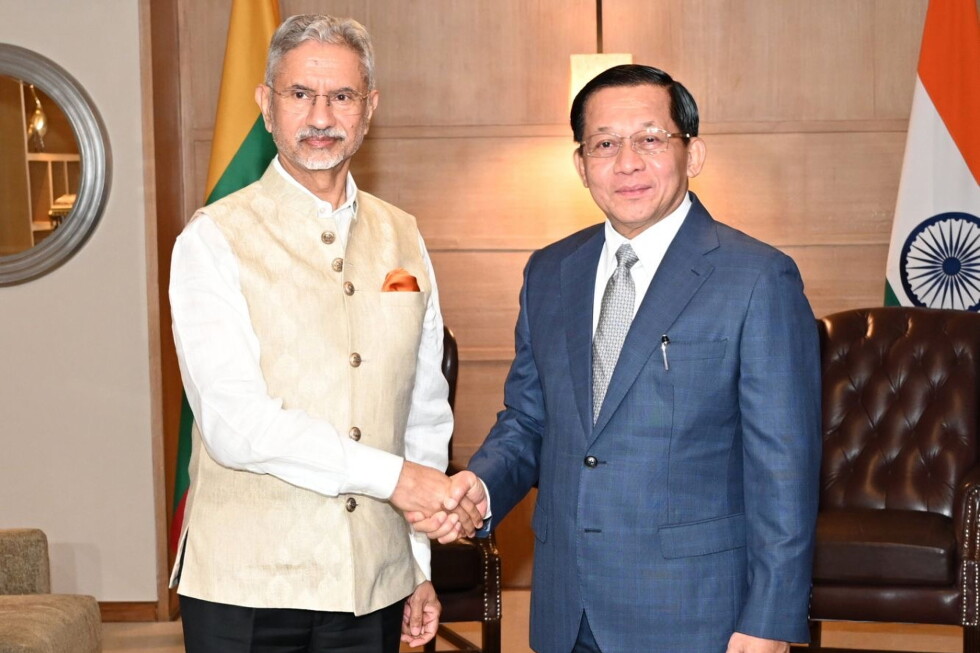
On Saturday, the head of Myanmar’s military-aligned administration launched an official diplomatic trip to India, a critical regional partner for the Southeast Asian nation, with a packed agenda of high-level talks focused on deepening bilateral cooperation. This trip marks Min Aung Hlaing’s first visit to neighboring India since he was inaugurated as Myanmar’s president in April, following a widely criticized election that opponents argue was carefully staged to cement the military’s ongoing authoritarian hold on national power. His most recent prior trip to India took place in 2019, when he served as the country’s military chief.
Myanmar state-controlled MRTV confirmed that Min Aung Hlaing, accompanied by a delegation of senior cabinet members, departed Naypyitaw, Myanmar’s capital, on Saturday morning. The delegation landed at Gaya International Airport in Bihar, an eastern Indian state located close to Bodh Gaya, one of the most sacred pilgrimage sites for Buddhist communities worldwide. Over the course of the visit, Min Aung Hlaing is scheduled to hold formal meetings with India’s top leadership, including President Droupadi Murmu and Prime Minister Narendra Modi, as well as senior government officials and leaders of Indian business associations. The talks are expected to cover opportunities to expand collaboration across economic, religious, cultural and social sectors, alongside plans to inspect key joint infrastructure projects in the region.
For decades, New Delhi has maintained open diplomatic and economic ties with Myanmar’s successive military-backed governments, a policy that has continued even after the 2021 military coup that ousted the elected civilian government led by Aung San Suu Kyi. Following the coup, Western nations imposed sweeping economic and diplomatic sanctions on the junta, after military forces launched a brutal crackdown on political opponents that escalated into a nationwide armed conflict and a massive humanitarian catastrophe.
Geopolitically, Myanmar holds major strategic importance for India’s regional security agenda. The two countries share a 1,643-kilometer land border and a contiguous maritime boundary in the Bay of Bengal. For years, New Delhi and the Myanmar military have collaborated on cross-border security operations and intelligence sharing to counter separatist insurgent groups that operate along their shared frontier. India currently also hosts tens of thousands of Myanmar refugees, most of whom have fled escalating violence in Myanmar’s northwestern Chin State and other conflict-wracked regions.
Despite the diplomatic and security rationale for the visit, the decision to host Min Aung Hlaing has drawn sharp criticism from pro-democracy and human rights activists, who warn that the trip will grant undeserved international legitimacy to a junta accused of widespread human rights abuses. In a pre-trip emailed statement released Friday, Yadanar Maung, a spokesperson for activist group Justice For Myanmar, called Min Aung Hlaing a war criminal waging a campaign of terror against the people of Myanmar, and condemned India’s choice to welcome him. Yadanar Maung noted that India has a long history of supporting Myanmar’s military through official training programs and deep economic ties, and called on New Delhi to reverse its policy. “India must change course, stop awarding false legitimacy to the junta, stop profiting from the military’s campaign of terror against the people, and instead support the Myanmar people who are struggling and sacrificing daily for federal democracy,” the statement read.