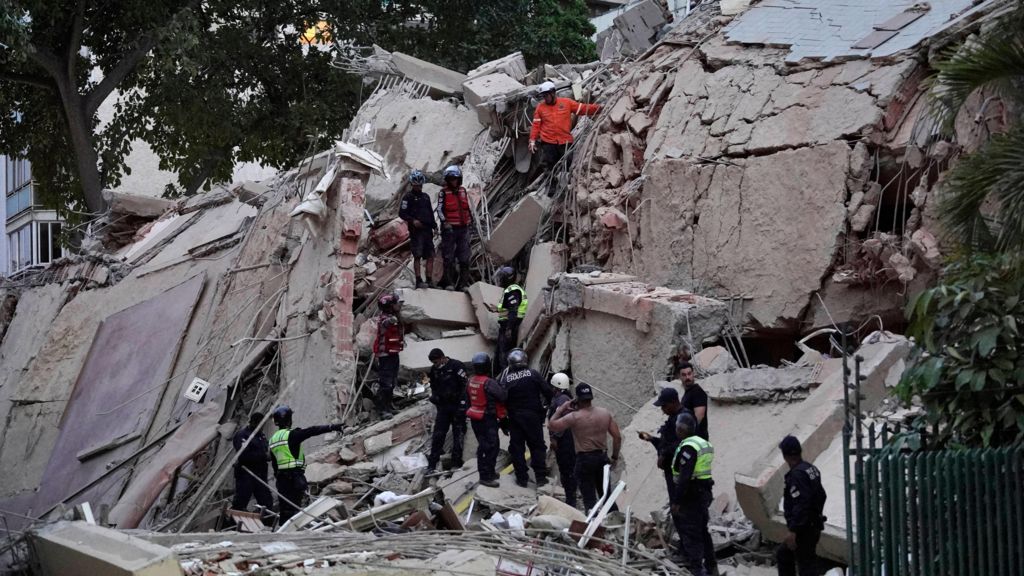
On a national holiday celebrating Venezuela’s foundational fight for independence, a rare double seismic event shocked the South American nation, leaving a trail of destruction and sparking a large-scale urgent rescue operation.
On June 24, 2026, starting at 18:04 local time (22:04 GMT), the greater Caracas region was hit by two major earthquakes separated by less than one minute. The U.S. Geological Survey (USGS) confirmed the first tremor registered a magnitude of 7.2, with its epicenter located near Montalbán, a small region just west of the capital’s city limits. Just 39 seconds after the first quake subsided, a second, stronger magnitude 7.5 temblor struck the same general area at a depth of roughly 10 kilometers. While neither epicenter was directly within Caracas proper, the shaking was felt intensely across the populous capital of more than 2 million people, and was even detected as far as Bogotá, Colombia, located more than 1,000 kilometers away from the impact zone.
The event coincided with Venezuela’s annual national holiday marking the 1821 Battle of Carabobo, the decisive victory led by independence icon Simón Bolívar against Spanish colonial rule. The timing, when many residents were gathered in public spaces for celebrations, did not prevent immediate panic: as buildings swayed and multiple structures collapsed in neighborhoods across the capital, crowds rushed into open streets to seek safety.
In the immediate aftermath of the quakes, interim President Delcy Rodríguez issued a national state of emergency, unlocking access to additional emergency funding, personnel and resources for search and recovery operations. In a televised address to the nation, Rodríguez extended immediate condolences to families affected by the disaster, though she did not confirm an official death toll in the hours immediately following the event.
Local officials have given early on-the-ground accounts of the destruction: Gustavo Duque Saez, mayor of the Caracas metropolitan municipality of Chacao, confirmed that at least two full building collapses occurred within his jurisdiction. As of initial reporting, 18 people have been pulled alive from rubble, with more than 500 first responders working around the clock to reach additional trapped residents. Photographs and video footage from the scene show concrete and debris scattered across city streets, with audio capturing trapped survivors calling out for help from collapsed structures.
Venezuela’s interior ministry has issued urgent guidance for residents across the capital, urging people to evacuate damaged homes over safety concerns. Officials noted compromised building integrity and potential damage to gas lines, prompting precautionary measures including a temporary halt to fuel shipments into the capital. Multiple reports of widespread internet outages have also been recorded in impacted areas, complicating initial rescue coordination.
As of the latest update, Venezuelan federal officials have not released any official confirmed counts of deaths or injuries. The USGS, however, has warned that catastrophic outcomes are highly likely due to the region’s particular vulnerability. According to the agency’s post-event assessment, most residential and public buildings in the affected area are constructed from reinforced brick masonry and adobe blocks, construction materials that cannot withstand the force of magnitude 7+ earthquakes. The USGS calculated that there is a 44% probability that the final death toll could reach 10,000, and a 30% probability that fatalities could exceed 100,000.
Shortly after the earthquakes, the U.S. Tsunami Warning System issued a regional tsunami advisory for Venezuela’s Caribbean coastline, as well as for island territories including the U.S. Virgin Islands and British Virgin Islands. The advisory has since been lifted, with officials confirming the quakes do not pose a continued tsunami risk to the region.
Emergency crews remain on the scene working through the night to clear debris and locate any people trapped, as authorities continue to work to assess the full scope of the damage across the region.