Early unconfirmed reports have emerged that one pilot from a US F-15 fighter jet downed over Iranian territory has been successfully recovered in a daring behind-enemy-lines operation. If verified, the mission would mark the latest chapter in the United States’ decades-long history of high-risk combat search-and-rescue (CSAR) operations. As of the latest updates, search efforts remain active deep inside Iran for a second crew member, according to CBS, the US partner of the BBC.
Combat search-and-rescue operations are widely ranked among the most complex, time-sensitive missions that the US military and its allied partners train to execute. Unlike conventional search-and-rescue efforts, which are typically carried out during humanitarian responses or post-disaster recovery in permissive environments, CSAR missions operate exclusively within hostile, contested territory — and in cases like this week’s operation in Iran, that means penetrating hundreds of miles deep into enemy sovereign territory.
In the US, elite US Air Force pararescue units hold the primary responsibility for CSAR operations, with pre-emptive deployments to forward positions near active conflict zones where aircraft are at heightened risk of being downed. At its core, a CSAR mission is focused on locating, providing medical care to, and extracting isolated military personnel, from downed aircrew to cut-off ground troops. These operations are almost always conducted with a fleet of specialized platforms: rescue helicopters as the primary extraction craft, supported by aerial refueling tankers to extend range, and combat aircraft on standby to provide air support, defensive patrols, and offensive strikes against approaching enemy forces.
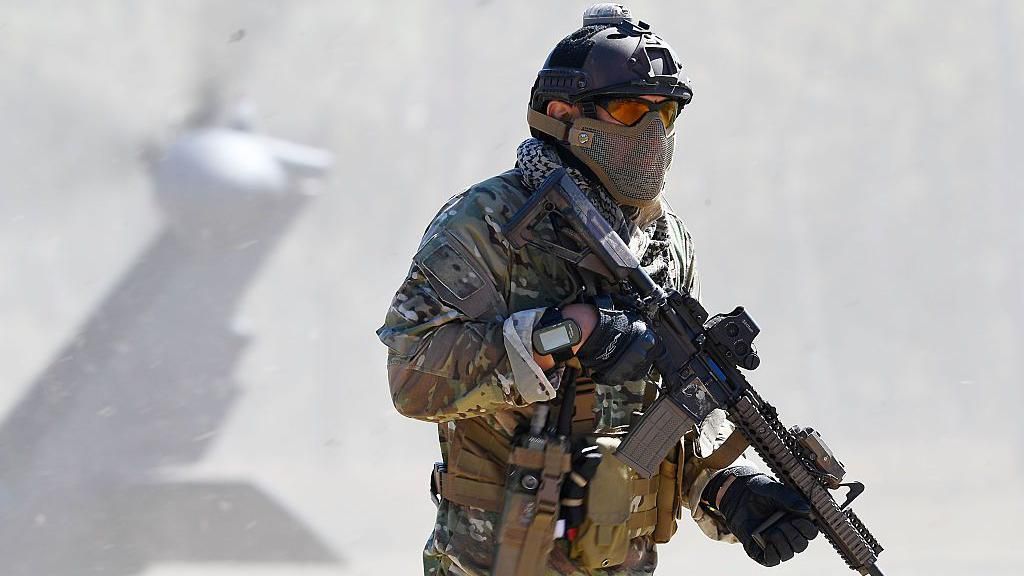
A former squadron commander of pararescue jumpers told CBS that an operation of the scale reported in Iran would involve at least two dozen elite pararescue personnel, inserted into the search area via UH-60 Black Hawk helicopters. The team is trained to parachute into the operating zone if helicopter insertion is not feasible, the commander explained. Once on the ground, their first priority is to establish contact with the missing crew member. After locating the personnel, they provide emergency medical care if required, evade hostile detection and pursuit, and move to a pre-planned rally point for final extraction.
“‘Harrowing and massively dangerous’ is an understatement,” the former commander told CBS. “This is what they train to do, all over the world. They are known as the Swiss Army knives of the Air Force.”
Verified video footage circulating from Iran on Friday shows US military helicopters and at least one refueling aircraft operating over Khuzestan Province in southern Iran, matching the reported area of operations. The mission’s clock is already ticking: Iranian state media has confirmed that Tehran has ordered civilians to locate the remaining missing US crew member alive, with a formal reward offered for information leading to their capture.
Speaking to BBC Radio 4’s *Today* programme, Laurel Rapp, director of the US and North America programme at the international affairs think tank Chatham House, noted that capturing the surviving crew member would represent a major diplomatic win for Iran. “Capturing the crew member would be a huge prize for Iran and would offer them a very powerful bargaining chip” in any future negotiations with Washington, Rapp explained.
Jonathan Hackett, a former US Marine Corps Special Operations specialist, told the BBC’s *World Tonight* programme that the top priority for US search teams is confirming whether the second crew member is still alive. “They’re trying to work backwards from the last point they knew that person was, and fan out based on the speed that person could move under different circumstances in this really difficult terrain,” Hackett said. He added that the reported operation would qualify as a “non-standard assisted recovery mission”, which may involve activating pre-existing contingency plans with local indigenous groups that were established in advance to support potential extraction efforts.
Wartime airborne rescue operations have a long and storied history dating back to World War I, when Allied pilots conducted improvised landings behind German lines in France to rescue downed colleagues. The modern lineage of US Air Force pararescue units traces to a 1943 mission in Japanese-occupied Burma (modern-day Myanmar), where two combat surgeons parachuted behind enemy lines to treat wounded cut-off US troops. A year later, the first ever helicopter combat rescue took place, when a US lieutenant extracted four trapped soldiers from behind Japanese lines — marking the first operational use of a helicopter in armed combat, according to Smithsonian’s *Air & Space Magazine*.
Formal dedicated search-and-rescue units were established by the US in the immediate aftermath of World War II, but the modern iteration of CSAR was forged during the Vietnam War. One famous, high-cost mission known as Bat 21 saw multiple US aircraft lost and multiple US service members killed during a days-long effort to extract a downed pilot behind North Vietnamese lines. The massive expansion of CSAR missions required by the Vietnam War, with their growing scope and complexity, pushed the US military to refine tactics and operating procedures that remain the foundation of CSAR work to this day. Thousands of rescue missions across Southeast Asia shaped the modern CSAR capabilities the US military deploys today.
While every branch of the US military maintains limited in-house CSAR capabilities, the US Air Force holds formal primary responsibility for personnel recovery across the US armed forces. This work is led almost entirely by pararescue jumpers, an elite component of the US special operations community. The official pararescue motto, “These Things We Do, That Others May Live”, reflects the unit’s core mission: upholding the US military’s longstanding promise to all service members that no one will be left behind on the battlefield.
Pararescuemen are dually trained as elite combatants and certified civilian paramedics, and complete what is widely considered one of the most rigorous selection and training pipelines in the entire US military. The full process takes roughly two years to complete, and includes advanced parachute and combat dive training, basic underwater demolition, survival training, resistance to interrogation training, escape and evasion training, and a full accredited civilian paramedic certification. Trainees also complete specialized advanced courses in battlefield trauma medicine, complex recovery operations, and advanced weapons handling. On deployment, pararescue teams are led by specialized Combat Rescue Officers, who are responsible for mission planning, inter-unit coordination, and on-ground execution of extraction operations.
Parescue teams deployed extensively across the post-9/11 wars in Iraq and Afghanistan, carrying out thousands of missions to extract wounded US and allied troops from combat zones. In 2005, pararescue teams carried out the extraction of wounded US Navy SEAL Marcus Luttrell, who was sheltering in an Afghan village after his four-person team was ambushed by Taliban fighters — an incident later adapted into the major motion picture *Lone Survivor*.
Missions to recover downed US pilots have grown increasingly rare over the past three decades. The most high-profile prior incidents include the 1999 recovery of a pilot whose F-117 stealth fighter was shot down over Serbia during the Kosovo War, and the 1995 extraction of US pilot Scott O’Grady, who evaded capture for six days after being shot down over Bosnia before being rescued in a joint Air Force and Marine Corps CSAR mission.