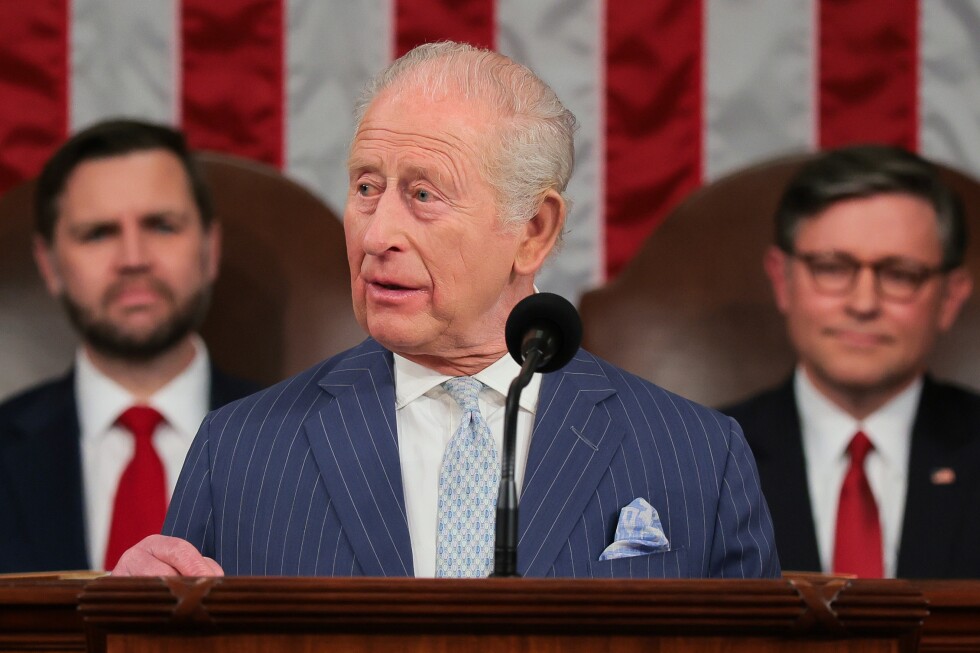
WASHINGTON — In a landmark address to a joint meeting of the U.S. Congress, King Charles III has delivered a sweeping, history-rooted speech celebrating the centuries-long interconnected destiny of Britain and the United States, while calling for renewed collective action to confront modern global crises against a backdrop of widespread international uncertainty.
Opening his remarks, the King extended sincere gratitude to congressional members and the American public for the opportunity to speak during his first visit to the U.S. as monarch and head of the Commonwealth, marking the 250th anniversary of the U.S. Declaration of Independence. He began with a lighthearted nod to the shared cultural ties between the two nations, quoting Oscar Wilde’s famous quip: “We have really everything in common with America nowadays except, of course, language.”
King Charles acknowledged the precarious global moment the address was delivered in, noting ongoing conflicts stretching from Europe to the Middle East that have created ripple effects felt in communities on both sides of the Atlantic. He also directly referenced the recent violent incident near the Capitol that targeted U.S. national leadership and sought to sow division, stating with unwavering conviction that such acts of aggression will never undermine democratic resolve. “Whatever our differences, whatever disagreements we may have, we stand united in our commitment to uphold democracy, to protect all our people from harm, and to salute the courage of those who daily risk their lives in the service of our countries,” he affirmed.
The monarch traced the deep historical roots of the bilateral relationship, noting that the modern connection between the two nations stretches back more than four centuries, and he is the 19th British sovereign to follow U.S. affairs closely. He paid tribute to Congress as a “citadel of democracy” founded to advance universal rights and freedoms, and recalled his late mother Queen Elizabeth II’s 1991 address to the same chamber, drawing a throughline of diplomatic friendship between the two nations. He even added a touch of gentle humor referencing the ancient British parliamentary tradition of holding a member of parliament hostage at Buckingham Palace during the State Opening of Parliament, prompting a light response from assembled lawmakers.
Reflecting on the foundational dispute of American independence, King Charles framed the conflict as a testament to the shared democratic roots that bind the two countries today. The core principle of “no taxation without representation,” he noted, grew from democratic values inherited from British legal and political tradition, turning an early disagreement into the foundation of a resilient partnership. Citing former U.S. President Donald Trump’s 2019 remarks during a state visit to the UK, he echoed that the kinship between the U.S. and UK is “priceless and eternal. It is irreplaceable and unbreakable.”
He further traced shared ideological origins back to the 1215 signing of Magna Carta, noting that the foundational document’s principles of checks and balances on executive power have been cited in more than 160 U.S. Supreme Court cases since 1789. He pointed to the shared memorial stone at Runnymede, where an acre of the historic Magna Carta site was gifted to the U.S. by the British people in memory of President John F. Kennedy, as a lasting symbol of shared commitment to liberty.
Against the current era of global turbulence, King Charles called for a revitalization of the transatlantic alliance, echoing Henry Kissinger’s framing of an Atlantic partnership built on twin pillars of Europe and America, a partnership he says is more critical today than at any point in history. Recalling his grandfather King George VI’s 1939 visit to the U.S. on the cusp of World War II, he noted that while the geopolitical context has shifted dramatically, the shared values that united the two nations then remain just as vital today.
Addressing modern security challenges, King Charles announced the UK’s commitment to the largest sustained increase in defense spending since the Cold War, a transformation he said is necessary to address evolving global threats. He also marked the upcoming 25th anniversary of the 9/11 terrorist attacks, noting that he and Queen Camilla would pay their respects to victims and their families during their stop in New York, reaffirming that Britain stood with the U.S. then and continues to stand with the nation today. He recalled the unified global response after the attacks, when NATO invoked Article V for the first time in its history, as a testament to the centuries-long history of shared sacrifice between the two nations.
The King reaffirmed unwavering support for Ukraine and its people, calling for continued collective resolve to secure a just and lasting peace. He outlined deep integrated defense cooperation between the U.S. and UK, from joint production of F-35 fighter jets to the groundbreaking AUKUS submarine partnership with Australia, noting these projects are built not on sentiment alone but on a shared commitment to long-term regional and global security.
Beyond security, King Charles highlighted the deep economic and technological ties that bind the two economies, noting $430 billion in annual bilateral trade and $1.7 trillion in mutual investment that supports millions of jobs on both sides of the Atlantic. He outlined new partnerships in cutting-edge fields including nuclear fusion, quantum computing, artificial intelligence, and pharmaceutical discovery, partnerships he said hold the promise of saving millions of lives around the globe.
He also drew attention to shared environmental responsibility, noting that the ancient Appalachian and Scottish mountain ranges were once a single continuous landmass, a natural reminder of the shared global fate of the two nations in confronting climate change and biodiversity collapse. He emphasized that the collapse of natural systems threatens both global prosperity and national security, a risk the world cannot afford to ignore.
Closing his historic address, King Charles framed the U.S.-UK relationship as one of the most consequential alliances in human history, forged from early division into a partnership that has shaped global order for decades. He called on both nations to reject inward-looking nationalism and reaffirm their shared commitment to defending democratic values alongside global partners. Echoing Abraham Lincoln’s Gettysburg Address, he noted that the world will remember actions more than words, and called for a rededication of the two nations to serving their people and all the people of the world. He closed with a simple, heartfelt toast to the enduring friendship between the two nations: “God bless the United States and God bless the United Kingdom.”