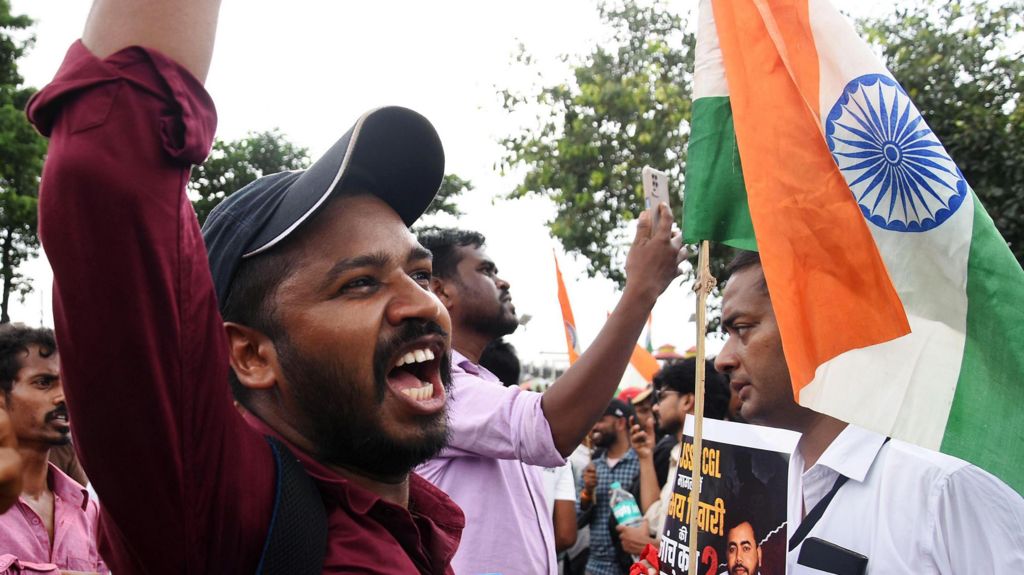
After 26 days of sustained public protest over widespread allegations of corruption and misconduct in state government recruitment exams, student and job-seeker protesters in India’s eastern state of Jharkhand have agreed to suspend their demonstration, following a series of key concessions from the state government. The mass movement, which drew thousands of participants and included multiple hunger strikes by demonstrators demanding systemic reform of the state’s public sector hiring process, finally reached a breakthrough this week after officials announced sweeping policy changes to address the protesters’ core concerns.
The unrest began in late July, sparked by public allegations of manipulation following the release of preliminary civil service exam results. Candidates raised alarms when leaked answer sheets shared online appeared to show that top-scoring applicants had answered fewer questions correctly than lower-ranked competitors, triggering widespread public anger over systemic fraud. The protest movement gained additional momentum in the wake of a larger, high-profile demonstration in New Delhi that ultimately forced the resignation of India’s federal education minister, putting severe political pressure on Jharkhand’s ruling coalition government led by Chief Minister Hemant Soren.
For nearly four weeks, hundreds of protesters maintained a continuous encampment at a stadium in the state capital of Ranchi, refusing to stand down until their demands for independent investigation and systemic reform were met. To break the weeks-long deadlock, the state government has agreed to cancel 22 controversial recruitment exams, and ordered a full investigation into dozens of additional past hiring tests. In a key compromise to resolve a sticking point over calls for an investigation by the federal Central Bureau of Investigation (CBI) — which the state government had repeatedly rejected — protesters have agreed to accept an independent judicial inquiry into the allegations, with a two-month deadline for the government to finalize the inquiry process and deliver on its remaining commitments.
Thus far, the state’s Criminal Investigation Department (CID) has already made multiple arrests in connection with the alleged irregularities, including the chair of the Jharkhand Public Service Commission (JPSC), the state body that administers most public sector recruitment exams. Earlier this week, Soren confirmed that “many shocking facts are emerging” from the ongoing CID probe, and announced that all exams administered by private hiring contractor TSR Data Processing Private Limited (TDPL) would be canceled, with a full review of all recruitment exams held in the state dating back to 2014.
Following the announcement of the agreement on Wednesday, protesters cleared the Ranchi protest site, holding celebratory gatherings where they exchanged garlands and set off fireworks to mark what they frame as a landmark win for student organizers. Student activist Ravindra Paswan, a key leader of the movement, emphasized that the suspension of agitation is conditional, noting that protesters will immediately resume demonstrations if the government fails to meet the two-month deadline for completing all promised reforms and investigations. Paswan added that if the judicial inquiry is not delivered as agreed, organizers will renew their push for a full CBI probe into the scandal.
While the agreement has ended the immediate standoff, it has also sparked an unexpected new political conflict: the cancellation of flawed exams has triggered protests from candidates who already passed the contested tests and started working in government roles. These successful candidates have argued that they earned their positions through legitimate merit, and should not be penalized for misconduct committed by other parties or state officials. Dozens have already filed petitions with the Jharkhand High Court contesting the cancellations, and it remains unclear what will become of their current appointments if the state investigation confirms widespread fraud in the exam processes.
Public sector government jobs are among the most sought-after positions in India, prized for their unprecedented job security and stable benefits. Every year, millions of Indian candidates spend months or even years preparing for competitive recruitment exams, hoping to secure one of the limited available roles. However, India’s public recruitment system has been plagued by repeated scandals in recent years, with regular allegations of pre-exam paper leaks, organized cheating, and systemic corruption that have eroded public trust in the hiring process. Recruitment processes also often drag on for years, leaving even qualified candidates facing extended periods of uncertainty about their employment prospects.
Politically, the protest has put Jharkhand’s ruling coalition — made up of Soren’s Jharkhand Mukti Morcha, the Indian National Congress, and several smaller regional parties — on the defensive. The state’s main opposition party, Prime Minister Narendra Modi’s national Bharatiya Janata Party (BJP), has publicly backed the protesters throughout the standoff, turning the recruitment scandal into a major political flashpoint ahead of upcoming state electoral cycles.