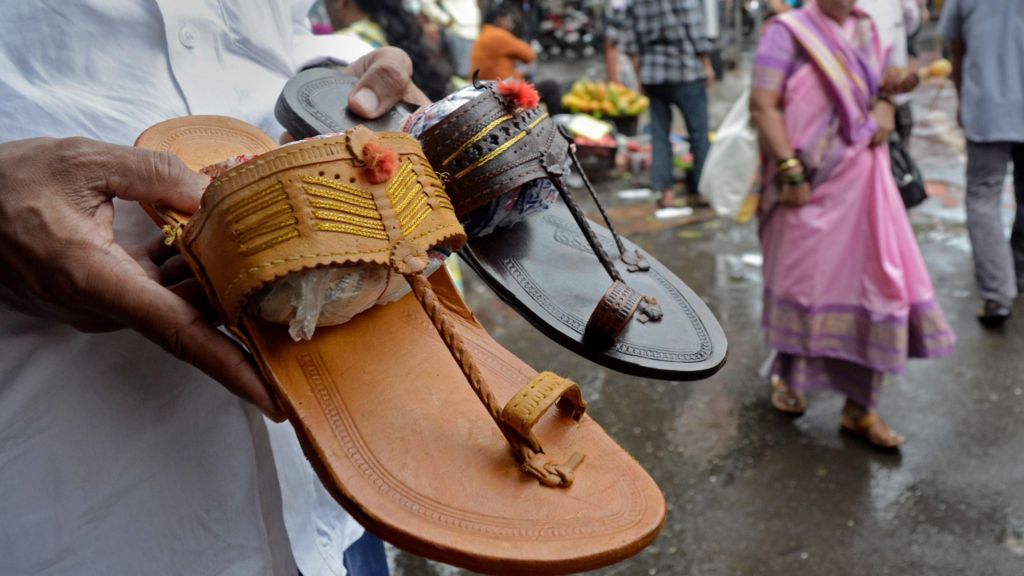
Nearly 12 months after drawing widespread public criticism for failing to credit the Indian origins of a similar footwear design, Italian luxury fashion house Prada has officially released a limited-edition collection of sandals drawing inspiration from India’s centuries-old traditional Kolhapuri sandal craft.
Rooted in a craft tradition stretching all the way back to the 12th century, authentic Kolhapuri sandals take their name from Kolhapur, a city in India’s western state of Maharashtra, where the style first emerged. The handcrafted leather footwear, traditionally produced by local artisans across Maharashtra and neighboring Karnataka, earned Geographical Indication (GI) status from the Indian government in 2019, a legal designation that protects the product’s regional authenticity and origin. For decades, mass-produced and authentic traditional versions of the sandals have retailed in local Indian markets for between 500 and 1,000 Indian rupees, equal to roughly $5 to $10. By contrast, Prada’s new luxury iteration carries a retail price of €750, or approximately $881, per pair.
The controversy that preceded this launch dates back to June 2024, when Prada first unveiled a nearly identical toe-loop sandal design during its Milan Fashion Week presentation. At that time, the brand labeled the item simply as “leather sandals,” making no mention of its connection to the traditional Indian craft, sparking broad backlash across social media and fashion circles over accusations of cultural appropriation. Prada later issued a public acknowledgment confirming the design’s roots in the Indian Kolhapuri tradition.
For this official commercial release, Prada has emphasized its commitment to centering the original craft and its creators. The company confirms that every pair of the new limited-edition sandals is handcrafted by experienced artisans based in Maharashtra and Karnataka, the traditional home of the craft. The collection is currently available for purchase through 40 Prada retail locations around the world, as well as via the brand’s global e-commerce platform. In a public statement, Prada framed the new line as a deliberate cross-cultural collaboration, noting that the collection “combines traditional techniques with contemporary design and premium materials,” creating what the brand describes as “a dialogue between Indian heritage and modern luxury expression.”
Beyond the new sandal line, Prada has also announced a multi-year initiative to invest directly in the Kolhapuri artisan community. In partnership with two leading Indian design institutes, the brand is launching a three-year skills training program for artisans working in eight Indian districts with deep ties to Kolhapuri sandal production. The program will deliver six-month structured training modules to a total of 180 participating artisans, with a select group of top participants offered the opportunity to pursue advanced training at the Prada Group Academy based in Italy.
Lorenzo Bertelli, head of corporate social responsibility for the Prada Group, explained that the core goal of the initiative is to empower local craft communities. “This project aims to support artisans by strengthening skills, preserving traditional knowledge and helping local communities sustain the craft,” Bertelli said. Tanu Kashyap, director general of the National Institute of Fashion Technology — one of the Indian partner organizations for the training program — added that the collaboration will also create new global opportunities for traditional Indian craft. The program will help open access to international luxury markets, raising global awareness of India’s rich handicraft heritage, Kashyap noted.
The Prada collaboration has reignited long-running debates within the global fashion industry about the ethical use of traditional South Asian crafts by large international luxury brands. For years, designers and cultural heritage advocates have raised concerns that international brands often draw on traditional craft and design motifs from South Asia without providing adequate credit, compensation, or support to the original communities that developed and preserved those practices over generations.