A powerful 7.7-magnitude earthquake rattled south-central Panama on Friday, triggering widespread structural damage, forcing mass evacuations, and shaking communities across the region roughly three days ahead of the country’s scheduled national earthquake preparedness drill.
According to data from the U.S. Geological Survey (USGS), the tremor hit shortly before 3:00 p.m. local time (20:00 GMT), with its epicenter located just 10 kilometers (6.2 miles) outside the small town of Pitaloza Arriba. The earthquake originated at a relatively shallow depth of 12 kilometers, a geological trait that typically amplifies destructive impacts on the Earth’s surface. USGS analysts noted the quake’s effects were expected to be felt across a broad swath of the country, with an estimated 4.6 million people experiencing moderate to severe shaking.
User-shared and verified footage circulating online documents significant damage across multiple local communities. In the towns of Penonomé and Soná, multiple structures have partially or fully collapsed: one clip captures one entire side and a central spire of a local Penonomé cathedral crumbling during the tremor, while another video shows a neighborhood hotel reduced to a pile of rubble. In one widely shared clip, a man can be heard shouting into collapsed debris, calling for any people who may be trapped beneath the wreckage. As of the latest updates, no injuries or fatalities have been officially reported, but the full scope of harm to infrastructure and residents remains unconfirmed.
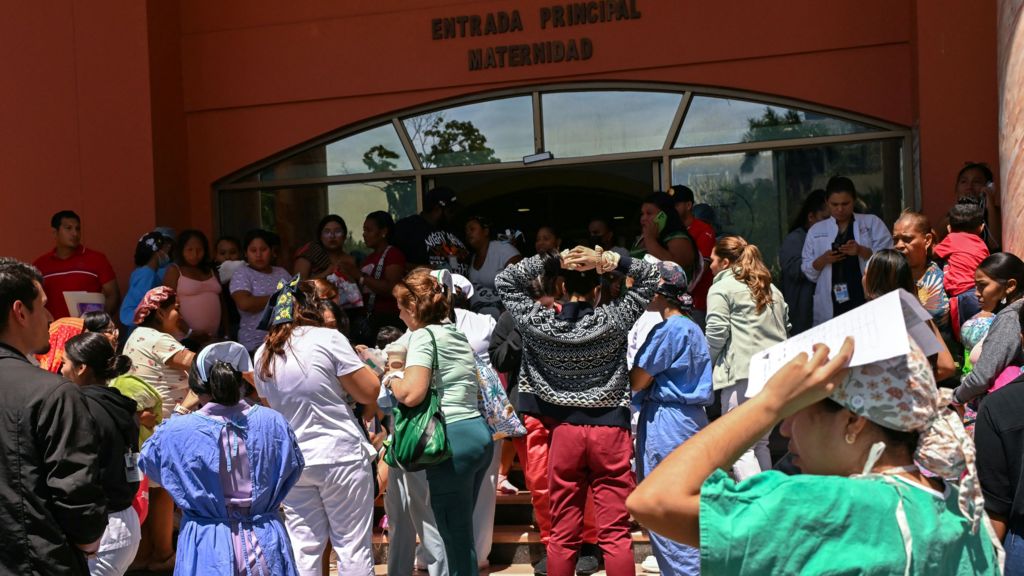
Residents across affected regions described widespread fear and uncertainty. Seventy-four-year-old Ricardo Brown, a resident of the Las Minas neighborhood in southern Herrera province, told Reuters that multiple homes in his community suffered visible cracking and structural damage. “We’re scared. It’s just the two of us old folks here. The house has cracked and we’re afraid it could fall on us,” Brown said in an interview. Even in Panama City, roughly 200 kilometers from the epicenter, authorities ordered immediate evacuations of dozens of buildings, including a working maternity ward. Thousands of residents gathered in city streets and nearby parks to wait out aftershock risks, with damage in the capital limited mostly to falling roof debris, according to initial reports.
In the hours following the main tremor, seismologists recorded multiple large aftershocks near the original epicenter, which officials warn could worsen existing structural damage and complicate initial damage assessment efforts. Initially, tsunami warnings were issued for 11 Panamanian neighboring countries across Central and South America, but the U.S. Tsunami Warning System later lifted all alerts, confirming no tsunami threat would materialize from the quake. The Panama Canal Authority, which oversees operations and marine traffic through the critical interoceanic waterway, confirmed that all canal infrastructure and operations remained fully unaffected by the seismic event.
Panama’s sitting President José Raúl Mulino announced that the entire national government had mobilized to coordinate response and recovery efforts, urging calm among the public. “What happened should not be used to cause alarm or disorder,” Mulino said in a public address. The earthquake comes just three days before Panama is set to hold a planned nationwide evacuation drill designed to prepare communities for a major seismic event, and it follows a string of destructive earthquakes that hit Colombia and Venezuela earlier this year.