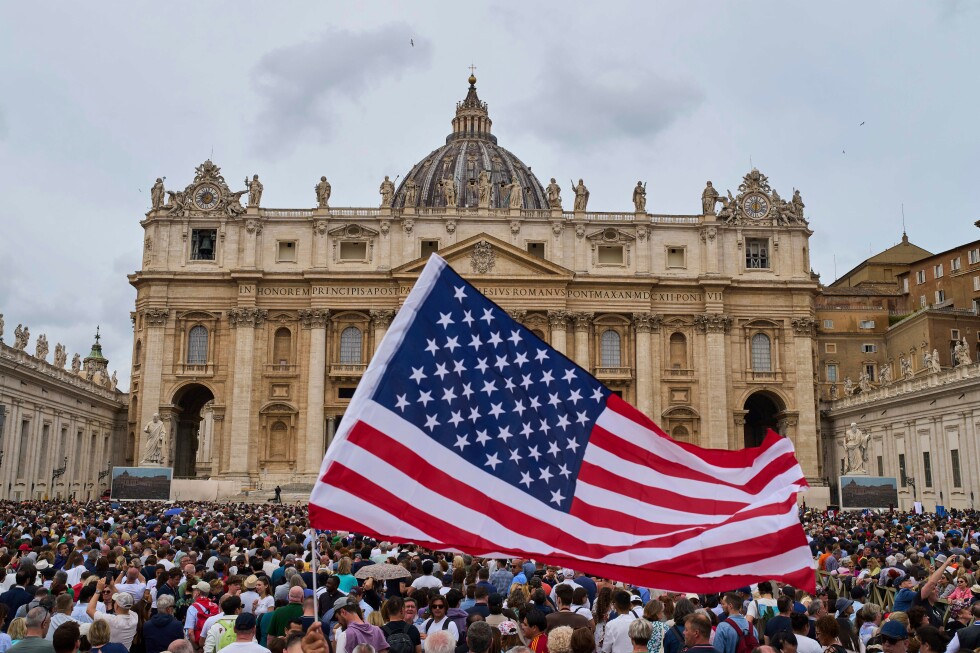
As Pope Leo XIV marked the first anniversary of his election to the papacy on Friday, the milestone was overshadowed by an escalating public feud with former president and current U.S. leader Donald Trump – a conflict that has dragged the soft-spoken, pastorally focused pontiff into the center of global geopolitical tensions.
When Leo took office one year ago, he framed his papacy as centered on walking alongside the global Catholic flock, prioritizing pastoral care over high-profile political confrontation. The 70-year-old pontiff, a former Midwestern U.S. missionary and Augustinian priest, has always been known for his reserved, mild-mannered demeanor: he prefers solitary tennis matches, can quote 5th-century St. Augustine from memory, and frames his calls for global peace as simple, faithful readings of Christian scripture, not political posturing.
But repeated public criticisms from Trump have forced Leo into the public fray, with the pontiff delivering increasingly sharp responses to the U.S. president’s attacks. The back-and-forth, which centers on competing stances on the ongoing Iran war, has strained diplomatic ties between the U.S. and the Holy See. On the eve of his anniversary, Leo hosted U.S. Secretary of State Marco Rubio, who traveled to Vatican City for a fence-mending meeting aimed at repairing bilateral relations. While both the Vatican and U.S. State Department reaffirmed their longstanding strong ties after the meeting, the conflict has nonetheless pushed Leo far outside his expected comfort zone on the global stage.
Most recently, after Trump misrepresented the pontiff’s positions, Leo hit back: “If someone wants to criticize me for announcing the Gospel, let him do it with the truth.”
Beyond the high-profile conflict with Trump, Leo’s first year in office has been defined by his promise to heal deep rifts within the Catholic Church and a polarized global community, a mission he has advanced steadily after 12 years of Pope Francis’ revolutionary, often divisive papacy. The pontiff has worked to calm tensions across the church, even amid rising threats of schism, as he navigates thorny challenges including friction between traditionalist and progressive factions, longstanding financial instability at the Holy See, and the geopolitical rift opened by his clashes with the Trump administration.
Cardinal Wilton Gregory, a retired Washington archbishop and fellow Chicago native, noted that social media has amplified existing divisions within the church, creating a unique test for any sitting pope. “He has to call us to our better angels,” Gregory said of Leo’s approach, which has focused on de-escalating tensions rather than leaning into partisan friction. This approach was on display during Leo’s recent trip to Africa, where he sought to downplay the feud with Trump, saying that entering a public debate with the U.S. president “is not in my interest at all.” “I primarily come to Africa as a pastor, as the head of the Catholic Church to be with, to celebrate with, to encourage and accompany all the Catholics throughout Africa,” he said, repeating his stance that the political trappings of his role as a head of state and global moral figure are not his primary focus.
For many observers, the novelty of having the first-ever U.S. pope, a development that breaks the longstanding unwritten norm that the papacy would not be held by a citizen of the world’s dominant superpower, has yet to fade. Unlike his predecessor Pope Francis, who frequently clashed with U.S. conservatives over his criticism of American-style capitalism and was often dismissed as out of touch with U.S. Catholic life, Leo speaks fluent English as a native speaker and has a deep, firsthand understanding of U.S. culture and institutions.
Anthea Butler, a senior fellow at the Koch Institute at the University of Oxford, noted that Leo’s criticism of current U.S. policy differs sharply from Francis’ confrontational style. “He’s doing it not coming full-on like Francis would,” Butler explained, “but approaching issues from the side. He’s not naming names, he’s merely preaching the Gospel.”
This approach has already yielded notable shifts in relations between the Holy See and U.S. Catholic institutions. During Francis’ papacy, tensions ran high between the Argentine pontiff and U.S. conservative Catholics, with unrelenting coverage of mismanagement and scandal at the Vatican leading many U.S. donors to stop contributing to the Holy See. Today, with a native-born U.S. leader in St. Peter’s, many U.S. Catholic leaders report newfound unity among American bishops, particularly around shared commitments to advocating for migrants and people living in poverty – a cohesion that leaders attribute in part to Leo’s unifying, accessible message.
“It’s very different when you are hearing the message without it being mediated through translation,” said Kerry Alys Robinson, chief executive of Catholic Charities USA. Robinson noted that U.S. Catholic bishops are more united today than they have been in decades, a shift she credits in part to Leo’s consistent call for collective action around issues of shared concern to the church.
Ward Fitzgerald, president of The Papal Foundation, which funds the pontiff’s global charity work, said the “Leo effect” has already translated to tangible growth in support from U.S. donors and new conversions to Catholicism across the U.S. and Europe. “I think there’s lots of reasons for it, but I certainly think that having a pope who speaks English helps young people understand the messages of the Holy Father,” Fitzgerald said. For U.S. donors, hearing the pontiff’s appeals directly in English resonates far more than translated remarks, Fitzgerald added, leading to increased giving. The Papal Foundation has already added 25 new donor families since Leo’s election – a significant gain, as membership requires a minimum pledge of $1.25 million.
Cardinal Timothy Dolan, the influential U.S. prelate who was a key power broker in the 2025 conclave that elected Leo and who has close ties to Trump, celebrated a special anniversary Mass for foundation donors last week in St. Peter’s Basilica. In his homily, Dolan compared Leo to St. Joseph, the patron saint of the universal church, describing the pope as matching St. Joseph’s quiet, steady character. “A man who exuded a sense of depth and substance,” Dolan said. “A man who is shy, all right, a man who is focused on his mission. A man, always attentive to God’s plan. I can think of no one who fits that description better than Pope Leo.”