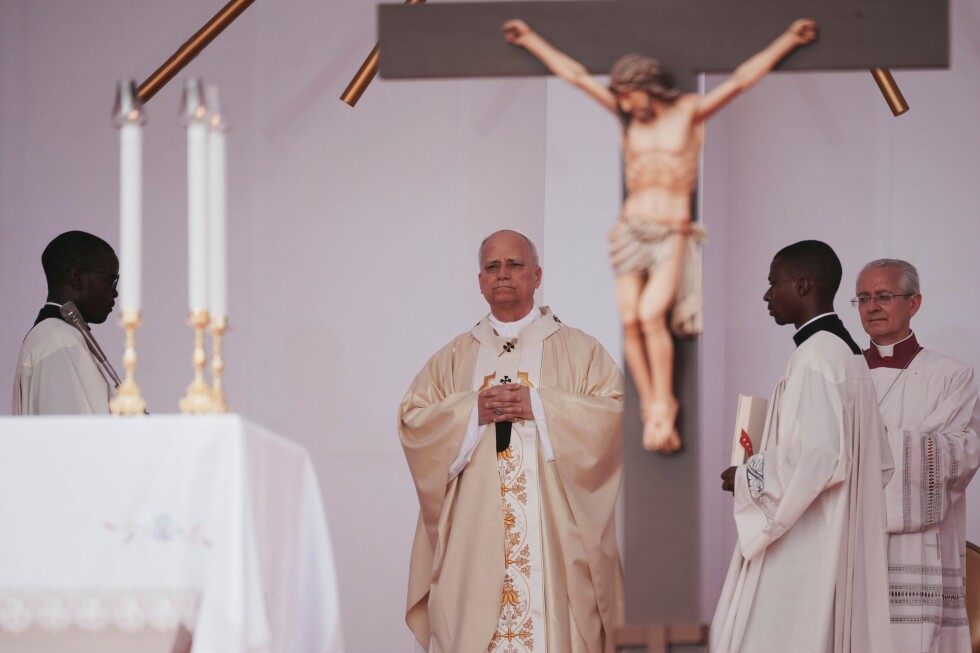
On a historic stop of his African pilgrimage in Luanda, Angola, Pope Leo XIV kicked off Sunday with a rousing call to action for Angolans to root out the pervasive “scourge of corruption” by embedding a culture of justice and collective sharing across the nation. The visit, which later brought the first U.S.-born pontiff to one of the trans-Atlantic slave trade’s most significant remaining sites, weaves together calls for national reconciliation in Angola with overdue reckoning over the Catholic Church’s centuries-old complicity in human trafficking.
Speaking to a crowd of roughly 100,000 worshippers gathered in Kilamba, a large residential development constructed by Chinese partners 15 miles outside the Angolan capital, the pontiff used his homily to lift up the aspirations of the Angolan people, while calling out the continued exploitation of the nation’s abundant mineral resources and its most vulnerable citizens. Decades after the end of a brutal post-independence civil war that left deep, unhealed scars across the country, Leo urged an end to old sectarian divides, hatred, and violence. “We wish to build a country where old divisions are overcome once and for all, where hatred and violence disappear, and where the scourge of corruption is healed by a new culture of justice and sharing,” he told the assembled crowd.
By Sunday afternoon, the pontiff traveled to the Sanctuary of Mama Muxima, a revered contemporary Catholic shrine located 70 miles south of Luanda on the banks of the Kwanza River. But the site’s origins stretch back to the late 16th century, when Portuguese colonizers built the Church of Our Lady of Muxima as part of a colonial fortress. For decades, it operated as a central hub of the trans-Atlantic slave trade: enslaved African people were held at the site, forcibly baptized by Portuguese clergy, then marched overland to the port of Luanda to be loaded onto slave ships bound for the Americas.
Today, the shrine’s layered history serves as a stark reminder of the Catholic Church’s institutional role in the trans-Atlantic slave trade, from the forced conversion of enslaved people to the Vatican’s long refusal to issue a full, formal acknowledgement and atonement for its complicity. The visit carries particular personal weight for Pope Leo XIV: genealogical research has confirmed the pontiff’s Creole ancestry includes both enslaved African people and white slaveholders in his family line that traces its North American roots to Louisiana.
For many Black Catholics across the globe, the trip to Muxima represents a long-awaited moment of reckoning and healing, according to Anthea Butler, a Black Catholic scholar and senior fellow at Oxford University’s Koch Center. Butler explained that millions of Black Catholics trace their connection to the faith directly to the era of slavery, when France’s Code Noir required all enslaved people owned by Catholic slaveholders to receive baptism, while many other enslaved Angolans brought their existing Catholic faith with them when they were trafficked to the Americas.
Scholars have long documented that 15th-century papal directives from the Vatican emboldened Portuguese colonizers to expand their slave trading operations across Africa. In 1452, Pope Nicholas V issued the papal bull *Dum Diversas*, which granted the Portuguese crown and its successors formal permission to “invade, conquer, fight and subjugate” non-Christian peoples across the globe, seize their lands and possessions, and “reduce their persons to perpetual slavery.” A second bull, *Romanus Pontifex*, issued three years later, alongside *Dum Diversas* formed the legal and ideological foundation of the Doctrine of Discovery, the framework that legitimized European colonial seizure of land across Africa and the Americas and justified the enslavement of Indigenous and African peoples.
While the Vatican formally repudiated the Doctrine of Discovery in 2023, it has never formally rescinded or rejected the original 15th-century papal bulls that authorized the slave trade. The Holy See has argued that a 1537 bull, *Sublimis Deus*, later reaffirmed that Indigenous peoples should not be stripped of their liberty, property, or enslaved, but scholars note this directive did not explicitly reverse or cancel the earlier authorization for the enslavement of African peoples.
Jesuit priest and slavery historian Christopher J. Kellerman, author of *All Oppression Shall Cease: A History of Slavery, Abolitionism, and the Catholic Church*, acknowledges that most of the 12.5 million Africans trafficked across the Atlantic were initially sold into slavery by African intermediaries, rather than captured directly by European traders. Even so, he notes, when the Muxima fortress and church were constructed, Portuguese forces both conducted independent slave raids and purchased enslaved people, openly relying on the papal permissions granted by the 15th-century bulls. “The popes repeatedly authorized Portugal’s colonization efforts in Africa and Portuguese participation in the slave trade, but the Vatican has never fully admitted this,” Kellerman said in comments to the Associated Press. “It would be so powerful if at some point Pope Leo were to apologize for the popes’ role in the trade.”
This is not the first time a sitting pope has addressed the harm of the slave trade during a visit to Africa. During a 1985 trip to Cameroon, St. John Paul II asked for forgiveness from African peoples for the crime of the slave trade, and during a 1992 visit to Goree Island, Senegal, West Africa’s largest historical slave trading center, he denounced the injustice of slavery, calling it a “tragedy of a civilization that called itself Christian.”
The connection between Pope Leo XIV and this painful history runs deeper than institutional responsibility. Harvard University professor Henry Louis Gates Jr., host of the popular genealogy series *Finding Your Roots*, published research confirming 17 of the pope’s American ancestors were Black, recorded in census records as mulatto, Black, Creole, or free people of color, with the pope’s family tree including both enslaved people and slaveholders. Gates presented his findings to Pope Leo during a private audience at the Vatican on July 5, and the Harvard Gazette reports the pope asked specifically about both his Black and white ancestors who held people in bondage. The pope has not yet spoken publicly about his family heritage or Gates’ findings, and some Black Catholic scholars say it would be inappropriate to impose a public narrative about the pope’s identity before he chooses to speak on the matter.
“It’s important that we tell our own stories,” said Tia Noelle Pratt, a sociologist of religion at Villanova University, Pope Leo’s alma mater, and author of *Faithful and Devoted: Racism and Identity in the African-American Catholic Experience*. “We haven’t heard anything from him about what he thinks about it, and so to impose anything on him, I think would be completely inappropriate.”
Cardinal Wilton Gregory, the retired first African American archbishop of Washington, who helped facilitate the meeting between Gates and Pope Leo, said he was delighted to support the encounter. “It’s one of the things that I think for many African Americans and people of color, they identify with great pride the pope has roots in our own heritage,” Gregory said. “And I think he’s happy about that too, because it’s another link to the people that he tries to serve and is called to serve.”