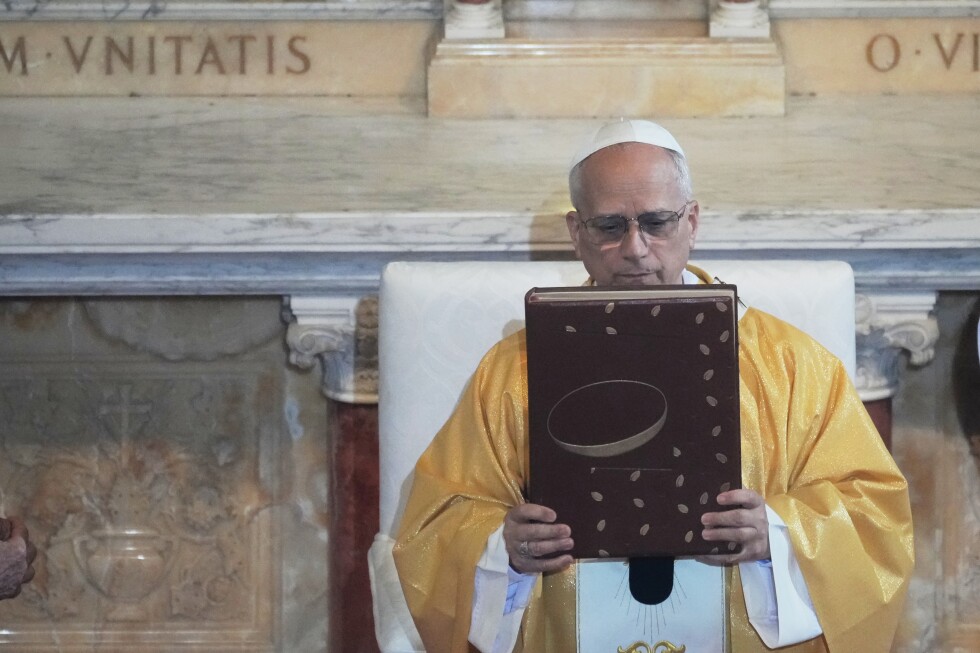
In an extraordinary clash between a sitting U.S. president and the first American-born pontiff in history, Pope Leo XIV doubled down Wednesday on his calls for global peace and interfaith dialogue while facing unrelenting public criticism from former President Donald Trump. Speaking to reporters aboard the papal plane mid-way through his multi-stop African tour — en route to Cameroon following an official visit to Algeria — the pope did not directly name Trump or his administration, but his carefully framed remarks made clear the mounting attacks had not gone unheard. Leo did not take questions from the assembled press, instead centering his comments on the legacy of St. Augustine of Hippo, the 4th and 5th century theological giant who has long been a core inspiration for Leo’s religious order and personal spirituality.
St. Augustine served as bishop of Hippo, the modern-day Algerian coastal city of Annaba, for more than 30 years. During his stop there on Tuesday, Leo retraced the saint’s roots, framing St. Augustine’s teachings as a critical anchor for the modern world. “His writings, his teaching, his spirituality, his invitation to search for God and to search for truth is something that is very much needed today, a message that is very real for all of us today as believers in Jesus Christ, but for all people,” Leo told reporters. The pope added that by visiting Hippo, he sought to share St. Augustine’s core vision of unity across divides: “unity among all peoples and respect for all people in spite of the differences.”
Leo highlighted a particularly striking example of interfaith cooperation he witnessed in Algeria, a nation where more than 90% of the population identifies as Muslim. Despite the religious majority, Algerians widely honor St. Augustine as one of their most iconic native sons, a shared respect Leo says builds critical bridges between Christian and Muslim communities. He also recalled his quiet visit to the Great Mosque of Algiers, where he offered silent prayer as a gesture of goodwill. “I think the visit to the mosque was significant to say that although we have different beliefs, we have different ways of worshiping, we have different ways of living, we can live together in peace,” Leo said. “And so I think that to promote that kind of image is something which the world needs to hear today.”
The pope also praised Algeria’s official welcome, marking the first papal visit to the nation in history. As the pontiff’s ITA Airways charter entered Algerian airspace, the military provided a full airborne escort, a gesture of respect Leo called a sign of “the goodness, of the generosity, of the respect that the Algerian people and the Algerian government have wished to show to the Holy See and to myself.”
The sustained public conflict between Trump and Pope Leo began after the pontiff publicly amplified condemnation of the ongoing war between Israel and Iran, saying God does not bless those who launch airstrikes, and calling Trump’s public threat to “annihilate Iranian civilization” “truly unacceptable.” Since that initial disagreement, Trump has launched repeated public broadsides against Leo. This week alone, the former president has accused the pontiff of being soft on crime, overly aligned with left-wing political positions, and even claimed that Leo owed his election as pope to Trump’s political influence. Over Tuesday night, Trump doubled down, posting “Not good!!!” on social media in response to resurfaced pre-papacy comments Leo made criticizing Trump. He also demanded: “Will someone please tell Pope Leo that Iran has killed at least 42,000 innocent, completely unarmed, protesters in the last two months, and that for Iran to have a Nuclear Bomb is absolutely unacceptable.”
Adding a separate layer of controversy, Trump recently shared then removed an AI-generated image that depicted him in a Christ-like figure, a move that drew widespread condemnation from across the political spectrum — even from many of his own supporters. U.S. Vice President JD Vance, a recent convert to Catholicism, also waded into the conflict, advising the pope to “be careful” when speaking on theological matters.