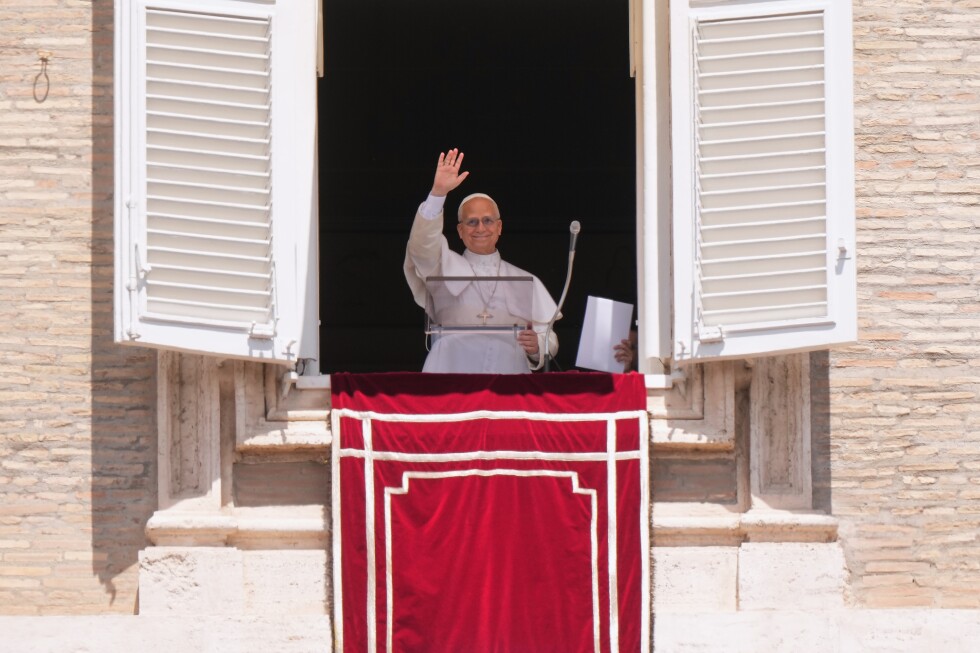
VATICAN CITY — The Vatican announced Monday that Pope Leo XIV will join Christopher Olah, co-founder of leading artificial intelligence firm Anthropic, for the official launch of the pontiff’s first-ever encyclical on May 25. The high-profile document, titled *Magnifica Humanitas* (Magnificent Humanity), centers on protecting and upholding human dignity amid the rapid global expansion of artificial intelligence.
Olah’s invitation to participate in the launch carries major geopolitical and policy significance, already signaling that the U.S.-born pope’s stance on AI governance will emerge as a new point of friction with the Trump White House. Just three months prior, in February 2025, the Trump administration issued an executive order banning all U.S. federal agencies from using Anthropic’s AI tools, and imposed additional sweeping sanctions on the company. The penalties came after Anthropic refused to grant the U.S. military unlimited access to its proprietary AI technology. Anthropic has since filed a lawsuit against the administration, alleging the penalties amount to illegal retaliation for the company’s commitment to building guardrails around harmful uses of its AI systems.
Since taking office, Pope Leo XIV has identified AI ethics and governance as a core priority of his papacy, and has repeatedly voiced deep concern over the development of AI for military applications, calling for global mandatory monitoring of high-risk AI deployments.
The format of the launch itself marks a break from Vatican tradition. Historically, new papal encyclicals are unveiled in the small Vatican press room, with only a small group of select officials and invited guests on hand to address reporter questions. For *Magnifica Humanitas*, however, the Vatican has organized a high-profile formal event in its main auditorium, featuring a roster of top religious and secular speakers.
Leading the presentation will be two of the Holy See’s most senior cardinals: Cardinal Víctor Manuel Fernández, head of the Vatican’s Dicastery for the Doctrine of the Faith, and Cardinal Michael Czerny, head of the Dicastery for Promoting Integral Human Development. Joining Olah as lay speakers are two prominent theologians, Anna Rowlands and Leocadie Lushombo. Vatican Secretary of State Cardinal Pietro Parolin will deliver the closing remarks, before Pope Leo XIV gives a keynote address and offers a final blessing to attendees.
Pope Leo XIV signed the encyclical on May 15, a date chosen intentionally to mark 135 years to the day after his namesake, Pope Leo XIII, signed *Rerum Novarum* — the landmark 1891 encyclical that addressed workers’ rights, the excesses of unregulated capitalism, and the obligations of states and employers to working people amid the Industrial Revolution. That document laid the foundation for modern Catholic social teaching, and the current pope has already referenced it repeatedly in discussions of the AI revolution, arguing the technology poses the same fundamental existential questions about work, dignity and power that industrialization sparked more than a century ago.
The new encyclical is expected to frame the global debate over AI through the lens of longstanding Catholic social teaching, which already encompasses principles of labor rights, global justice, and peace. A brief look at Anthropic’s background contextualizes why this collaboration is notable: the company was founded in 2021 by Dario Amodei and a group of researchers who left OpenAI over public disagreements with then-CEO Sam Altman over AI safety priorities. From its founding, Anthropic has centered its public mission on building safety guardrails for artificial general intelligence (AGI) — the advanced AI system that can outperform humans on most economic and cognitive tasks, a goal both Anthropic and OpenAI are pursuing from their San Francisco bases. As of early 2025, the privately held Anthropic reported a valuation of $380 billion, placing it as one of the world’s most valuable AI companies alongside OpenAI and Elon Musk’s combined SpaceX-xAI venture. Its flagship chatbot Claude competes directly with OpenAI’s ChatGPT and xAI’s Grok.
The Associated Press’ religion coverage is supported through a collaboration with The Conversation US, with funding from Lilly Endowment Inc. The AP retains full editorial responsibility for this content.