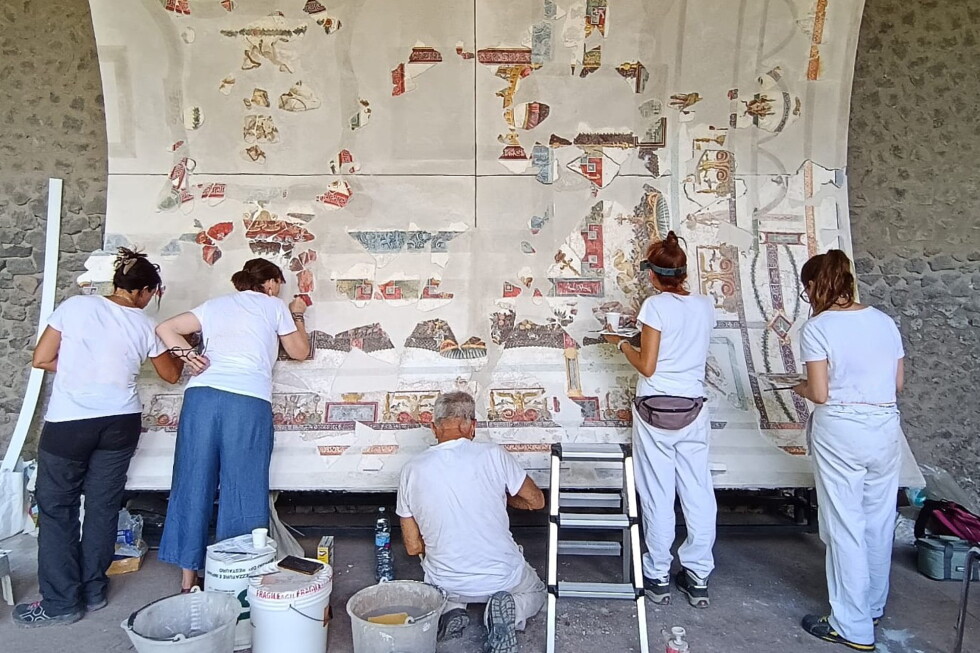
ROME – One of the world’s most iconic archaeological sites, the ancient Roman city of Pompeii, has revealed a remarkable new cultural artifact: a partially reconstructed vaulted ceiling covered in intricate frescoes, decorated with vivid depictions of figures from classical Greek mythology. Pompeii, famously frozen in time when Mount Vesuvius erupted catastrophically in 79 AD, has yielded countless treasures over centuries of excavation, and this new discovery adds another extraordinary layer to our understanding of daily life in the ancient city. The finished partial reconstruction was presented to the public this Thursday, marking the conclusion of an international workshop focused on cutting-edge new findings and modern restoration practices at the UNESCO World Heritage Site. Drawing more than 2.5 million visitors annually, Pompeii remains Italy’s one of the most popular tourist destinations, making new archaeological developments there closely watched by both the global heritage community and cultural travel sectors. Officials from the Pompeii Archaeological Park announced further details of the project in an official statement released Friday. According to park authorities, the restored ceiling is thought to have originally decorated a large banquet hall on the upper floor of a residential villa, which also included an adjacent commercial bakery on the premises. Unlike traditional static restoration methods, the project team employed a groundbreaking modular approach to reconstruct the curved vault. Experts first built a custom curved supporting structure that matches the original curvature of the ancient ceiling, then fitted all recovered and restored fresco fragments into their correct positions on the frame to recreate the original layout. A key advantage of this innovative system is its flexibility: as additional fresco fragments are uncovered in future excavations and undergo restoration, they can be seamlessly added to the existing reconstruction, gradually completing the full artwork over time. Following careful analysis of the recovered imagery, archaeologists have confirmed that the central narrative theme of the ceiling frescoes centers on the mythic pairing of Dionysus, the Greek god of wine, celebration and feasting, and Ariadne, the Cretan princess famous for her role in the myth of the Minotaur. The union of Dionysus and Ariadne is one of the most enduring and widely depicted myths in classical Greco-Roman art, making it a fitting decorative theme for a space used for grand social banquets in ancient Pompeii. This project not only preserves a fragile piece of ancient art for future study but also demonstrates how modern innovative techniques are transforming the way archaeologists recover and display artifacts from this unique site.
Pompeii archaeologists reconstruct frescoed ceiling of a banquet hall, with more fragments to come