In a development that reshapes current discussions of U.S. military posture across Europe, Polish government leaders confirmed Wednesday that they have accepted Washington’s clarification that the canceled deployment of 4,000 American troops to the Central European nation is only a temporary hold, rather than a permanent drawdown.
The announcement came after a wave of surprise and unease rippled through Warsaw last week, when officials learned that the 2nd Armored Brigade Combat Team of the U.S. Army’s 1st Cavalry Division — originally scheduled to rotate into Poland, a frontline NATO member sharing a border with war-torn Ukraine — would not arrive as planned. The reaction set off heightened transatlantic tensions, coming on the heels of the Trump administration’s previously announced plan to cut U.S. troop levels stationed in Germany, a decision that already stirred criticism and anxiety on both sides of the Atlantic.
By Tuesday evening, top U.S. defense officials moved to ease those concerns. Pentagon chief spokesperson Sean Parnell framed the halted deployment to Poland as a “temporary delay,” adding that Warsaw has long served as a “model U.S. ally” within the NATO alliance. Poland currently stands out among NATO members for its defense spending commitment, allocating roughly 4.7% of its national GDP to military outlays in 2025 — the highest proportional share of any alliance member.
Parnell explained that the delay stems from a broader restructuring of U.S. ground forces in Europe, where the Pentagon is reducing the number of active brigade combat teams from four to three, and is still in the process of finalizing new basing assignments across the continent. U.S. Vice President JD Vance also pushed back against assumptions of a permanent drawdown in Poland, telling reporters Tuesday that “That’s not a reduction. That’s just a standard delay in rotation that sometimes happens in these situations.”
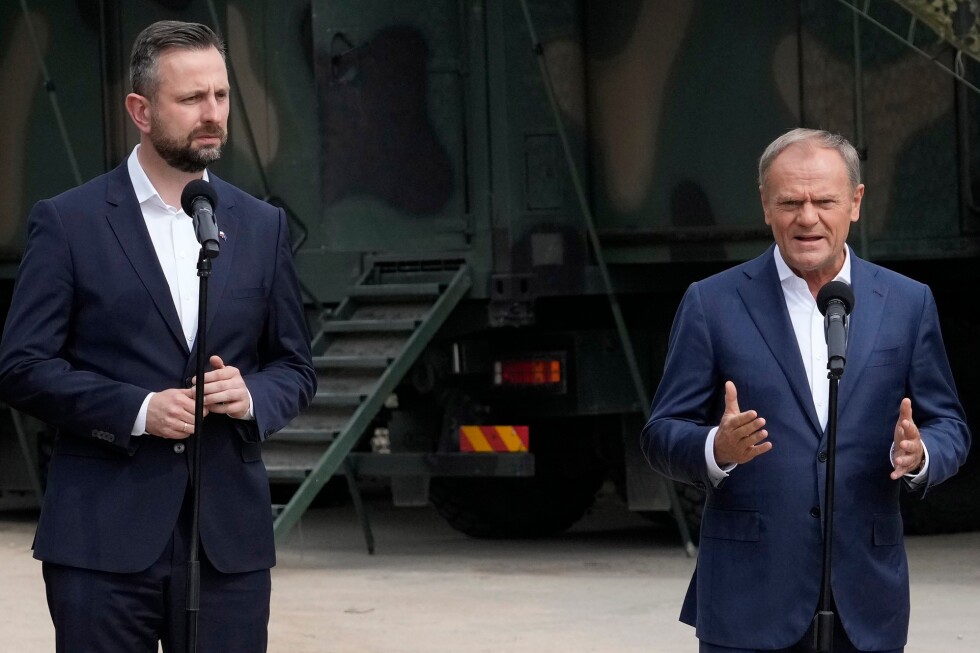
Top Polish leaders echoed the U.S.’s framing on Wednesday. Prime Minister Donald Tusk said he was pleased to receive “Washington’s declaration that Poland will be treated as it deserves.” Polish Defense Minister Władysław Kosiniak-Kamysz, who held a call with U.S. Defense Secretary Pete Hegseth Tuesday night, noted that the updated U.S. assurances confirm that the overall “U.S. presence is maintained” in Poland. He added that shifting rotational deployments into a permanent U.S. troop presence has long been a Polish priority, and such an outcome would be “always much better.”
Currently, around 10,000 U.S. troops are based in Poland, the vast majority of whom serve on rotational deployment cycles. Polish officials also confirmed that Warsaw will be included in all upcoming discussions about the ongoing restructuring of U.S. military forces across Europe. To date, U.S. officials have not publicly disclosed how long the deployment delay will last, and Kosiniak-Kamysz said he expects to receive additional clarification on the future U.S. troop footprint in the coming weeks.
Even as Warsaw accepts the temporary delay, Tusk warned that European nations cannot afford to ignore the clear signal from Washington that the U.S. intends to reduce its long-term military footprint on the continent, and that European states must increase their own defense commitments to fill the gap.
NATO Secretary-General Mark Rutte backed that assessment Wednesday, noting that alliance members have been aware for roughly a year of the Trump administration’s plan to withdraw some U.S. troops from Europe. Rutte said it is “rightly” expected that European nations and Canada will take on greater responsibility for conventional deterrence and defense across the NATO alliance, particularly in its European theater. While the U.S. “will stay involved” in transatlantic security, Rutte acknowledged that over time, Washington may reorient its military resources to other global hotspots.
The Trump administration has repeatedly warned European allies in recent months that they must take greater ownership of their own security, including the defense of Ukraine against Russian aggression. The planned drawdown of at least 5,000 U.S. troops from Germany followed public comments from German Chancellor Friedrich Merz, who claimed the U.S. had been “humiliated” by Iran’s leadership and criticized what he called a U.S. “lack of strategy in the war” in the Middle East.
Associated Press correspondent Lorne Cook contributed reporting from Brussels, Belgium.