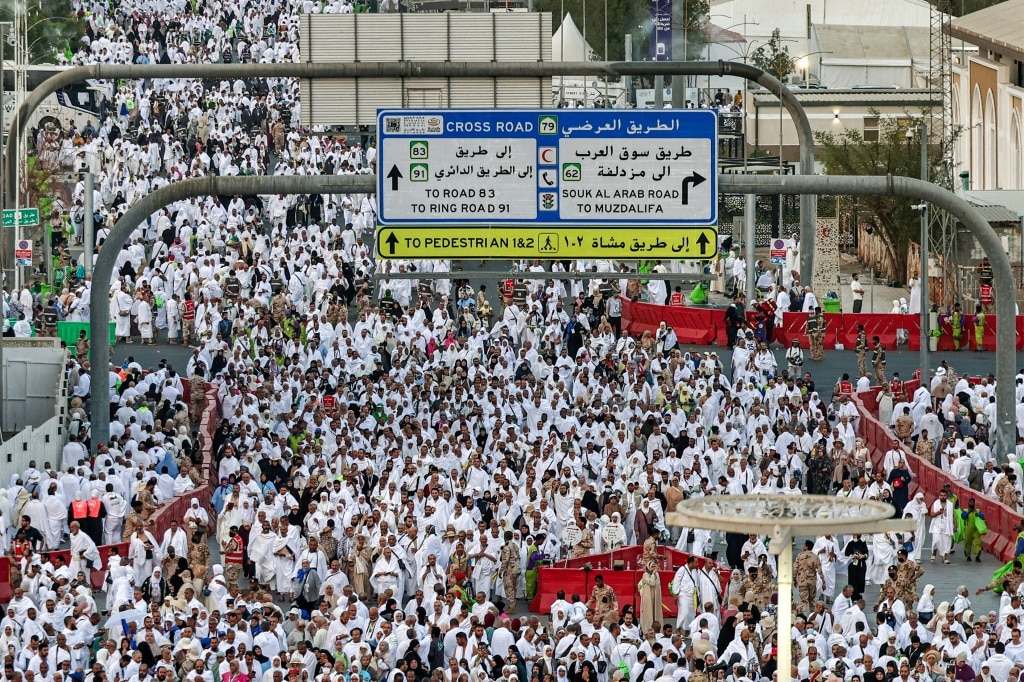
On Tuesday, millions of Muslim worshippers from across the globe gathered on Saudi Arabia’s Mount Arafat to mark the sacred climax of the annual hajj pilgrimage, turning the rocky desert hill near Mecca into a sea of faith as they fulfilled one of Islam’s most fundamental obligations, even as regional conflict and record-breaking heat created unprecedented challenges for organizers and pilgrims alike.
This year’s gathering drew more than 1.5 million total participants, a figure that reflects strong international turnout despite ongoing armed conflict in the Middle East sparked by recent US-Israeli strikes on Iran. In response to those attacks, Tehran launched retaliatory drone and ballistic missile strikes targeting key infrastructure and energy facilities across the Gulf region, including sites within Saudi Arabia, creating widespread uncertainty that impacted travel plans for many Iranian pilgrims. Official data shows just over 30,000 Iranians have completed the journey this year, equal to roughly one-third of the 86,000 pilgrims the country originally expected to send. Iran’s state-run IRNA news agency confirmed that the reduced numbers are a direct result of the ongoing wartime situation. Even amid this regional unrest, Saudi officials noted over the weekend that overall international participation this year still exceeds the total recorded in 2024.
From the first break of dawn, worshippers clad in the traditional seamless white ihram garments gathered on the 70-meter hill, which holds profound religious significance: it is the site where the Prophet Muhammad is believed to have delivered his final farewell sermon more than 1,400 years ago, outlining the core principles of the Islamic faith. Pilgrims recited verses from the Quran and offered personal prayers, enduring searing desert temperatures that reached as high as 44 degrees Celsius in Mecca over recent days. For many, the moment marked the fulfillment of a lifelong spiritual goal.
“It is an indescribable feeling,” shared Ahmed Abu al-Ezz, a 35-year-old Egyptian engineer making his first hajj journey as he approached the hill. “This is something I have dreamed of my entire life, and to be here now is beyond words.”
To support the massive crowd of pilgrims traveling to the site, volunteer teams distributed free bottled water, portable parasols, and pre-prepared food packages, while security and medical support helicopters regularly patrolled the airspace above the gathering to monitor conditions and respond to emergencies.
Hajj is one of the five central pillars of Islam, a religious obligation that every physically and financially able Muslim must complete at least once in their lifetime. This year’s gathering presented unique heat-related challenges, amplified by human-caused climate change, which scientists confirm is increasing the frequency and intensity of extreme heatwaves across the globe. Unlike female pilgrims, male worshippers are prohibited from wearing head coverings during hajj rituals, forcing many to rely on portable umbrellas to block the blistering midday sun.
Saudi authorities have implemented sweeping heat safety reforms since the 2024 hajj, when temperatures soaring above 50 degrees Celsius contributed to the deaths of more than 1,300 pilgrims. Upgrades for 2025 include expanded shaded walkways and gathering areas, as well as the deployment of thousands of additional trained medical personnel. The Saudi Ministry of Health confirmed it has mobilized more than 50,000 healthcare workers and 3,000 ambulances across the pilgrimage route to treat heat exhaustion and other medical emergencies.
Following the day of prayer on Mount Arafat, pilgrims will travel to the nearby plain of Muzdalifah to spend the night in open air, collecting small pebbles that will be used for the symbolic “stoning of the devil” ritual in the valley of Mina, which is scheduled to begin on Wednesday. The full sequence of hajj rituals typically takes five days or more to complete, tracing the exact path Prophet Muhammad took during his final pilgrimage in 632 CE.
For the Al Saud royal family, which rules Saudi Arabia and holds the ceremonial title of “Custodian of the Two Holy Mosques” (referring to the sacred sites in Mecca and Medina), successful organization of the annual hajj has long been a core source of domestic and international political legitimacy.