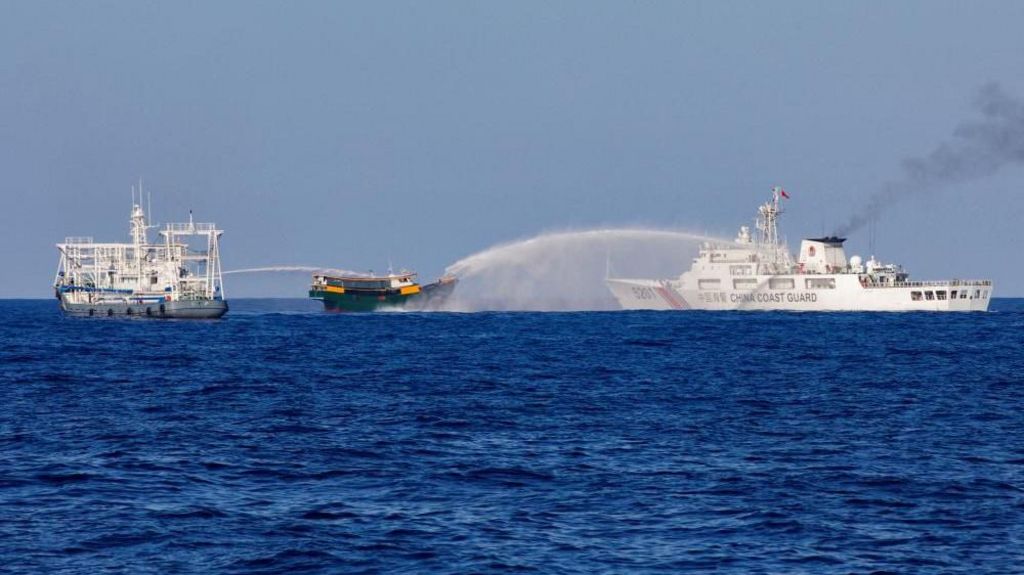
A decade after a landmark international arbitration ruling on South China Sea territorial claims, tensions between the Philippines and China have erupted into a new diplomatic row, sparked by an offensive AI-generated cartoon published by China’s state-run outlet China Daily. The controversial animation, posted to the outlet’s public Facebook page on July 10, depicts the Philippines as a cowering monkey wearing a national flag shirt, shoved onto a rickety boat-based karaoke stage by large arms emblazoned with the flags of the United States and Japan. After being berated for singing an incorrect tune, the monkey pulls out a sign referencing the 2016 South China Sea arbitration award before being thrown into the sea and struck by a water cannon — a deliberate reference to repeated encounters between Chinese and Philippine vessels in the disputed waters.
Manila’s leadership has roundly condemned the imagery, labeling it dehumanizing, racist, and unacceptable in civil diplomatic discourse. In an official statement, the Philippine Department of Foreign Affairs argued that political and legal disagreements between the two nations do not justify the use of derogatory, dehumanizing content that violates basic norms of state-to-state communication. The ministry demanded immediate removal of the video, warning that the offensive imagery and accompanying misinformation only deepen mutual distrust between the two neighbors. The Philippine defense ministry went further, describing the clip as contemptible propaganda that exposes what it called the moral and intellectual bankruptcy of China’s official propaganda apparatus. Defense Secretary Gilbert Teodoro, who was personally sanctioned with a travel ban by Beijing earlier this year, called the pattern of aggressive messaging impossible to ignore, referencing what he described as erratic behavior from Chinese authorities in recent months. As of press time, the video remains publicly accessible on China Daily’s Facebook page, and Chinese official bodies have not issued any response to Manila’s formal rebuke.
This latest incident comes amid a steady escalation of maritime frictions between Beijing and Manila over the past decade, rooted in overlapping territorial claims to two key contested features: the Spratly Islands and Scarborough Shoal, which China refers to as Huangyan Island. Geographically, Scarborough Shoal sits just 160 kilometers off the coast of the Philippines, more than 800 kilometers closer to Manila than to mainland China. In recent years, Chinese Coast Guard vessels have regularly deployed high-pressure water cannons against Philippine civilian and military vessels operating near the shoal, resulting in vessel damage and crew injuries. Just last June, tensions flared twice in quick succession: Beijing installed a floating barrier across the entrance to Scarborough Shoal’s lagoon, which was removed only after Manila filed a formal diplomatic protest, and later announced a travel ban barring Teodoro and his immediate family from entering mainland China, Hong Kong, and Macau.
The current row falls on the ten-year anniversary of the 2016 Permanent Court of Arbitration ruling at The Hague, which sided with Manila in a case brought by the Philippines, concluding that China’s sweeping nine-dash line claims across most of the South China Sea have no legal foundation under international law. Beijing has consistently rejected the ruling, refusing to recognize the tribunal’s jurisdiction over the territorial dispute. In the caption accompanying its controversial video, China Daily reiterated Beijing’s long-held position, framing the arbitration award as not a tool for peace but rather a deliberate pretext for confrontation framed as international law. The caption repeated Beijing’s narrative that the Philippine government is allowing itself to be used as a pawn in the geopolitical strategies of outside powers, specifically the US and Japan, by stirring up tensions in the disputed waterway.
The monkey cartoon is not an isolated incident: it is the latest in a series of satirical, mocking posts published by China Daily on its Facebook page in recent weeks targeting Philippine actions in the South China Sea. Previous posts in the series have depicted the Philippines as a clown and a snake, among other unflattering animal and character portrayals. This escalation in rhetorical and symbolic aggression comes as the Philippines has deepened its security cooperation with the United States and other regional allies in recent years, stepping up its own patrols and resistance to Chinese territorial assertions in the contested areas.