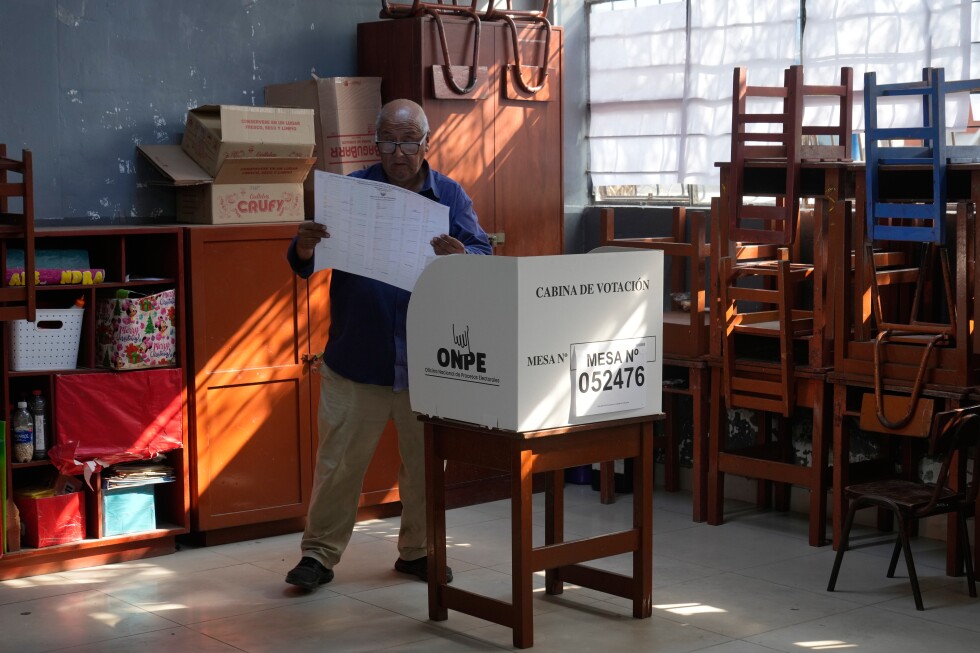
LIMA, Peru — Widespread logistical failures that blocked thousands of voters from casting ballots on Sunday have forced Peru’s electoral officials to extend voting into Monday, pushing the final outcome of the country’s highly contested presidential election past the original scheduled announcement date. The chaotic opening day of voting, which saw countless citizens both within Peru and overseas locked out of polling stations, left millions waiting in uncertainty as the nation navigates one of its most fragmented political moments in modern history.
Electoral authorities confirmed that just over 52,000 eligible voters will get a second chance to cast their ballots on Monday. This extension applies to voters registered in Lima, Peru’s densely populated capital, as well as two overseas polling locations: Orlando, Florida, and Paterson, New Jersey. Officials initially put the number of eligible voters for the extended voting period at 63,300 before revising the figure downward to correct an earlier miscount.
Peru enforces mandatory voting for all citizens between the ages of 18 and 70, with a fine of up to $32 imposed on those who fail to participate without a valid excuse.
Sunday’s vote caps a turbulent decade for Peruvian politics: 35 candidates are competing to claim the presidency, a role that has already changed hands eight times in 10 years. The crowded field includes a former cabinet minister, a popular comedian, and the heir to a well-established political dynasty, reflecting deep divisions within the country’s electorate.
The election is being held against a backdrop of soaring violent crime and persistent institutional corruption, which has spawned overwhelming public discontent. Most Peruvian voters already view the full slate of candidates as untrustworthy and ill-prepared to tackle the country’s most pressing crises. In response to widespread public anxiety over public safety, many candidates have put forward hardline policy proposals, including plans to construct massive new maximum-security megaprisons, restrict food access for incarcerated people, and reinstate the death penalty for severe criminal offenses.
For many ordinary voters, public safety remains the top priority, even as frustration with political brokenness runs deep. Heidy Justiniano, a 33-year-old nurse waiting in line to vote at a Lima public school, told reporters she had still not settled on a candidate by the time she reached the polling station. “There’s so much crime, so many robberies on every corner; a bus driver was killed just recently,” Justiniano said. “What matters most to us right now is safety, the lives of every person. Politicians don’t always keep their promises. This time, we have to choose our president wisely so that he can improve Peru.”
In total, more than 27 million Peruvians are registered to vote in the election, with roughly 1.2 million of those registered at overseas polling stations, primarily in the United States and Argentina.
Under Peruvian electoral law, a candidate must win an outright majority of more than 50% of the vote to claim the presidency without a runoff. Given the fragmented electorate and the unprecedented size of the candidate field — the largest in Peruvian history — political analysts almost universally predict that a second-round runoff election will be held in June.
In addition to selecting a new president, voters are also casting ballots to fill seats in a newly reconfigured bicameral Congress, a change mandated by recent legislative reforms. This marks the first time in more than three decades that Peruvians will directly elect members to a full two-chamber legislature, with the reforms concentrating substantial new governing power in the newly established upper chamber.