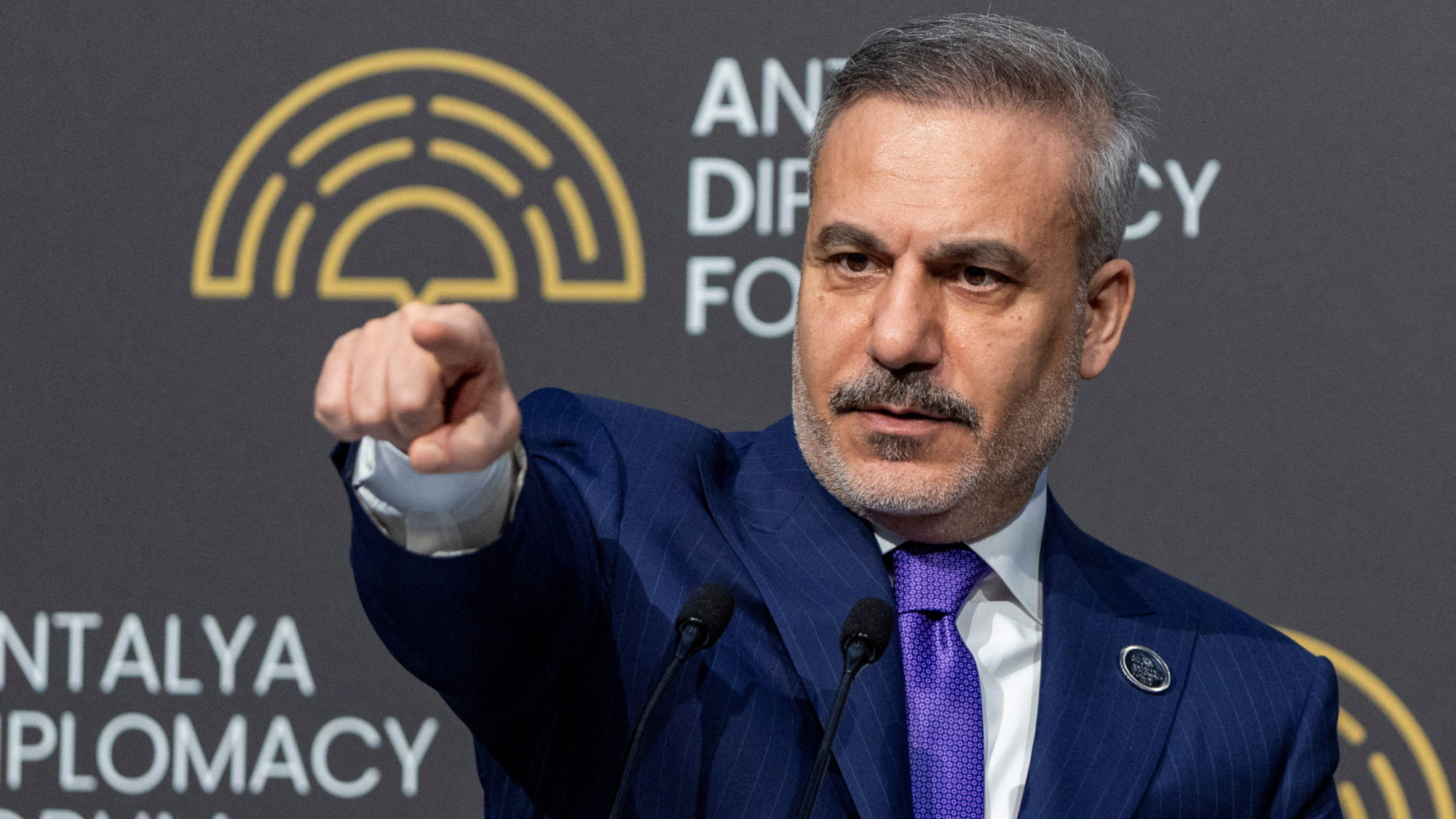
Speaking at this weekend’s Antalya Diplomacy Forum in southern Turkey, Foreign Minister Hakan Fidan has amplified longstanding Turkish concerns over the expanding trilateral military alliance between Israel, Greece, and Cyprus, warning that the bloc has sparked quiet unease among Muslim nations across the region.
Fidan pointedly noted that Greece, a longstanding member of the North Atlantic Treaty Organization, has moved forward with the partnership despite its NATO commitments, adding that Turkish officials have never received public or private assurances that the alliance was not structured to counter Turkish regional interests.
The top diplomat referenced a provocative 2023 comment made by Israeli Prime Minister Benjamin Netanyahu during a trilateral summit in Jerusalem. Standing alongside his Greek and Cypriot counterparts, Netanyahu issued a veiled jab at regional powers with imperial ambitions, saying: “To those who fantasise they can re-establish their empires and their dominion over our lands, I say: Forget it. It’s not going to happen. Don’t even think about it.” Fidan confirmed the comment was widely interpreted as a direct reference to Turkey.
The Israel-Greece-Cyprus alignment, first launched in the early 2010s, already includes formal security and defense cooperation, encompassing joint military exercises, cross-border intelligence sharing, and coordinated strategic planning in the Eastern Mediterranean. Just last week, Fidan drew sharp backlash from Athens when he claimed the alliance is designed to encircle Turkey from the south, warning that the bloc “brings more problems” and “leads to war.”
Greek officials immediately rejected the accusation, emphasizing that their cooperation with Israel and Cyprus is purely defensive in nature and not targeted at any third country. Repeating his position on Sunday, Fidan pushed back against Athens’ denials, arguing that the military dimension of the trilateral partnership is undeniable.
“Greece can say what it wants, but the picture is clear,” Fidan told attendees of the forum. “There is no other country in Europe that has taken this kind of step towards military cooperation and partnership.”
He added that Turkey’s concerns extend far beyond national security, noting that the alliance is a source of quiet anxiety for Muslim countries across the region, even if most have chosen not to voice their worries publicly. “Israel has been recently running an expansionist policy, and Turkey’s concerns aren’t unwarranted,” Fidan said.
In a bid to counter framing that Turkey is building a counter-bloc to the Israel-led alliance, Fidan clarified that recent regular dialogue mechanisms Turkey has established with Saudi Arabia, Egypt, and Pakistan to coordinate on regional issues are not equivalent to a military alliance, and are not directed against Israel. “We aren’t like Israel. They established a military alliance with Greece and Cyprus against the Muslim countries,” Fidan said. “We, unlike Israel, try to end the conflicts in the region, stabilise it.”
Internal tensions within the trilateral alliance have already come to light in recent months. A December 2023 report from Cypriot newspaper Politis revealed that Nicosia is uncomfortable being dragged into the growing standoff between Israel and Turkey, accusing Netanyahu of stoking tensions to score domestic political gains. A regional official familiar with internal negotiations confirmed to Middle East Eye at the time that Cyprus is uneasy with Israel’s aggressive approach, calling the prime minister’s rhetoric “the usual playbook with Israel: messaging to its domestic audience with lots of bluster and gusto, ignoring the hard facts and projecting its own narrative.”
The report also noted that selective leaks from Israeli sources claiming the three countries planned to form a joint military brigade — with 1,000 troops each from Israel and Greece, and 500 from Cyprus — had particularly agitated Cypriot officials. Both Cypriot Defense Minister Vasilis Palmas and a senior Greek official denied any plans for a joint brigade in separate comments to Middle East Eye in December and early 2024 respectively.