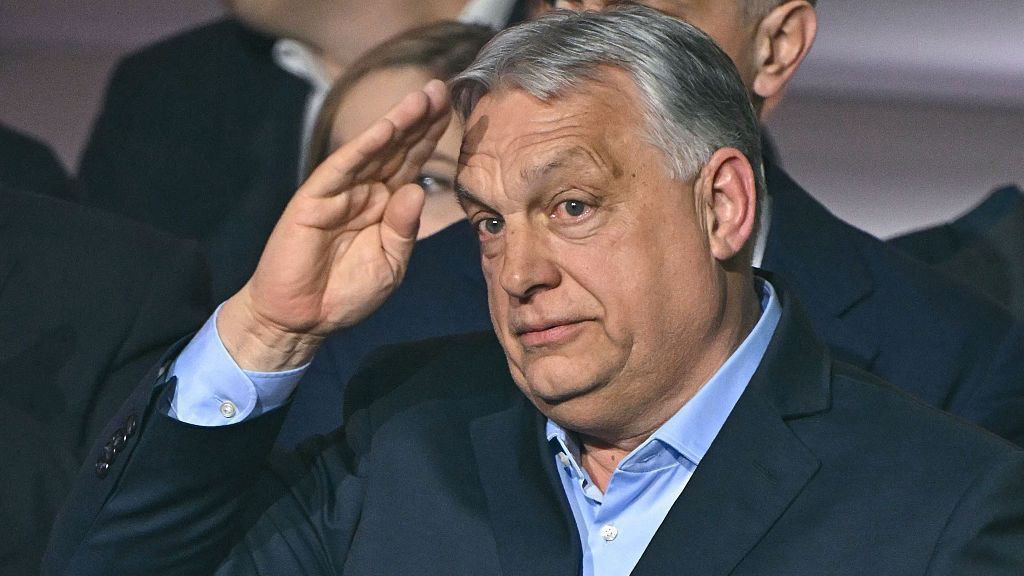
For 16 years, Hungarian Prime Minister Viktor Orbán governed the Central European nation through a unique, constantly shifting political experiment that even he struggled to name. The label “illiberal democracy,” often attached to his leadership, carried harshly negative connotations he rejected, while the term preferred by his right-wing American allies—“national conservatism”—never accurately fit his ideological profile. Unlike most traditional conservatives who seek to preserve established systems, Orbán built his power on constant radicalization, leaving little existing institutional order to conserve.
A defining feature of his tenure was theatrical defiance of European Union leadership in Brussels, where he positioned himself as a rogue outsider thumbing his nose at mainstream European politics. Every time Brussels pushed back against his policies, Orbán turned the backlash into political capital, framing himself as the sole defender of Hungarian national interests against overreaching foreign bureaucrats.
His leadership was marked by stark contradictions that went largely unchallenged for decades. He painted himself as a fierce opponent of globalization, yet actively courted German automakers and Chinese and South Korean electric vehicle battery manufacturers to set up large-scale operations in Hungary. He positioned himself as the ultimate champion of national sovereignty, but refused to condemn Russian aggression or stand up for Ukraine’s territorial integrity amid the ongoing war with Moscow. He railed against mass immigration from the Middle East and Africa to win political support, while quietly encouraging labor migration from Sri Lanka, the Philippines, Ukraine and Turkey to staff the new foreign-owned factories he attracted to the country. Even his signature pro-natal policy, which poured billions in public funds into encouraging Hungarian families to have more children, failed to deliver its core promise: by 2025, Hungary’s fertility rate had dropped back to 1.31, the exact same figure he inherited from the socialist government he ousted in 2010.
After winning a two-thirds parliamentary supermajority in 2010, Orbán moved swiftly to reshape Hungary’s entire institutional framework to lock in his power. Just one year into his first term, he rammed through a new constitution aligned with his political agenda, then used his parliamentary majority to rewrite laws governing the judiciary, electoral system, and national economy, remaking the country in the image of his ruling party.
But on a historic Sunday election, Hungarian voters delivered a decisive rejection of Orbán’s long-running experiment. The opposition candidate, Péter Magyar, won a landslide victory, ending the ruling party’s 16-year hold on power. Orbán swiftly conceded defeat Sunday night, a move widely seen as a calculated effort to preserve his public legacy after more than a decade in power.
Magyar’s victory stemmed from a clear rejection of Orbán’s polarizing approach to governance. He campaigned on an inclusive vision of national identity that contrasted sharply with Orbán’s divisive, exclusionary rhetoric, carrying the Hungarian flag to every campaign rally to connect with broad voter dissatisfaction. Most importantly, analysts say, Hungarian voters had grown exhausted by the constant state of conflict Orbán relied on to maintain power. Voters also expressed widespread anger at growing economic inequality under Orbán: the country’s wealthy elite amassed unprecedented fortunes, while poverty deepened and the middle class shrank dramatically.
Orbán won nearly every political battle he fought over his 16 years in office, but his people ultimately wanted peace, stability, and the normalcy of a functional European democracy, rather than constant confrontation. That is exactly what Magyar has promised to deliver. Addressing thousands of jubilant supporters celebrating on the banks of the Danube after his win, Magyar declared: “Tonight we celebrate. But tomorrow, we start work.”