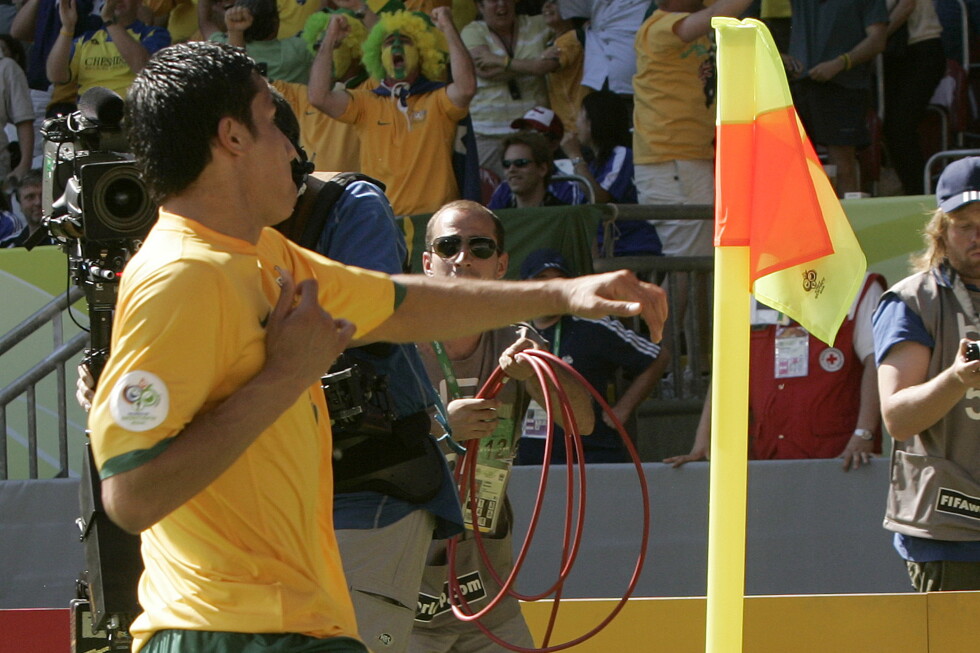
Two decades have passed since Tim Cahill etched one of the most recognizable celebrations in Australian soccer history into global memory. During the opening match of the 2006 FIFA World Cup against Japan, Cahill scored a dramatic late equalizer to turn the tide of the game, which ultimately ended in a 3-1 Australian victory. Immediately after the ball hit the back of the net, the forward sprinted to the corner of the pitch and launched into a playful shadow boxing routine against the corner flag. What began as an impulsive moment of joy has grown into a beloved generational tradition for Australian soccer at the World Cup.
Months after Cahill hung up his boots in 2019, another Australian star carried the tradition onto one of the sport’s biggest stages. At the 2019 Women’s World Cup in France, during a critical group stage match against Italy, Sam Kerr — then a rising talent making her mark on international soccer — recreated Cahill’s iconic shadow boxing routine to celebrate one of her goals. The moment paid homage to Cahill’s legacy while signaling the continuity of the tradition across Australia’s men’s and women’s national programs.
Kerr would go on to rewrite the Australian soccer record books: in 2022, she surpassed Cahill to become the country’s all-time leading international goalscorer, and she led the national women’s side, the Matildas, to a historic semifinal finish at the 2023 Women’s World Cup co-hosted by Australia and New Zealand. Now, the tradition has passed to a new generation of Australian talent, with 20-year-old Nestory Irankunda adding his own name to the lineage.
On Saturday night, Irankunda made history for Australia’s men’s national team, the Socceroos, during their 2-0 upset win over Turkey. The young winger became the youngest goalscorer in Australian World Cup history, and he marked the milestone by paying direct tribute to the man who inspired his soccer journey from childhood. Just like Cahill 20 years earlier, Irankunda sprinted straight to the nearest corner flag after his goal, throwing a rapid series of punches in a perfect recreation of the iconic celebration that first made the routine famous.
Unlike his predecessors, Irankunda has already cultivated his own unique set of trademark goal celebrations, from acrobatic backflips to playful Michael Jackson-inspired dance moves that have become a defining part of his on-pitch persona. Even so, the young star made clear that Cahill has been the biggest influence on his career to date.
“Tim Cahill was my biggest inspiration in Australian football, and I look up to him,” Irankunda told reporters after the match when asked about his decision to replicate the celebration. “I look up to him and I want to be like him one day and I’m really really proud of myself to get the goal.”
Like many young Australian soccer talents, Irankunda launched his professional career domestically, spending three seasons competing in the A-League with Adelaide United before earning a move to European soccer. In 2025, he completed a permanent transfer to English Championship club Watford, where he is continuing to develop his game ahead of future international and club competitions.