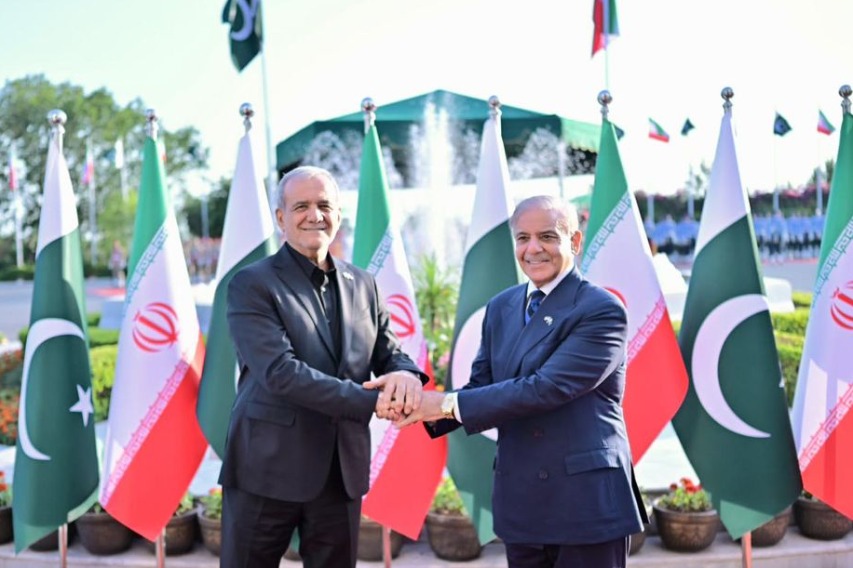
ISLAMABAD, June 24 — During a joint press appearance with visiting Iranian President Masoud Pezeshkian on Tuesday, Pakistani Prime Minister Shehbaz Sharif issued key clarifications on the recently signed US-Iran Islamabad Memorandum of Understanding, confirming the framework does not address Iran’s ballistic missile program and that the topic was never part of negotiation discussions.
Sharif urged stakeholders and global observers to avoid misinterpreting the purpose of the MoU, emphasizing that the entire agreement is crafted exclusively to advance cross-region peace and stability, with no clauses or provisions related to ballistic missile development or proliferation. He opened the press briefing by extending a warm welcome to Pezeshkian, reaffirming Pakistan’s long-standing commitment to deepening collaborative ties between the two nations across key sectors including cross-border trade, economic growth, large-scale infrastructure projects, post-conflict reconstruction, and collective regional security initiatives.
“Pakistan and Iran share far more than a common border—we are brotherly nations connected by hundreds of years of intertwined history, shared faith, overlapping cultural traditions, and deep civilizational bonds,” Sharif stated. “Iran’s success is our success, just as Iran’s challenges are our challenges,” he added, underscoring the close bilateral relationship between the two neighboring states.
The prime minister went on to thank Iranian leadership for placing confidence in Pakistan’s role as an honest and impartial mediator. He noted that the signing of the Islamabad MoU has resolved a high-stakes standoff that carried the potential to spill over and destabilize the broader Middle East region, paving the way for the first round of technical-level talks held recently in Burgenstock, Switzerland.
Sharif also offered sincere condolences to all those who lost lives during the preceding US-Iran conflict, and commended Pezeshkian’s deft leadership throughout the diplomatic process. Beyond acknowledging Iran’s cooperation, he extended gratitude to Qatar, Saudi Arabia, Turkiye, and Egypt for their ongoing support of the regional peace process, and also recognized the critical contributions of Pakistan’s own military and diplomatic leadership to reaching the landmark agreement.