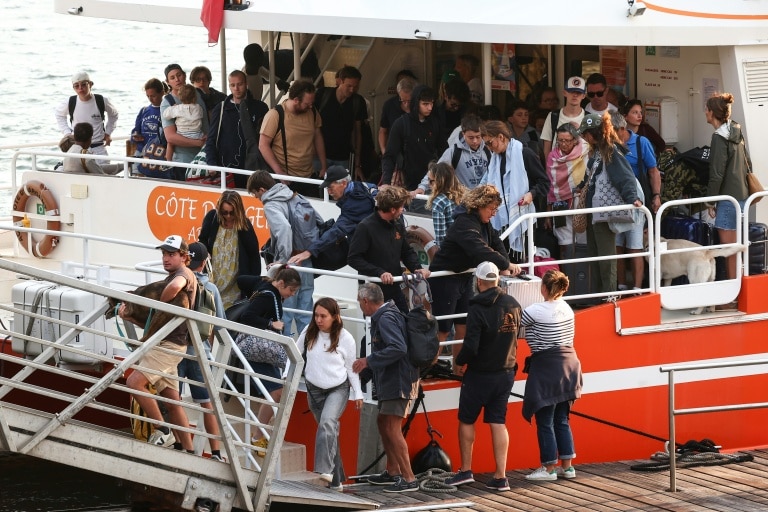
A rapidly spreading wildfire forced the complete evacuation of France’s Cap Ferret peninsula on Friday, with more than 400 residents and vacationers escaping the blaze via a fleet of civilian and official boats. The evacuation order came as the inferno, burning just kilometers from one of France’s most famous Bordeaux wine regions, expanded to cover more than 8,000 hectares — an area roughly one and a half times the size of Manhattan. The Cap Ferret wildfire is not an isolated disaster: it is one of multiple active blazes burning across the country amid the peak summer vacation season, which has drawn thousands of tourists to the southwestern Atlantic coast. In response to the spreading flames, authorities have already ordered thousands more visitors to evacuate coastal campsites and seasonal holiday homes, as hundreds of firefighters backed by water-bombing aircraft work around the clock to contain the fire lines. As the crisis escalates beyond the capacity of national response resources, French President Emmanuel Macron announced that Paris has activated the European Union’s civil protection mechanism to request additional firefighting support from neighboring member states. Macron warned that the wildfire situation across the country remains “very intense”, with little sign of relief in the coming days. Data from the European Forest Fire Information System (EFFIS) confirms that 2024 is already shaping up to be one of the worst years for wildfire activity on the continent: the total area of burned vegetation across EU countries is already the second largest recorded since systematic satellite tracking began. The unfolding disaster comes as southern Europe continues to face record-breaking summer heat waves and drought conditions, which have created tinder-dry conditions across forests and shrublands, increasing the risk of uncontrolled wildfire spread.
博客
-

WAFCON favourites Nigeria eye World Cup slot and record prize money
The 2026 Women’s Africa Cup of Nations (WAFCON), the continent’s flagship biennial women’s football tournament, is set to kick off this Sunday in Morocco, with two major high-stakes rewards on offer for competing teams: direct qualification to the upcoming 2026 FIFA Women’s World Cup and a record-breaking $2 million first-place prize purse.
This year’s edition marks a historic expansion of the tournament, growing from 12 participating nations at the previous tournament to 16 teams, all vying for continental glory. As 10-time WAFCON champions and the defending title holders, Nigeria’s Super Falcons enter the competition as the clear pre-tournament favorites, carrying the momentum of a dramatic 2022 final victory that saw them come back from a two-goal half-time deficit to beat host nation Morocco 3-2 with a late winning goal from midfielder Jennifer Echegini.
Echegini, who plies her trade at Paris Saint-Germain, returns to the squad this year alongside the other two goal scorers from that iconic final: Canada-based forward Esther Okoronkwo and Chinese Super League attacker Folashade Ijamilusi, all hungry to add another continental title to their resumes. For the Super Falcons, the roadmap to success starts with securing one of four automatic World Cup qualification spots reserved for African semi-finalists, according to head coach Justine Madugu.
“Our first priority is reaching the semi-finals and clinching one of four World Cup places automatically reserved for Africa,” Madugu told reporters ahead of the tournament opener. “Our second goal is to defend the trophy and bring it back to Nigeria. We know it will not be easy because every other nation wants to depose us. We have in our possession something precious that everybody else wants. However, we will remain resolute and focused and try to achieve both objectives.”
Madugu has assembled a 25-player roster that blends veteran experience with emerging young talent, drawn from clubs across the globe ranging from Mexico and Israel to China. The squad includes just one home-based player, goalkeeper Fatima Oloko of Abia Angels, while the Super Falcons will be captained by Rasheedat Ajibade, Echegini’s PSG teammate. The team also boasts Chiamaka Nnadozie, the Brighton & Hove Albion shot-stopper widely recognized as the top women’s goalkeeper on the continent. One notable absence from the 2022 winning squad is defender Ashleigh Plumptre, the England-born Al-Ittihad player who has been ruled out of the tournament with an injury.
Drawn into Group C, Nigeria will face a challenging opening round that includes strong contender Zambia, disciplined Egypt, and first-time WAFCON participants Malawi. Zambia boasts two of the most dangerous attacking players in African women’s football: Racheal Kundananji, who made headlines in 2024 when she transferred from Madrid CFF to America’s Bay FC for a then-world record transfer fee, and consistent goal scorer Barbra Banda. While Malawi enter the tournament as underdogs, they field a formidable attacking pair in the Chawinga sisters: Tabitha of Lyon and Temwa of Kansas City Current.
Across the four groups, the tournament features a mix of continental powerhouse and rising contenders. In the 13 editions of WAFCON held since 1991, only two other nations have lifted the trophy besides Nigeria: Equatorial Guinea, which won twice, and South Africa, which claimed the 2022 title. Equatorial Guinea failed to qualify for this year’s tournament, while South Africa enters as the top seed in Group B, where they will face Tanzania, Ivory Coast and Burkina Faso.
Host nation Morocco, which finished as runner-up in both of the past two WAFCON tournaments it hosted, will kick off Group A play against Algeria, Senegal and Kenya. The July 30 matchup between Morocco and Algeria is already expected to be a tense affair, carried by the long-standing strained political relations between the North African neighbors, rooted in the disputed phosphate-rich Western Sahara territory and historical border disagreements.
Group D is rounded out by 2022 bronze medalists Ghana, three-time tournament runners-up Cameroon, and first-time qualifiers Cape Verde, who will look to replicate the incredible success of their men’s national team at the 2024 FIFA World Cup.
A total of 34 matches will be hosted across five stadiums, with three venues in the capital city of Rabat and two in Morocco’s commercial hub Casablanca. The tournament also includes two classification matches between quarter-final losers, which will decide which African team earns a spot in the inter-continental World Cup play-offs.
-

Christian Brothers makes new sexual abuse payout proposals after pause bid
In a dramatic policy reversal that has ended weeks of crippling uncertainty for hundreds of historical child sexual abuse survivors, trustees of the Christian Brothers have announced a landmark new compensation plan that shifts responsibility for all current and future payouts to the organization’s private school network, Edmund Rice Education Australia (EREA).
The reversal comes just weeks after the Christian Brothers triggered widespread outrage and anxiety when it requested a moratorium on all compensation payments to survivors, claiming the organization faced imminent financial insolvency that left it unable to meet outstanding abuse claims. That decision left survivors who had already won settlements or were waiting for judgements in limbo, with no guarantee they would receive the redress they had been awarded.
Under the new proposal submitted to the Supreme Court, EREA – which manages more than 40 Catholic schools across Australia, serving a student population of over 44,000 – will take on full legal and financial liability for all existing abuse claims, all future legal proceedings, and all claims submitted through the federal National Redress Scheme. In a formal statement released Friday, Christian Brothers trustees confirmed that the two organizations had signed a binding memorandum of understanding designed to deliver a final resolution for all creditors, including abuse survivors.
“This means that not only will current claimants with settlements or judgments be paid in full, but EREA will assume responsibility and liability for all current and future legal proceedings as well as for claims before the National Redress Scheme,” the statement read.
EREA board chair Stephen Brown emphasized that the organization views the decision as both a moral obligation and a commitment to the long-term stability of its educational mission. “By supporting a revised scheme of arrangement we are committed to supporting those who have suffered abuse,” Brown said. “This decision will also support the long-term sustainability of the educational ministry, including more than 44,000 students entrusted to EREA’s stewardship. EREA is committed to supporting those who have suffered abuse, so today we are seeking to provide reassurance that we will step in to address future funding shortfalls.”
The new arrangement has been broadly welcomed by Australia’s Albanese Labor Government, which harshly criticized the original pause on payments for the unnecessary distress it caused survivors. Social Services Minister Tanya Plibersek noted that the weeks of uncertainty between the Christian Brothers’ original announcement and the new plan have been an unneeded burden for people who already carried profound trauma from their abuse.
“The past few weeks of uncertainty have been difficult for victim survivors of abuse in institutions run by the Christian Brothers,” Plibersek said. “They should never have been put in the position of wondering whether their claims would be met. No level of compensation can undo the profound harm experienced by victim survivors of child sexual abuse. But we know that redress – including counselling, apologies and financial compensation – can play an important role in helping survivors feel heard, believed and supported.”
-

Socceroos star allegedly tests positive for cocaine after speeding
A rising star of Australia’s men’s national soccer team, the Socceroos, finds himself at the center of a drug and driving scandal following two high-speed traffic stops in central Sydney that ended with an alleged positive cocaine test. Twenty-two-year-old midfielder Cristian Volpato, who recently switched his international football allegiance from Italy to Australia ahead of the latest World Cup, was first pulled over by New South Wales Police on the Anzac Bridge just after 11 p.m. local time this past Thursday.
Law enforcement officials confirmed that Volpato was driving a BMW Coupe through a 60km/h zone at speeds between 86 and 94km/h when he was stopped. A standard roadside breath alcohol test came back negative for the 22-year-old, but officers let him go only to pull him over again less than two hours later in the same speed-restricted zone. This second stop found Volpato allegedly speeding at 109km/h, and a follow-up oral fluid test returned a positive result for the presence of cocaine.
In immediate sanctions issued following the second stop, New South Wales Police issued Volpato a formal speeding infringement notice and suspended his international driver’s license for a six-month period, barring him from operating any vehicle within the state for the duration of the ban. Authorities confirmed they have sent a second oral fluid sample for independent laboratory testing, and that the investigation into the incident remains open as they await the confirmatory test results.
Volpato’s career has made rapid progress in recent years: he came up through Italy’s youth international setup, only committing to represent Australia’s senior national team in May, just weeks before the Socceroos finalized their World Cup squad. He went on to feature in three of Australia’s four matches at the tournament, where the team advanced to the round of 32 before being eliminated by Egypt in a penalty shootout. At club level, Volpato has been a regular fixture for Italy’s top-flight Serie A side Sassuolo since joining the club in 2023. He notched 24 league appearances for the club during the 2024-2025 season, helping the team finish 11th in the league table.
As of the publication of this report, BBC Sport has reached out to both Football Australia, the governing body for soccer in the country, and Sassuolo’s club management to request comment on the allegations against Volpato. Neither organization has issued a public response at this time.
-
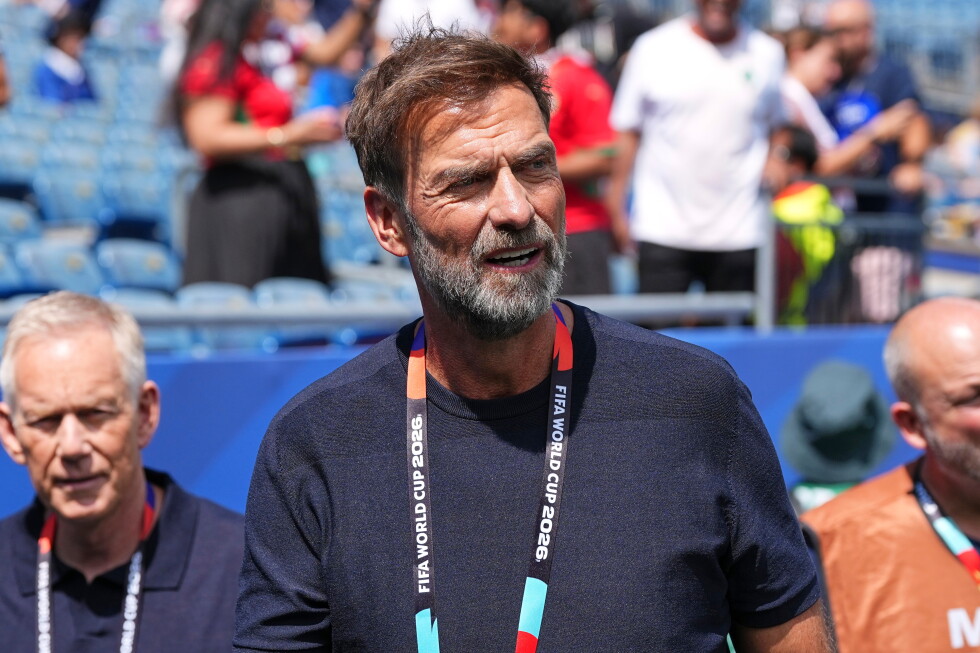
Jürgen Klopp expected to be named new Germany coach after World Cup failure
FRANKFURT, Germany — Top-tier German soccer is on the cusp of a major leadership shift, with iconic former Liverpool manager Jürgen Klopp widely anticipated to be confirmed as the new head coach of Germany’s men’s national team this Friday. The appointment comes as the country’s football federation rushes to rebuild national pride after a third consecutive underwhelming World Cup campaign.
The German Football Association (DFB) is scheduled to host an official press conference Friday morning to formalize the three-and-a-half-year deal, which marks Klopp’s return to top-level coaching more than two years after stepping away from Liverpool at the end of the 2023-24 Premier League season. Multiple German media outlets have confirmed the contract will run through the 2028 UEFA European Championship, hosted in the United Kingdom and Ireland, and extend all the way to the 2030 FIFA World Cup co-hosted by Morocco, Portugal, and Spain.
Klopp has been the DFB’s undisputed top target for the role ever since former coach Julian Nagelsmann stepped down in late June, just days after Germany suffered a shocking early World Cup exit. Nagelsmann’s side crashed out of the tournament in the round of 32, losing on penalties to underdog Paraguay — a result that extended Germany’s decades-long drought in World Cup knockout football. Remarkably, the four-time world champions have not won a single knockout match at any men’s World Cup since lifting the trophy on home soil in 2014, a statistic that has sparked widespread criticism of the national program across Germany.
Negotiations between Klopp and DFB officials first began during the 2026 World Cup, when Klopp was working as a television pundit for international broadcasters based in New York. By July 11, the federation confirmed that the two sides had reached a preliminary agreement on all “essential key points” of the contract, clearing the way for final negotiations that were concluded earlier this week.
When Klopp departed Anfield in 2024, he cited chronic fatigue from the relentless schedule of top-flight club football as his primary reason for stepping back, ending his iconic nine-year tenure at Liverpool that brought the club a Premier League title, a Champions League trophy, and multiple domestic cup honors. In the two years since leaving Liverpool, Klopp has served as global head of soccer for the Red Bull sports conglomerate, overseeing the development of the company’s network of elite clubs across Europe, North America, and Africa. In public comments earlier this month, the 59-year-old coach confirmed he had completed his period of rest, telling reporters he now feels “fully recharged” and eager to take on the challenge of leading a national team.
For German soccer, the appointment of Klopp — one of the most popular and successful coaches of his generation — is widely seen as a fresh start for a program that has struggled to replicate its historic success in recent major tournaments. Klopp’s proven track record of building cohesive, high-performing teams and his widespread public appeal have left many German fans hopeful he can end the country’s long run of World Cup disappointment and return the national side to contender status at the highest level of the sport.
-
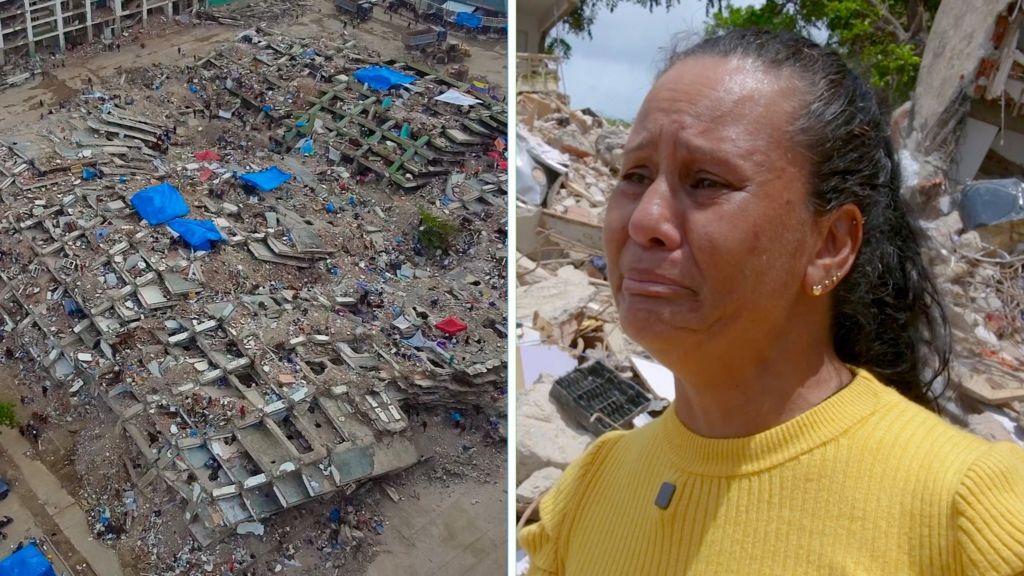
Families still search for bodies a month after Venezuela earthquakes
Four weeks after catastrophic earthquakes ripped through communities across Venezuela, heartbroken families are still combing through rubble and collapsed structures in a desperate bid to recover the remains of their missing loved ones, as official death tolls continue to climb and grim projections place the number of unaccounted-for people far higher.
Venezuelan government officials have confirmed that the confirmed death toll from the series of powerful quakes has now crossed the 5,300 mark, a devastating milestone that underscores the extreme destruction the seismic events left in their wake. Even more alarming, independent and preliminary estimates from on-the-ground response teams suggest that as many as 50,000 people remain unaccounted for, leaving thousands of households stuck in agonizing limbo with no closure about the fates of their family members.
The weeks following the earthquakes have stretched into a grueling waiting game for many relatives, who have grown frustrated with the pace of recovery and search operations. Many have taken on the dangerous work of searching through unstable debris themselves, unwilling to wait for overstretched official rescue teams to reach their neighborhoods. As the one-month mark passes, the tragedy continues to unfold across the country, with communities grappling with both the human cost of the disaster and the long work of rebuilding that lies ahead.
-

New twist in star-studded defamation suit between Rebel Wilson and Charlotte MacInnes
One of Australia’s most closely watched entertainment industry legal disputes is set to drag on after the losing party in a high-profile defamation case confirmed plans to challenge the recent ruling. The lawsuit pits A-list Hollywood actor Rebel Wilson, best known for her role in the *Pitch Perfect* franchise, against actor Charlotte MacInnes, who landed the lead role in Wilson’s directorial debut project *The Deb*. The dispute stems from an Instagram post Wilson shared that made claims about an incident between MacInnes and *The Deb* producer Amanda Ghost. In the post, Wilson alleged that MacInnes had complained about feeling uncomfortable during a shared bath with Ghost while both were wearing swimwear, only to backtrack on those concerns to advance her career prospects. MacInnes has repeatedly denied ever feeling uncomfortable or making any such complaint about the encounter, and subsequently launched defamation proceedings against Wilson in Australia’s Federal Court. After weeks of testimony and legal argument, Justice Raper delivered her ruling earlier this week, finding that Wilson had not defamed MacInnes in her social media comments. In her judgment, Justice Raper noted that descriptions of the incident as “unusual” or “bizarre” were more than fair, pointing out significant inconsistencies between the accounts provided by MacInnes and Ghost. Raper also highlighted that MacInnes had materially altered her version of events multiple times in the lead-up to the trial, concluding that both MacInnes and Ghost gave unreliable testimony. The judge ultimately ruled that Wilson had successfully proved her comments were substantially true, allowing Wilson’s full defense to the defamation claim. Immediately following the verdict, Wilson took to Instagram to share her reaction with followers, thanking her supporters, family, and the Australian judicial system for the outcome. She reflected on the stress of the legal process, writing that while the experience had been personally challenging, it had strengthened her commitment to standing up for what she believes in while continuing to create work that entertains audiences. Just days after the ruling was handed down, however, legal representatives for MacInnes confirmed they would not accept the outcome, confirming their client intends to file an appeal against Justice Raper’s decision. The announcement means the bitter public dispute between the two entertainment industry figures, which has gripped public attention across Australia and drawn interest from Hollywood circles, will remain unresolved for the foreseeable future as the appeal process moves forward.
-

Two Chinese win world’s top Maths prize for solving century’s-old problems
For the first time in the award’s storied history, two Chinese-born mathematicians have claimed the prestigious Fields Medal, widely recognized as the highest honor in the global mathematical community, marking a watershed moment for China’s decades-long push to advance excellence in mathematical research.
Hong Wang, 35, a researcher with academic positions in the United States and France, and Yu Deng, 37, a professor at the University of Chicago, accepted the award alongside two other recipients: John Pardon of the U.S. and Jacon Tsimerman of Canada, during the official awarding ceremony held in the U.S. on Thursday. Each of the four honorees received a prize purse of 15,000 Canadian dollars, equivalent to roughly $10,500 USD.
What makes this year’s wins all the more notable is that both Wang and Deng were recognized for solving open mathematical problems that have stumped leading minds in the field for more than a century. For Wang, the honor carries an extra layer of significance: she is only the third woman ever to receive a Fields Medal, since the award was first established in 1936.
Wang earned her prize for co-solving the century-old Kakeya conjecture, a problem first posed by Japanese mathematician Soichi Kakeya in 1917. The question explores what the minimum possible area is that a line segment — analogized to a rotating pencil — covers when it is rotated through a full 360-degree turn. Working with colleague Josh Zahl, Wang expanded the analysis from the traditional two-dimensional flat plane to three-dimensional space, finally resolving the long-standing open question when the pair published their definitive proof last year.
Wang explained to AFP the enduring appeal of the conjecture, noting that its core concepts naturally appear across a wide range of unrelated mathematical fields, which is why it has remained a central focus of research for more than 100 years. Wang’s research focuses on harmonic analysis, a branch of mathematics centered on the study of wave behavior and signal transformations.
For Deng, the honor came for his breakthrough resolution of Hilbert’s Sixth Problem, another open question first introduced by legendary German mathematician David Hilbert in 1928 as part of his famous list of 23 unsolved mathematical problems. The problem asks how it is possible to derive the collective behavior of a large system from the individual movement of its component particles. Deng approached the problem by modeling and analyzing the behavior of gas particles, producing the first complete solution to the century-old question.
In a statement following the award announcement, Deng called the honor “a really great honor to have my name listed after all those great mathematicians I’ve always been admiring.”
The 2026 award ceremony comes at a time of growing debate over the role of artificial intelligence in advancing mathematical research, as machine learning tools increasingly challenge traditional human-led computation and proof-building. Still, the historic wins for the two Chinese mathematicians have already sparked widespread celebration across China.
On Chinese social media platforms including Weibo and Rednote, hashtags related to the achievement, including “Fields Medal” and “First Chinese mathematicians to win Fields Medals,” racked up millions of views within hours of the announcement, with thousands of public comments pouring in from users expressing national pride. “Pride of all Chinese people,” one widely liked Weibo comment read. Another simply noted, “We are witnessing history.”
Mainstream Chinese media outlets have also dedicated extensive coverage to the two new medalists, publishing deep dives that cover everything from their early educational trajectories and personal research interests to the broader significance of their wins for China’s mathematical community. Shing-Tung Yau, the first ethnic Chinese mathematician to ever receive a Fields Medal, called the achievement a decades-long dream come true for the Chinese mathematics field.
The Fields Medal is awarded only once every four years, and it is restricted exclusively to outstanding mathematicians under the age of 40, a requirement that has kept the award’s prestige high across the global academic community.
-
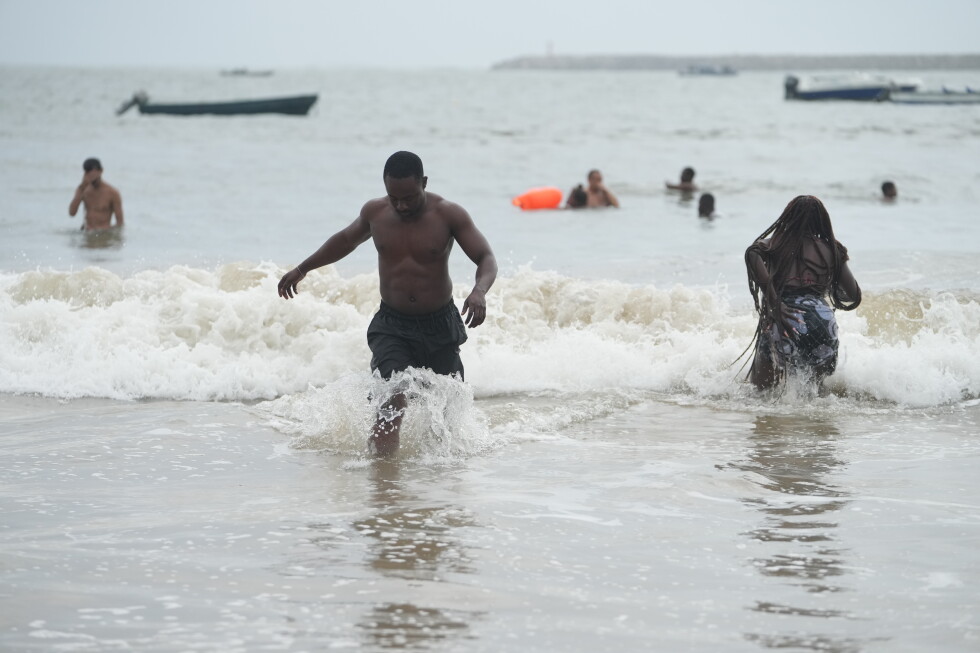
A beach break in Nigeria’s Lagos is becoming too expensive for many
For millions of residents across Nigeria’s bustling commercial capital Lagos, the Atlantic shoreline has long served as one of the only accessible escapes from the city’s relentless chaos, sweltering equatorial heat and year-round 80% average humidity. But a sweeping government-backed push to privatize most of the region’s 180-kilometer coastline has transformed this once-free public amenity into a luxury out of reach for low- and middle-income communities.
Mukthar Oladunmade, a 27-year-old writer who has made weekend beach trips a lifelong ritual, says the transformation has turned a beloved pastime into an unaffordable burden in Lagos alone. Even after traveling across West Africa for work and enjoying low-cost or free beach access in Accra, Cotonou and Dakar, Oladunmade told reporters he spends an average of 25,000 naira ($18) every time he visits a Lagos beach — a sum that far outstrips the budget of most local residents.
Takwa Bay, one of the last remaining stretches of shoreline not under private control, is where Oladunmade now travels to enjoy the ocean. For context, Nigeria’s federal minimum wage sits at just 77,000 naira ($56) per month, and more than 60% of Lagos’ 20 million residents work in the informal sector with irregular, low incomes. Entry fees alone now range from 2,000 naira ($1.50) to 60,000 naira ($44) across privatized beaches, with additional costs for seating, food, drinks and recreational activities adding hundreds of additional naira to each visit.
The privatization trend comes as part of the Lagos state government’s long-running “megacity” initiative, which aims to position the metropolis as a leading global destination for international business and luxury tourism. The strategy has delivered clear financial gains: the state’s internal revenue hit 2.6 trillion naira ($1.9 billion) in 2025, marking a 16% year-over-year increase that outpaces every other Nigerian state. To expand the initiative, the government has also reclaimed coastal land for exclusive private developments including a new deep-sea port and the high-end Eko Atlantic residential neighborhood, with more luxury projects planned for the coming years.
But critics argue these economic gains are coming at the steep cost of inclusive public access, pricing out generations of residents who have relied on beaches as their primary source of affordable recreation. “The approach of the Lagos state government for a long time has not been about the people, it is about the money,” explained Olamide Udoma-Ejorh, director of the Lagos Urban Development Initiative, a nonprofit focused on building an equitable, inclusive city. “It is about how do we build this city in a way that is making money?”
Private operators defend the higher price points, noting that large upfront investments in beach infrastructure mean businesses only turn a profit for part of the year, requiring higher markup on entry, food and amenities. In past statements, Lagos government officials have also argued that privatization has delivered tangible improvements, leaving beaches cleaner and safer for visitors. Officials did not respond to requests for comment for this report.
For ordinary residents, the monetization of Lagos’ beaches reflects a broader trend of displacing working-class communities to make room for elite development, even as the city’s daily hustle and chronic stress makes access to open public space more critical than ever. “I should have access to nature for free. This is a reflection of how everything is monetized,” said Esther Sorkpor, a final-year student at the University of Lagos. “Nigeria is already a very high-tension country, and it is just very stressful to navigate.”
Analysts and urban justice advocates are calling for a full review of Lagos’ public space management policies, arguing that coastal shorelines should be treated as a core civic asset rather than a revenue-generating commodity. As the sun sets over Takwa Bay, the last holdout of free public beach access, visitors pack their belongings to leave, passing the private luxury shores of Eko Atlantic on their trip back to the mainland — a visible reminder of the city’s growing divide between its megacity ambitions and the needs of its ordinary residents.
-

Orthodox monks are the first to live and pray at a monastery in Estonia for 80 years
Nestled 40 kilometers outside Estonia’s capital Tallinn, a converted farmhouse holds a quiet, historic milestone for one of Europe’s most secular societies: the launch of the first male Orthodox monastery launched by the Estonian Apostolic Orthodox Church in decades. Known as Kirikla Orthodox Monastery, the community marks the return of male Orthodox monastic life to Estonia after more than 80 years, a gap that stretches back to the interwar independence period before Soviet occupation.
Inside the small, curtain-partitioned chapel, ancient words of the Divine Liturgy now ring out in the Estonian language, led by 41-year-old Bishop Damaskinos, the monastery’s founding abbot, who wears traditional flowing white and gold vestments during services. Damaskinos and 31-year-old Father Paisios are the community’s first two permanent monks, splitting their days between structured prayer, manual labor, and spiritual practice in line with traditions first honed at Greece’s Mount Athos, the 1,000-year-old global center of Orthodox monasticism.
The founding of Kirikla comes amid a longstanding split in Estonian Orthodox Christianity, dating back to the collapse of the Soviet Union. The larger of the country’s two Orthodox jurisdictions remains affiliated with the Moscow Patriarchate, while the independent Estonian Apostolic Orthodox Church has worked for decades to rebuild its own monastic institutions after Soviet authorities closed most religious communities and stigmatized faith across the Baltic region. Today, the Estonian Apostolic Orthodox Church oversees more than 60 parishes and one women’s convent across the country, but has not hosted a community of male monks since before World War II.
For Damaskinos, the monastery’s purpose extends far beyond Estonia’s borders. “The monastery’s meaning is also global in the sense that we pray for the whole world,” he explained during an interview with the Associated Press at the chapel in July 2026. The abbot emphasizes that spiritual quality of community members matters far more than raw numbers; even as only two monks currently reside at Kirikla, his focus remains on nurturing faithful commitment rather than rapid growth. “What we are worried about is the spiritual quality of the monks, that the monks actually take seriously their task of praying for the whole world,” he said.
The monastery’s daily routine follows a steady, intentional rhythm that sets it apart from the fast-paced, digitally connected world outside. Days begin at dawn with solitary prayer, followed by a communal morning service, then hours of manual labor ranging from weeding garden beds and tending potato crops to small construction work. A second evening service wraps up the day, leaving only brief evening time for rest, with almost no access to cellphones or the distractions of modern life. Despite the demanding schedule, both monks report deep fulfillment: shielded from widespread external stress, they feel rested and grounded in their routine.
This deliberate, purpose-driven way of life has struck a chord with young Estonian visitors and summer volunteers, who join the monks in their agricultural work. Religious scholars note that this growing interest in faith among young Estonians is a generational shift. Raised decades after the end of Soviet anti-religious campaigns, young Estonians carry none of the inherited prejudice against organized religion that shaped older generations. “They don’t have any bad experience with religion, they don’t have any experience with religion at all,” explained Priit Rohtmets, an associate professor of church history at the University of Tartu. “This, of course, gives a chance for religious communities.”
Unlike married Orthodox parish priests, monastic vows require lifelong celibacy, poverty, and obedience; anyone seeking to join the community must first spend up to three years as a novice living the monastic routine before taking permanent vows. While other faiths already have small monastic communities in Estonia — including a Dominican Catholic community that returned to Tallinn in 1996 and a Theravada Buddhist monastery on Aegna Island — new monastic foundations are rare across 21st-century Europe, where many existing communities are shrinking and closing as fewer people take vows. That makes Kirikla’s launch a particularly hopeful development for religious observers and faithful alike.
The monastery currently operates out of the donated farmhouse, gifted to the community by a local Estonian businessman, with no additional permanent buildings completed. Damaskinos says that while the community may eventually earn income by selling homegrown produce and handcrafted religious goods such as candles and incense, his top priority is not construction or expansion. “What interests me more, rather than finishing the buildings, is to finish building the brotherhood,” he said. “It’s a work that never finishes, but at least it creates a good basis for monastic continuation here in Estonia.”
On selected days, the community opens its gates to visitors and pilgrims, promoting open days through social media to invite people seeking a break from the chaos of modern daily life to experience their routine. “Monastic life is difficult, but through all these difficulties we find true happiness,” Damaskinos said. “So I hope that when people come here they see the happiness that we represent.”