博客

  • Takeaways from AP’s report on Latin America’s hard shift to the right

    Takeaways from AP’s report on Latin America’s hard shift to the right

    Across Latin America’s largest economies, a new political tide is rising: right-wing populist candidates are quickly gaining voter support, positioning their tough-on-crime, hardline immigration platforms as a direct counter to the left-wing populist wave that swept through the region just a few years ago.

    While overall regional homicide rates have fallen broadly over the past decade compared to 10 years prior, sharp upticks in violent crime in key nations and a widespread surge in non-violent criminal activity have created fertile ground for conservative populists. These candidates have echoed the heavy-handed security strategy popularized by El Salvador’s President Nayib Bukele, framing migrants as primary scapegoats for rising insecurity even as disaffected voters continue to embrace the approach, despite widespread warnings that it risks normalizing human rights violations and eroding democratic institutions.

    Data from InSight Crime, a leading think tank focused on organized crime in the Americas, paints a nuanced picture of regional crime trends. Between 2024 and 2025, the combined average homicide rate across Latin America and the Caribbean dropped by more than 5%, pushing the median regional rate down to roughly 17.6 homicides per 100,000 residents. But this overall decline masks dangerous spikes in countries at the center of the global cocaine trade. Peru and Colombia, the world’s two top cocaine producers, along with neighboring Ecuador—whose key shipping ports have become critical transit hubs for drug traffickers targeting European markets—have all seen sharp increases in drug-linked killings.

    In 2024, official data recorded 2,400 homicides in Peru and 14,780 in Colombia, marking the highest annual death tolls for both nations since at least 2020. In Ecuador, the surge was even more dramatic: homicides rose 31% year-over-year to hit 9,216, cementing public anxiety over growing criminal control.

    Adam Isacson, director for defense oversight at the Washington Office on Latin America, explains that while populist politics from across the ideological spectrum have performed well in recent elections, only right-wing candidates have been able to offer voters immediate, short-term security promises that deliver a perceived sense of safety within months—even when those promises come at the cost of democratic norms and human rights protections. Left-leaning candidates, by contrast, typically prioritize long-term, systemic solutions such as community violence prevention programs, improved police training, and comprehensive judicial and prison reform. These approaches are widely recognized as evidence-based, but they require years to produce tangible results that voters can feel.

    “It’s absolutely what you’re supposed to be doing, but people’s patience runs out,” Isacson noted. “So, there come the Bukeles of the world saying, ‘You want to feel better? We got this.’”

    The impact of this political shift is already playing out in high-stakes national elections across the region. In Colombia, where large swathes of rural territory have fallen back into armed conflict after a broken 2016 peace deal, pro-Trump businessman Abelardo de la Espriella has surged to the top of pre-election polls ahead of this weekend’s presidential runoff, having centered his entire campaign on a Bukele-inspired hardline security crackdown. In Peru, where extortion rates have jumped fivefold over the past five years, Keiko Fujimori—who has built her political brand on the authoritarian legacy of her disgraced late father, former President Alberto Fujimori—has advanced to the June 7 presidential runoff running on an unapologetic law-and-order platform, where she has vowed to deploy military forces to prisons and national border crossings.

  • A far-right backlash is surging in Latin America as crime fears fuel Bukele-style crackdowns

    A far-right backlash is surging in Latin America as crime fears fuel Bukele-style crackdowns

    At the opening of the 2020s, Latin America appeared to be on an irreversible leftward trajectory. Fueled by widespread public anger over deep-seated systemic inequalities that were drastically worsened by the COVID-19 pandemic, progressive leaders won power across most of the region’s largest economies, from Brazil and Chile to Colombia and Peru. But just a few years later, a sharp conservative political backlash is gaining momentum across the continent.

    While overall homicide rates across most of Latin America have fallen compared to 10 years ago, sharp upticks in violent crime in key nations and a region-wide surge in non-violent offending, particularly gang-led extortion, have created a perfect political opening for right-wing populists. These candidates have mobilized voters by leaning into hardline, heavy-handed promises to crack down on both organized crime and irregular migration, borrowing a playbook popularized by El Salvador’s authoritarian President Nayib Bukele. Their inflammatory rhetoric framing migrants as inherent criminals has earned the public backing of former U.S. President Donald Trump, and energized alienated voter bases, even as human rights observers warn these policies risk widespread abuses and undermine democratic institutions.

    Enrique Roig, vice president of the Washington-based non-profit Human Rights First and a former U.S. State Department official, notes that a new coordinated cross-regional right wing has emerged, aligned with the U.S. MAGA movement that has also weaponized public anxiety over crime to drive political mobilization. “It’s easier to sell locking people up than it is to deal with the reasons why mainly young men join gangs in countries like El Salvador,” Roig explained.

    Adam Isacson, director of defense oversight at the Washington Office on Latin America, points out that while populist politics have found traction across the ideological spectrum in recent years, only right-wing candidates have been able to offer short-term security fixes that promise voters they will “feel safer in six months” — even if that requires trading democratic norms and human rights protections. Left-leaning proposals, by contrast, center on long-term, structural solutions such as community violence intervention programs, improved police training, and comprehensive judicial and prison reform that take years to deliver tangible results.

    “It’s absolutely what you’re supposed to be doing, but people’s patience runs out,” Isacson said. “So, there come the Bukeles of the world saying, ‘You want to feel better? We got this.’”

    Across the region, right-wing candidates aligned with this tough-on-crime agenda have already surged to front-runner status or won office. In Colombia, where large swathes of rural territory have fallen back into armed conflict between government forces and rebel groups, pro-Trump businessman Abelardo de la Espriella has led polls ahead of the upcoming presidential runoff election, modeling his platform explicitly on Bukele’s agenda. In Peru, where extortion cases have grown fivefold over the past half-decade, Keiko Fujimori — daughter of disgraced authoritarian former President Alberto Fujimori — advanced to the June 7 presidential runoff on a hardline law-and-order platform, vowing to deploy the military to prisons and border regions. In Costa Rica, voters reeling from record drug-linked homicides elected conservative populist Laura Fernández in February on the same tough-on-crime platform, while in Honduras, businessman Nasry Asfura won December’s election after Trump endorsed him as a partner to fight “narco-communists.”

    Data from InSight Crime, a think tank focused on organized crime across the Americas, shows that the combined average homicide rate for Latin America and the Caribbean dropped by more than 5% in 2025 compared to 2024, with the regional median rate hitting 17.6 per 100,000 people. But the trend masks dangerous exceptions in key cocaine-producing and transit nations. Colombia and Peru, the world’s two largest cocaine producers, along with neighboring Ecuador, which has become a key trafficking gateway to European markets, have all seen sharp spikes in drug-related killings. In 2025, Peru recorded 2,400 homicides and Colombia reported 14,780, the highest annual totals for both countries since at least 2020. Ecuador saw a staggering 31% year-over-year rise in killings, hitting 9,216 total homicides.

    Much of this soaring violence in Ecuador stems from the expansion of transnational cartels from Mexico, Colombia, and the Balkans, which expanded their operations during the pandemic and recruited local gang members to control trafficking routes. Disputes over territory have even spilled into the country’s prison system, where more than 1,000 inmates have been killed in targeted attacks since 2021. While Ecuador recorded 16,100 reported extortion cases in 2025, down from 23,000 in 2024, experts widely note the crime is drastically underreported across the region.

    In Chile, long considered one of Latin America’s most stable and safe countries, the shift in political tides has been particularly dramatic. Four years ago, voters rejected ultra-conservative candidate José Antonio Kast to elect Gabriel Boric, a young progressive former student activist who campaigned on addressing Chile’s long-standing social inequalities. But last year, widespread public fear over rising crime — amplified by popular narratives linking the surge to the country’s growing Venezuelan migrant population — handed Kast a historic victory.

    Venezuelan transnational criminal groups such as the Tren de Aragua gang have exploited the mass migration wave out of Venezuela to expand human trafficking and extortion networks across the region following the pandemic. In Chile, this has led to an unprecedented surge in carjackings, kidnappings, and gang shootouts. Chile’s Interior Ministry data shows the national homicide rate rose 30% between 2021 and 2022, peaking at 6.7 per 100,000 people. While the rate has declined slightly since, it remains well above pre-pandemic levels, and other violent crimes continue to climb: kidnappings have risen nearly 180% over the past four years.

    During his campaign, Kast visited Bukele’s notorious mega-prisons in El Salvador and adopted the Salvadoran leader’s hardline playbook, handily defeating his left-wing opponent in December. He pledged to build a massive border wall, toughen prison conditions for gang members, and deport hundreds of thousands of undocumented migrants. Voters largely overlooked his hardline stances against abortion and same-sex marriage, as well as his public defense of Augusto Pinochet’s brutal military dictatorship, in exchange for his promise of rapid public safety gains.

    In Peru, Keiko Fujimori has similarly leveraged public anxiety over rising violent crime to stage a political comeback, four years after she lost the presidency to left-wing leader Pedro Castillo, who is now imprisoned on corruption charges. Campaigning under the slogan “Peru with Order,” Fujimori won the largest share of the vote in April’s first round of voting, and entered the June 7 runoff in a technical tie with Roberto Sánchez, Castillo’s political heir.

    Experts warn that growing public support for these authoritarian-leaning security policies — a tradition long tied to 20th-century right-wing dictatorships across the region — has grown alongside collapsing public trust in state institutions and rising disillusionment with democratic governance. Eduardo Moncada, director of the Institute of Latin American Studies at Columbia University, explains the prevailing public mindset: “democracy hasn’t been able to keep me and my family safe, so maybe democracy is part of the problem.”

    This shift poses a major existential challenge to the region’s left-wing governments, which have overseen sluggish economic growth, grappled with high-profile corruption scandals, and failed to deliver on landmark promises of social reform in recent years. Even progressive leaders have been forced to shift with the changing political tide: Chile’s progressive Jeannette Jara and Peru’s Sánchez have both softened their stances on security policy, while Uruguayan President Yamandú Orsi has called Bukele’s authoritarian security model “worthy of further study.” Guatemala’s center-left government declared a national state of emergency to crack down on gang violence this year and has accepted security assistance from the Trump-aligned U.S. administration targeting drug traffickers.

    But for newly elected leaders who campaigned on rapid hardline security change, the realities of governing large, cash-strapped democracies have quickly tempered their ambitions — a reality that stands in stark contrast to Bukele’s El Salvador, where his ruling party holds a legislative supermajority that allows him to enact policy without opposition.

    Ecuadoran President Daniel Noboa, elected in 2023, campaigned on a promise to lock gang leaders in floating prison barges and build a network of mega-prisons. But after taking office, he abandoned the floating prison plan entirely, and it took his administration until November of last year to open the first mega-prison. Beatriz García Nice, a policy analyst at the Washington-based Stimson Center, explained that “Building mega-prisons hasn’t been that easy or that straightforward because the country is in a very bad state financially and because President Daniel Noboa still sees himself as a democrat.”

    Nearly three months into Kast’s tenure as Chile’s president, public opinion has grown skeptical: most voters report they cannot see any difference between his security crackdown and the policies of his left-wing predecessor. After promising to immediately round up and expel the country’s more than 300,000 undocumented migrants, his government has only organized two deportation flights. Kast’s public rhetoric has softened noticeably, and he sparked widespread outrage last month when he described his mass deportation promise as “a metaphor.” Even during a June 1 address rolling out new security measures — including a ban on social benefits for people convicted of attacking police — he sought to lower supporters’ inflated expectations.

    “Governing, as many of you know, means taking responsibility for reality, especially when it’s difficult,” Kast said. “I’m proceeding step by step because this isn’t something that happens overnight.”

  • Africa’s Ebola outbreaks complicated by victims who prefer traditional healers over hospitals

    Africa’s Ebola outbreaks complicated by victims who prefer traditional healers over hospitals

    In the conflict-torn eastern region of the Democratic Republic of the Congo, a decades-long battle against Ebola has entered a new, particularly challenging phase, as deep-seated cultural beliefs, widespread misinformation, and systemic mistrust of modern medicine continue to cost lives during the country’s 17th recorded outbreak of the deadly virus.

    First identified in the biodiverse Congo Basin in 1976, Ebola remains misunderstood by many communities across central Africa. For countless residents, the onset of the virus’ brutal hemorrhagic symptoms is interpreted as a spiritual curse or affliction brought by outsiders, driving them to seek healing from traditional healers and faith leaders rather than formal medical facilities. This pattern has repeated itself in the current outbreak, centered in Congo’s Ituri Province, where delayed care and unregulated gatherings of worshippers have contributed to a rising death toll that has already reached at least 181 people.

    What makes this outbreak especially alarming is its cause: the Bundibugyo strain, a rare variant of Ebola for which no officially approved vaccines or antiviral treatments currently exist. The outbreak was formally confirmed on May 15, though public health experts suspect infections may have begun as early as February, when initial tests targeted a different Ebola variant, delaying detection and response. The World Health Organization quickly designated the event a Public Health Emergency of International Concern, and the U.S. government has since implemented a temporary entry ban for non-U.S. passport holders who have recently traveled to Congo, Uganda, or South Africa.

    In Ituri’s epicenter town of Bunia, dangerous misinformation has further undermined response efforts. One pervasive rumor claims the virus is spread by malicious actors who plant enchanted charms wrapped in dollar bills in public pit latrines. “Some people still describe Ebola as something mysterious, spiritual, or brought by outsiders, rather than a disease that needs medical care,” explained Onesphore Bangenza, a field worker with the humanitarian organization Mercy Corps, speaking from Bunia. “When people do not trust the health system, they often go first to traditional healers, faith leaders, or people they already know. The danger is that many only reach the hospital when they are already very sick.”

    Local cultural dynamics add extra layers of risk. Many communities adhere to traditional burial customs that require close physical contact with deceased loved ones, a practice that has consistently driven Ebola transmission throughout past outbreaks. Faith leaders, who often hold more social trust than outside medical workers, are expected to lay hands on the sick to pray for healing, turning religious gatherings into potential super-spreading events. To date, the outbreak’s victim list includes frontline health workers lacking proper personal protective equipment, as well as pastors and worshippers who gathered for prayer services amid active transmission.

    The Bundibugyo strain has a long history of being misunderstood. The first recorded outbreak of this variant occurred in 2007 in Uganda’s Bundibugyo District, the namesake mountainous farming region home to roughly 200,000 people. That outbreak killed 36 people and left lasting community trauma, with many residents still frustrated that the rare strain bears their home district’s name. Even in that initial outbreak, cultural misunderstanding drove many sick residents to traditional healers before seeking care. Samuel Kuule, the Ugandan nurse whose blood sample confirmed the 2007 outbreak, recalled that many early patients blamed witchcraft for their symptoms. Kuule himself experienced terrifying symptoms including peeling skin, bloodshot eyes, and severe headache, but never turned from modern care, even as others around him sought spiritual solutions. “For those who are weak in faith, they may (think) that they are being bewitched. Maybe they can believe it,” he said.

    Local traditional healers themselves acknowledge that many residents turn to spiritual and herbal remedies only after modern medicine fails to deliver quick results. “For us in African traditional societies, in most cases when you fall sick and you go to the hospitals and they give you some injections and there is no improvement, there and then you switch to your neighbor, or anybody, and say maybe he is the one bewitching you. Then you decide to go to the witch doctor,” said Amon Balinda, speaking for a veteran traditional healer from the 2007 outbreak region.

    Public health experts emphasize that Ebola begins when the virus spills over from an infected wild animal — most commonly fruit bats — into human populations, usually through the handling or consumption of bushmeat. It spreads exclusively through close contact with the bodily fluids of infected people or corpses, making early testing, isolation, and contact tracing the most effective tools to slow spread. Even so, deep-seated beliefs continue to hinder these efforts.

    Humanitarian groups have begun adapting their approach, working to enlist religious and traditional leaders as partners in public health outreach rather than sidelining them. A viral video shared widely across Ituri recently featured Deogratias Kasereka, a catechist who recovered from Ebola after finally seeking care in Mongbwalu, a high-transmission area. Kasereka admitted he nearly died after putting off hospital care to tend to his fields, crediting his children with convincing him to seek medical treatment.

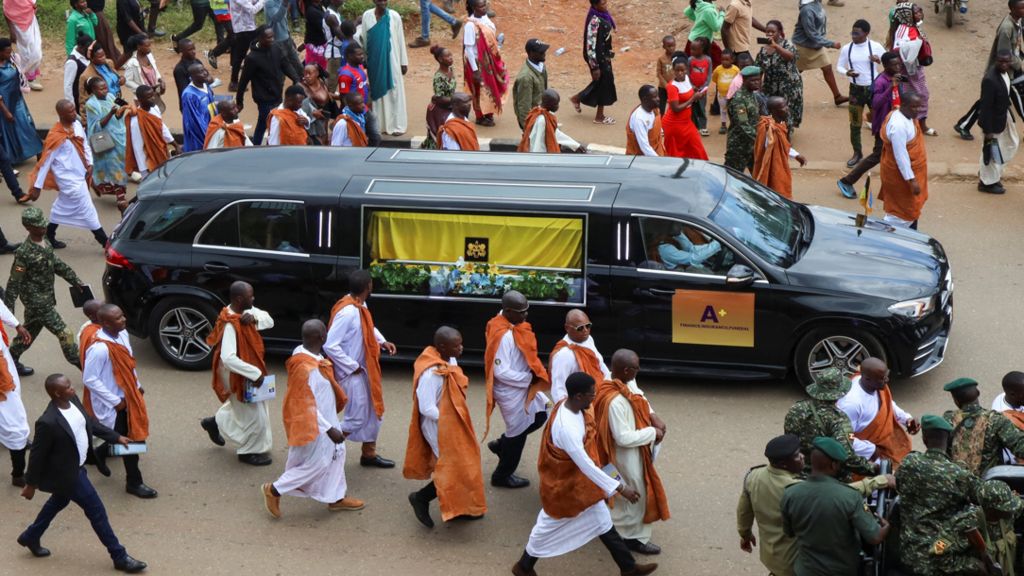
    Ugandan President Yoweri Museveni recently echoed public health warnings in a televised address, rebuking faith leaders who continue to physically touch sick believers during prayer. “The pastors, the pastors, the pastors. The people of God — they are the ones who touch patients. … God is not deaf. You can pray without touching,” Museveni said, noting that WHO Director-General Tedros Adhanom Ghebreyesus had informed him that a large share of Congo’s current victims are religious people engaging in high-risk prayer practices.

    As response teams work to contain the outbreak in a remote region already destabilized by rebel violence and mass displacement, the core challenge remains changing community attitudes to encourage early care-seeking and disrupt unsafe cultural practices that fuel transmission.

  • World shares are mixed and oil trades below $80 on optimism over interim US-Iran war deal

    World shares are mixed and oil trades below $80 on optimism over interim US-Iran war deal

    Global equity markets traded mixed on Wednesday, with benchmark oil prices holding below the $80 per barrel threshold, as market participants closely monitor developments around a tentative U.S.-Iran interim agreement to end their ongoing conflict and prepare for a highly anticipated interest rate decision from the U.S. Federal Reserve.

    In early European trading session, regional benchmarks displayed divergent performance. Britain’s FTSE 100 slipped 0.2% to settle at 10,471.84, pulled down after official inflation data revealed U.K. consumer price growth held steady at 2.8% in May despite rising fuel costs. Germany’s DAX index retreated 0.3% to 24,829.58, while France’s CAC 40 bucked the downward regional trend to climb 0.2% to 8,465.32.

    Across the Asia-Pacific, most major stock indices closed higher, with Japan and South Korea notching fresh all-time record highs. Tokyo’s Nikkei 225 rose 0.7% to end the session at 69,902.25, after hitting an intraday peak of 70,125.75. The rally was fueled by stronger-than-expected trade data showing Japanese exports surged 17% year-over-year in May, driven largely by robust global demand for the country’s high-tech manufactured goods.

    South Korea’s benchmark Kospi index gained 1.6% to close at 8,864.24, also marking a new record closing high. Large-cap technology and semiconductor stocks led the upward move, even as AI-related equities faced a broad sell-off on U.S. markets a day earlier. Samsung Electronics, South Korea’s most valuable public company, added 1% to its value, while top memory chipmaker SK Hynix jumped 5.8%. Hong Kong’s Hang Seng Index fell 0.7% to 24,312.16, while mainland China’s Shanghai Composite Index rose 0.4% to 4,108.08. Other regional indices also posted modest gains: Australia’s S&P/ASX 200 climbed 0.5% to 8,966.30, Taiwan’s Taiex added 0.2%, and India’s Sensex gained 0.3%.

    Global oil markets stabilized on Wednesday after a sharp sell-off the previous session, as optimism over a potential end to the U.S.-Iran conflict and the reopening of the Strait of Hormuz — a critical chokepoint that handles a large share of global oil and gas trade — pulled prices sharply lower. Uncertainty remains over key terms of the tentative deal, however, including whether it requires Israel’s full withdrawal from Lebanon. Brent crude, the global benchmark for oil pricing, edged 0.1% higher to $79.05 per barrel early Wednesday, after tumbling more than 5% in the previous session. Even with the drop, the price remains above the roughly $70 per barrel level seen in late February, before the conflict began. U.S. benchmark crude traded nearly unchanged at $76.02 per barrel.

    HSBC economists noted in a recent research note that returning global oil supply flows to pre-conflict norms will take months to achieve, citing multiple significant hurdles including mine clearance in shipping lanes, reinstatement of commercial insurance coverage for oil cargos, drawing down excess stored crude in Gulf storage facilities, repositioning of global oil tanker fleets, and restarting idled oil production fields.

    Later Wednesday, the Federal Reserve is set to conclude its two-day monetary policy meeting, the first gathering led by new Fed Chair Kevin Warsh. Market analysts broadly expect the central bank to hold its benchmark interest rate steady, despite repeated pressure from former U.S. President Donald Trump to push through rate cuts. Persistent inflation concerns tied to energy price volatility from the Iran conflict have reinforced the Fed’s cautious stance, as lower interest rates could further stoke upward pressure on consumer prices.

    Preston Caldwell, chief U.S. economist at Morningstar, argued in a recent commentary that underlying economic conditions point to slowing inflation once energy market shocks fade. “With weak wage growth and rent growth, underlying forces are pointing to inflation falling sharply once the energy price shock recedes. We don’t expect the Fed to hike rates in 2026,” Caldwell wrote, adding that his team forecasts the Fed will begin cutting rates again in 2027.

    In currency markets, the U.S. dollar weakened slightly against the Japanese yen, dipping to 160.15 yen early Wednesday from 160.42 yen in the prior session. The euro also edged lower, trading at $1.1601, down fractionally from $1.1608.

    On Tuesday, U.S. equity markets also posted mixed results. The benchmark S&P 500 fell 0.6%, while the Dow Jones Industrial Average gained 0.6% to hit a new all-time high. The technology-focused Nasdaq Composite dropped 1.2% to 26,376.34, dragged down by losses across large technology stocks fueled by renewed investor concerns over a potential valuation bubble in AI-related equities. Chip giant Nvidia fell 2.4%, Broadcom dropped 4.4%, and memory chipmaker Micron Technology lost 6.2%. Against the broader tech sell-off, Elon Musk’s SpaceX gained 4.8% to extend its winning streak to three consecutive trading days following its recent public debut on Wall Street. Restaurant conglomerate Yum Brands rose 1.9% after announcing it would sell its Pizza Hut brand to U.S. private equity firm LongRange Capital for $2.7 billion.

  • Japan’s exports jump 17% in May, but logs a deficit as imports surge

    Japan’s exports jump 17% in May, but logs a deficit as imports surge

    TOKYO – Fresh government data released Wednesday by Japan’s Finance Ministry reveals that the world’s fourth-largest trading economy has logged its first monthly trade deficit in four months for May, as soaring demand for AI-related technology pushed up imports enough to offset double-digit growth in outbound shipments. Preliminary calculations show that Japan’s total exports climbed 17% year-on-year to 9.51 trillion yen, equivalent to roughly $59.4 billion, while total imports jumped 12.5% over the same period to 9.89 trillion yen ($61.8 billion). The gap between inbound and outbound trade left the country with a 378.6 billion yen ($2.4 billion) trade deficit.

  • Sudan’s young women return to international soccer as war and taboos linger

    Sudan’s young women return to international soccer as war and taboos linger

    Against a backdrop of devastating civil war, deep-rooted cultural conservatism, and overwhelming systemic challenges, Sudan’s under-17 women’s national soccer team made history last week in Casablanca, Morocco, marking the first appearance of any Sudanese women’s soccer side on the international stage since conflict ripped through the northeast African nation in 2023.

    Walking onto the turf of Larbi Zaouli Stadium, the team’s bright red jerseys cut a striking figure against the lush green pitch. Most of the squad members are teenage schoolgirls; several fled their homes to escape ongoing fighting, and many had never competed in an organized league or stepped onto a professional stadium before this qualifying tournament for the 2028 Los Angeles Olympics.

    For 17-year-old captain Nura Mohamed, the opportunity to represent her country outweighed any pressure of competition. “My goal is to lift up soccer in my country,” Mohamed told the Associated Press in an on-site interview. “It’s a beautiful, unique feeling because, at the end of the day, I just love playing.”

    The road to Casablanca was anything but smooth. When Sudan’s national soccer federation needed to field a squad to avoid forfeiting its spot in the Olympic qualifiers, it could not assemble a full senior women’s team amid the chaos of war. Instead, officials turned to this young, inexperienced group, which only began formal training just weeks before the qualifying matches. The outcome on the scoreboard was lopsided: the squad conceded 30 goals across two matches against Comoros, ending with an 18-0 defeat after a 17-0 opening loss. Many players wept after the final whistle, even as a small crowd of loyal fans cheered them off the pitch.

    Veteran coach Burhan Tia, who oversees all of Sudan’s women’s national teams, acknowledged the massive gap between his side and more established competitors after the first match. “The difference between us and the others is huge. We cannot yet compete at the highest level,” Tia said. “Comoros has many players competing in Europe, our team is mainly made up of schoolgirls.”

    Despite the heavy losses, federation leaders frame the team’s debut as a pivotal victory for women’s soccer in Sudan, which collapsed entirely when civil war broke out between the Sudanese Armed Forces and the Rapid Support Forces in April 2023. For organizers, just getting the young squad to Casablanca represents a critical step in keeping the fragile women’s program alive through the conflict. “Some traveled long distances just to attend training. Many are separated from their families, yet they continue to work hard and pursue their dream,” said Manal Ali Bushra, a businesswoman who leads the federation’s women’s soccer committee. To build long-term stability for the program, Ali Bushra added, the federation is developing new infrastructure projects, including a planned dedicated sports city and stadium renovations in relatively safe regions of Sudan, though she declined to share details of the program’s budget.

    Building the team from scratch required extraordinary effort from Tia, who stepped into the role knowing the magnitude of the challenge he faced. “First, I had to find girls who played soccer. Then, once I found girls who played, I had to make sure they were the right age,” he explained. “Then I needed to convince their parents to let them miss classes for training.” With the domestic women’s league suspended indefinitely due to the war, Tia conducted scouting trips across Sudan and into neighboring Egypt, where hundreds of thousands of Sudanese families have sought refuge from the fighting. He ultimately recruited 10 players from Cairo-based soccer academies and teams, with the remaining members coming from safer cities across Sudan. Tia had hoped to recruit young talent from conflict-battered regions like Darfur and Kordofan, an area long known for producing Sudan’s top athletes, but widespread displacement and the loss of official identification documents made it impossible to verify player ages for international eligibility. The war has also destroyed much of Sudan’s transportation network, turning once-short intercity trips into days-long journeys marked by constant danger.

    On the pitch, the team’s lack of high-level competitive experience was clear: several players struggled with basic tactical positioning, struggled to maintain a consistent offside line, and repeatedly turned to the sideline for coaching guidance throughout both matches. But their presence alone carries enormous political and social weight in a country where women’s participation in public sports has faced decades of pushback.

    The ongoing conflict, which the United Nations has labeled the world’s worst current humanitarian crisis, has killed more than 40,000 people and displaced more than 14 million since it broke out in 2023, with famine and infectious disease spreading rapidly across contested regions. Before the war, women’s soccer in Sudan only just began to emerge: the first official women’s league was established after the 2019 revolution that ousted long-time Islamist president Omar al-Bashir, whose three-decade rule enforced strict public order laws that severely restricted women’s public freedoms. Even after the revolution, conservative religious leaders have condemned women’s soccer: prominent preacher Abdulhay Yousif has claimed the creation of a women’s league is an effort to undermine traditional Islamic values.

    Liv Tønnessen, a political scientist specializing in Sudanese gender politics, explained that for the Bashir regime, women competing in sports was framed as a source of fitna — a term understood in Sudan’s conservative context as moral or sexual chaos. “The idea of women running, jumping, sweating, and even something as simple as their bodies being visible in motion, was seen by Bashir’s Islamist regime as producing fitna,” Tønnessen, a former guest researcher at a women-only university in Sudan, told the AP. “So when women step onto a soccer pitch, they are directly confronting that entire logic. They are not just present in a male-dominated sports arena, they are moving freely in it, on their own terms.”

    Off the pitch, players have also faced widespread harassment: on the team’s official social media accounts, dozens of commenters have mocked the squad for their lopsided defeats, with many posting misogynistic messages telling the players to “go back to the kitchen” in multiple languages.

    The team’s participation in the qualifiers has also sparked political debate. While the military government led by Gen. Abdel Fattah al-Burhan has approved the team’s international trip, the United Nations has documented widespread sexual and gender-based violence committed by Burhan’s Sudanese Armed Forces. Tønnessen argues the military’s public support for the team is a calculated move to boost its international legitimacy, framing the state as functional and aligned with the progressive goals of the 2019 revolution.

    But prominent Sudanese women’s rights activist Hala Al-Karib pushes back on claims that the team is being exploited for political gain. Instead, she argues the core issue remains long-standing underinvestment in women’s soccer across Sudan, calling for sweeping reform of the national soccer federation. For Al-Karib, the team’s right to compete matters more than political posturing.

    Back on the Casablanca pitch, all the politics, conflict, and public debate faded into the background. For a few hours, there was only a group of young women, united by their love of the game, chasing a dream on the international stage.

  • A chilling Romanian exhibition replays videotaped secret police interrogations from 1989

    A chilling Romanian exhibition replays videotaped secret police interrogations from 1989

    Thirty-four years after the collapse of Nicolae Ceaușescu’s brutal communist regime in Romania, a groundbreaking new exhibition in the capital Bucharest has pulled back the curtain on the systematic repression and psychological violence carried out by the country’s feared secret police force, the Securitate.

    Titled “A.REST 1989,” the exhibition is hosted at the National History Museum of Romania and runs through mid-September. A collaborative project between the museum, Romania’s National Council for Studying the Securitate Archives (CNSAS), and the Ministry of Culture, the exhibit leverages rare, never-before-displayed video footage to reconstruct the grim reality of detentions and interrogations that defined the Securitate’s sprawling network of surveillance and control.

    At the heart of the exhibition are 26 original 1989 videotapes, held by CNSAS, that capture the live interrogations of four detainees. These recordings, preserved accidentally amid the chaotic, violent collapse of the socialist regime at the end of that year, are displayed on grainy, wall-mounted screens in the museum’s central hall. A full-scale reconstruction of a sparse detention cell, fitted with only a narrow bed, an empty metal bowl and a chipped cup, anchors the space, offering visitors a visceral sense of the isolation and dehumanization endured by detainees.

    Many of the recordings lay bare the coercive, intimidating tactics Securitate interrogators used to break suspects. Intense psychological pressure, repeated threats of violence, and intimidation targeting detainees’ family members feature heavily in the footage, with questioning often veering into absurdity that leaves detainees exhausted and disoriented. In one exchange, a woman whose husband was accused of defection tells her interrogator, “I no longer have the strength to fight. I need logical arguments, not this nonsense.”

    Alongside the raw video recordings, the exhibition also displays rare artifacts connected to dissident activity and repression. These include a clandestine printing press owned by journalist Petre Mihai Băcanu, which the Securitate seized in early 1989 after Băcanu and his associates used it to publish an anti-Ceaușescu, anti-government newspaper. Băcanu’s own question to interrogators — “How could we, after 45 years of socialism, still be afraid of people’s opinions, even of their thoughts?” — is featured prominently as a testament to the regime’s fear of dissent. Another chilling artifact on display is a pair of modified glasses designed to blindfold detainees during transport, preventing them from identifying locations or other political prisoners.

    Exhibition curator Oana Demetriade, a historian at CNSAS, explained that the project evolved from an initial plan to create a student documentary. After reviewing the unedited tapes, she partnered with architects and designers to build the immersive exhibition, noting that the archive offers an unprecedented unfiltered look at Securitate operations. “That’s what this whole archive brings new,” she said. “How it gets here and how people, those who are arrested, in the end, are repeatedly threatened, yelled at, threatened with beatings, threatened with the family suffering, and so on.”

    Mihai Demetriade, also a CNSAS historian and co-curator of the exhibition, outlined the two parallel systems of illegal detention the Securitate operated. “Preventative detention” was deployed for political cases alleging crimes against the state, while “operational detention” functioned as a state-sponsored kidnapping system: dissidents were locked away to silence them during sensitive political events, such as party congresses or visits from foreign leaders. Unlike post-regime victim testimonies or redacted official documents, the Demetriade noted, the live recordings are irrefutable evidence of the regime’s brutality, impossible for historical revisionists to dismiss. “This space is important because it proves how rapacious, tough, aggressive the communist dictatorship remained even in the last moments of the communist system,” he added.

    Organizers frame the exhibition as a belated memorial to victims of Securitate repression. “In the world of Securitate ‘justice,’ detainees or those under arrest were merely prisoners, captives in the operational labyrinth of manufactured guilt,” the organizing team says. With this display, “the victims, thus, gain a voice and a place.”

    The exhibition arrives at a critical moment for Romanian collective memory: as nationalism has grown in the country in recent years, so has nostalgic revisionism about the Ceaușescu era, particularly among young Romanians who have no direct personal experience of life before the 1989 revolution. Cornel Constantin Ilie, manager of the National History Museum of Romania, said the exhibition is designed to cut through this misremembering by confronting visitors with unvarnished facts. “It is an exhibition that puts you in front of facts that cannot be ignored,” he said. “It’s very important because we must not forget and we must not repeat. … What we see in this exhibition is an ugly face of history, it is a story in which human freedom, human dignity were suppressed.”

  • Extraordinary Messi makes more history in masterclass for the ages

    Extraordinary Messi makes more history in masterclass for the ages

    The 2026 FIFA World Cup opening matchday delivered a historic spectacle that will be etched into football lore forever, as 38-year-old Lionel Messi turned Kansas City Stadium into his personal stage, producing a breathtaking hat-trick that cemented his place among the sport’s all-time greats. The iconic Argentine forward delivered a performance for the ages, capping a 3-0 victory over Algeria by equaling Miroslav Klose’s record 16 career World Cup goals, a milestone that came on the 20th anniversary of his 2006 World Cup debut, and just one day after he became the first player in history to compete at six editions of the tournament. The day had already seen other global superstars shine: Kylian Mbappe and Erling Haaland both netted braces in their own opening fixtures, but as the sun set over the Kansas City skyline, it was clear the main event belonged to Messi.

    Even before his record-breaking hat-trick, the evening felt scripted for magic. Just four minutes into the match, Messi raced past Algeria’s defense to slot past goalkeeper Luca Zidane (son of French legend Zinedine Zidane), only for an offside flag to rule out the early goal. The packed stands of Argentina fans still erupted as if they had lifted the trophy itself; journalists in the press box knew it was not a question of if Messi would score, but when.

    That moment arrived in the 18th minute. From 25 yards out, Messi shifted onto his favored left foot and curled a blistering strike toward the top-right corner. Zidane got both hands to the effort, but the power of the shot carried it into the net, sending the stadium into delirium. It was Messi’s 14th World Cup goal, and the start of a historic night. Former Everton midfielder Leon Osman summed up the moment: “Messi is celebrating like it’s his first World Cup goal. With the ability he has, he never seems to age. It’s a brilliant ball into his feet and, as you’d expect, he finishes it superbly.”

    At 38, Messi continues to defy the conventional limits of age for a professional footballer. This marked his 27th World Cup match, more appearances than any player in tournament history, and across 90 minutes he remained sharp, constantly scanning for space, anticipating his teammates’ runs, and looking every bit as fast and dangerous as he did a decade ago. By the 60th minute, he had doubled his tally: a costly unforced error from Zidane left the ball rolling straight into Messi’s path, and he converted with characteristic cool composure. The goal made him the oldest player ever to score twice in a single World Cup match, and put him just one strike away from equaling Klose’s all-time scoring record.

    The milestone third goal came in the 76th minute, when substitute Nico Gonzalez played a perfectly weighted pass into Messi’s path. He made no mistake, slotting home to complete his first ever World Cup hat-trick. As thousands of Argentina fans chanted his name, Messi lifted his arms to the sky, taking in the moment that 20 years of work had built to. When he was substituted late in the match, he left the pitch to a standing ovation that echoed long after he reached the touchline.

    Speaking after the match, Messi called the moment deeply meaningful: “To enjoy this with my family, with my team-mates, the ones who are always there, is a really beautiful moment. The squad, it’s a very united, very strong group. I feel good; we were lucky enough to win a tough match. It’s important to start off with a win in the first game. I’m grateful to the fans, because once again they’ve shown that Argentina is crazy about this – we packed the stadium again. Everything I’m experiencing now is a bonus. I’ve been fortunate enough to achieve all my dreams — or even more than I ever dreamed of achieving — both professionally and personally.”

    Argentina head coach Lionel Scaloni said he struggled to put Messi’s legacy into words: “I don’t have the words to describe Messi. For 20 years, he’s had us used to seeing things like this and he inspires everyone who watches him play.”

    Even after the final whistle, thousands of fans stayed in the stands to celebrate, filling the stadium with the blue and white of the Argentine flag and chants of Messi’s name that carried into the Kansas City night. For supporters, who wore his name on their backs and displayed tattoos of his likeness, Messi is far more than a footballer: words like “hero”, “idol”, and “our everything” were common descriptors among the crowd. Even Patrick Mahomes, the Kansas City Chiefs star quarterback who usually commands headlines in this very stadium, watched on from the stands, captivated by Messi’s magic.

    Having led Argentina to World Cup glory in 2022, few would now bet against the ageless superstar leading his nation to another title run. On an opening day filled with the world’s biggest football talents, there was no question who stood above the rest: 20 years after his first World Cup appearance, Lionel Messi is still the main event.

  • Tunisia’s Hervé Renard embraces challenge against Japan in World Cup debut

    Tunisia’s Hervé Renard embraces challenge against Japan in World Cup debut

    Hours after touching down in Monterrey, Mexico, veteran French football manager Hervé Renard stepped onto the training pitch Tuesday to lead his new Tunisia national squad for the first time. The 57-year-old’s appointment comes on the heels of Tunisia’s humiliating 5-1 opening defeat to Sweden, which prompted the immediate firing of former boss Sabri Lamouchi.

    Renard now faces an extremely tight turnaround: just four days to integrate himself into the squad, assess player form, and devise a game plan for Tunisia’s must-win second Group F fixture against Japan this Saturday. A man familiar with last-minute coaching overhauls, this is not the first time Renard has stepped into the role Lamouchi vacated. Back in 2014, the two-time Africa Cup of Nations-winning manager took over as Ivory Coast’s head coach following the team’s early group stage exit from that year’s World Cup, a parallel that makes his latest appointment a striking moment in his managerial career.

    Renard brings a resume packed with high-profile World Cup upsets that make him an intriguing pick for Tunisia’s uphill battle. Most famously, he led Saudi Arabia to a stunning 2-1 victory over eventual tournament champion Argentina at the 2022 Qatar World Cup, one of the biggest upsets in modern World Cup history. Four years prior, at the 2018 Russia World Cup, his Moroccan national side held powerhouse Spain to a surprising draw, even if the team ultimately fell short of qualifying for the knockout round.

    For Renard, the draw of the World Cup’s unique energy was enough to convince him to take on the high-pressure role with little preparation time. “It’s a World Cup. I know the passion around this event. That’s what motivated me to come and it’s a challenge which isn’t easy,” he told reporters on the training ground Tuesday. He added that he has emphasized team focus to his new players, telling the squad, “At the moment we need to be focused on ourselves. We still have a few days to be ready.” He also encouraged the side to stay resilient in the face of their opening defeat, telling players they must keep their heads up as they represent their nation on the global stage.

    The task Renard faces is steep. Tunisia has never advanced past the group stage in its six previous World Cup appearances, and the path to the knockout round looks narrow after the heavy opening loss. The Carthage Eagles now need positive results against both Japan and group-leading Netherlands to secure a spot in the next stage, a feat that would go down as one of Renard’s most impressive career achievements if he pulls it off.

  • Trump to wrap G7 summit facing skepticism at home and jitters overseas over his plan to end Iran war

    Trump to wrap G7 summit facing skepticism at home and jitters overseas over his plan to end Iran war

    EVIAN-LES-BAINS, France — On Wednesday, U.S. President Donald Trump concluded formal working sessions of the Group of Seven summit at the scenic Alpine lakeside resort, capping off days of diplomatic talks dominated by his push to win global backing for a still-unseen tentative nuclear agreement with Iran. Even as allied leaders and domestic stakeholders openly question the pact’s lack of detail, Trump has framed the unsigned deal as a historic breakthrough that will permanently block Iran from developing or acquiring a nuclear weapon.

    The G7 gathering of the world’s leading industrialized nations wrapped up its formal agenda with focused discussions on two pressing global priorities: the long-term governance of artificial intelligence and strategies to stimulate sustained inclusive economic growth across major economies. Before departing for Washington D.C., Trump is set to attend a lavish one-on-one dinner hosted by French President Emmanuel Macron at the Palace of Versailles outside Paris, an honor marking the upcoming 250th anniversary of American independence that Trump has openly welcomed.

    The core controversy overshadowing Trump’s final summit day remains the Iran deal. Neither the White House nor Iranian officials have publicly released the full text of the agreement, which is scheduled for a formal signing ceremony this Friday at a luxury resort on Switzerland’s Lake Lucerne. Despite the lack of transparency, Trump lauded the still-unpublished memorandum to reporters, saying “It’s a great document. Here’s what it says: Iran will never have a nuclear weapon. It won’t have one to buy, to develop — it will not have a nuclear weapon. And I would say that’s about 99.9% of what I wanted.”

    Skepticism runs deep on multiple fronts. Key U.S. ally Israel has openly expressed unease over the terms of the agreement, while Republican lawmakers in Trump’s own party have raised doubts that the deal goes far enough to curb Iran’s nuclear ambitions. The international community is also waiting for concrete proof that the pact will deliver on a critical secondary promise: reopening and permanently securing the Strait of Hormuz, the vital maritime chokepoint that Iran has effectively closed to commercial oil traffic since the outbreak of the recent conflict. Before the war, roughly 20% of the world’s traded oil and natural gas passed through the strait.

    Complicating the agreement further, U.S. and Iranian officials have publicly offered conflicting interpretations of the deal’s terms. Iranian Foreign Minister Abbas Araghchi has stated that Israel’s ongoing military presence in southern Lebanon, where Israeli forces have been targeting Iran-backed Hezbollah militants, would count as a violation of the pact. “Without the withdrawal of Israeli forces from the territories they occupied during this war, the war has not fully come to an end,” Araghchi said. For his part, Trump acknowledged Tuesday that an Israeli strike on Hezbollah would not automatically derail the deal, but criticized Israel’s prolonged military campaign, noting “Israel’s fighting Hezbollah too long, and too many people are being killed.” Israeli strikes in Lebanon have killed nearly 4,000 people, hundreds of whom are civilians, and forced more than 1 million people to flee their homes since March 2.

    Beyond the Iran nuclear debate, Trump scheduled a series of key bilateral meetings on his final G7 day, including a sit-down with Indian Prime Minister Narendra Modi that comes at a fraught moment for U.S.-India ties. Tensions have risen in recent weeks after three Indian sailors were killed in a U.S. military strike on a commercial tanker in the Gulf of Oman, carried out as part of Washington’s blockade of Iranian oil shipments. New Delhi has formally protested the incident, and relations have already been complicated by Trump’s back-and-forth tariffs on Indian goods over India’s continued purchases of discounted Russian oil, as well as Indian concerns that Trump’s recent trade truce negotiations with China could weaken India’s position as a rival manufacturing hub. The two leaders enjoyed a close relationship during Trump’s first term in office, but the dynamic has shifted significantly since his return to the White House.

    Trump also planned to hold one-on-one talks with Egyptian President Abdel-Fattah el-Sissi, one of three Middle Eastern leaders invited to the summit by host Macron. On Tuesday, G7 leaders held a working lunch with el-Sissi, Qatar’s ruling emir, and the president of the United Arab Emirates focused on developing alternative energy supply routes that bypass the Strait of Hormuz. French Foreign Ministry spokesperson Pascal Confavreux explained that discussions centered on planning and financing overland infrastructure to redirect Gulf energy exports away from the closed chokepoint.

    For Trump, the high-profile Versailles dinner is a particularly anticipated stop. The U.S. president openly shared his excitement for the event, saying that the opulent historic venue, the former royal residence of French kings from Louis XIV to Louis XVI, was enough to convince him to extend his post-summit stay in France. “I’m a fan of beautiful places, and I was leaving in the afternoon, and then the French president who happens to be a very nice man, invited me to dinner at Versailles,” Trump said. “And Versailles is not gold leaf — Versailles is the real deal. And I said I’d like to do it.”

    The reporting was contributed by AP correspondents based in Evian-les-Bains, Geneva and Washington, with original reporting from Madhani in Geneva.