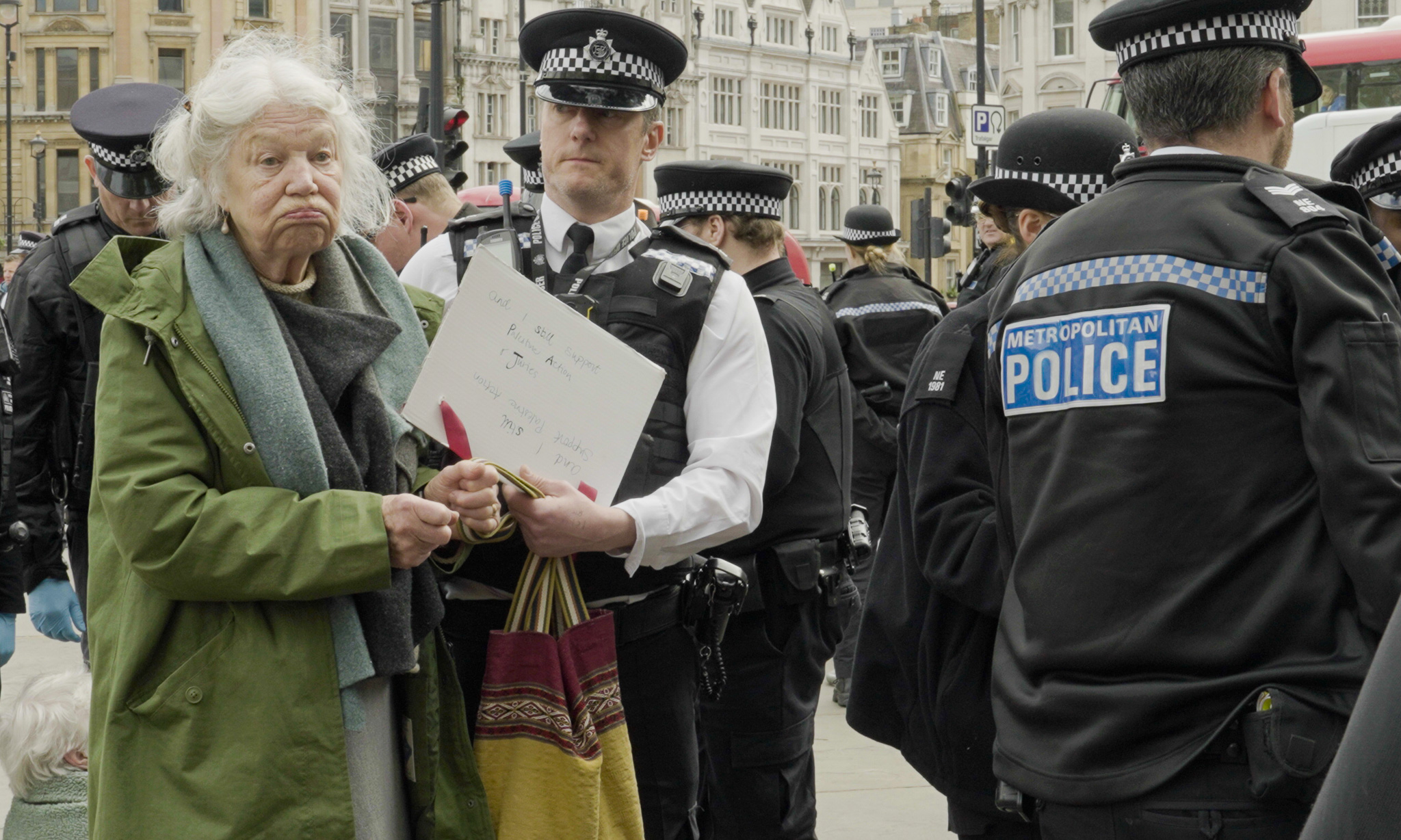
On a Saturday afternoon in central London, hundreds of demonstrators gathered in the iconic Trafalgar Square to openly defy the UK government’s recent ban of the direct action group Palestine Action, deliberately putting themselves at risk of arrest under sweeping counterterrorism legislation.
Organized around a silent vigil, approximately 500 protesters set up camping chairs along the base of Trafalgar Square’s central steps, holding handcrafted cardboard placards that bore a simple, unapologetic message: “I oppose genocide, I support Palestine Action.” In a show of force that preceded the start of the demonstration, London’s Metropolitan Police had already lined the open square with police vans, deploying a heavy uniformed presence hours before the first protester arrived.
Footage and on-the-ground reporting from the event captured images that have become increasingly common across the UK in the months since the ban was enacted: elderly protesters, many grey-haired, frail, or relying on crutches for mobility, were physically hauled away by officers. A number of demonstrators chose to dress as Suffragettes, the early 20th-century British women’s suffrage activists, to draw a parallel between their current civil disobedience and historical fights for democratic rights. At one point during the arrests, one elderly woman lost consciousness while being carried by officers, and was placed in the recovery position by police as onlookers watched on.
This demonstration is far from an isolated incident. Since the UK government formally proscribed Palestine Action as a terrorist group in July 2025, more than 1,600 people have been arrested under counterterrorism laws simply for holding placards echoing the same message displayed at the Trafalgar Square vigil, government data shows. Many of the attendees at Saturday’s gathering have already been detained multiple times for the same act of peaceful protest.
Among the protesters were 70-something siblings Mark and Betty, who traveled separately from Wales and Cornwall to attend the London vigil. Both have a long history of local Palestine advocacy, and this marked their first joint appearance at a national demonstration. Mark, a Jewish genocide scholar, told Middle East Eye that his participation carries triple weight: as a member of the Jewish community, a scholar of mass atrocities, and a critic of the UK government’s policy. “I don’t want to be here. I want the government to acknowledge a failing and unravel this ban,” he said.
Betty, also Jewish and a veteran of decades of anti-war organizing, echoed her brother’s frustration. “There is really very little else we can do. We’ve done everything: smaller local protests, writing letters to our Members of Parliament, signing petitions,” she explained. “But clearly this government will not be told unless it is forced to be told by making things very, very difficult for them by being here.” She added that the current political climate has reached a deeply worrying point: “But now we’ve got into the stage where we’re not even allowed to turn up on the street with a bit of paper for being absurdly peaceful people.”
Also in attendance were former Palestine Action supporters who had been imprisoned after the ban, among them Heba Muraisi, who took part in a 73-day hunger strike behind bars to protest both poor detention conditions and the proscription itself. Muraisi, who had only recently been released, told reporters she had watched previous “Lift the Ban” protests on a small prison television, and witnessing the police response in person was staggering. “It’s crazy actually witnessing it. It’s both insane and disgusting. Look how many police are here, just for elderly people holding placards. It’s a joke. The state is a joke,” she said.
Trudi Warner, a veteran activist who previously faced contempt of court charges for holding a pro-jury rights placard outside a climate change trial, argued that the UK government is completely disconnected from widespread public sentiment on Palestine. “People are outraged, they are furious, and we’re trying to show that,” Warner said. “Our thing is show, don’t tell. We can tell people that we’re living in an authoritarian state. They won’t believe us, but we can show them, and that’s what these actions are all about.”
Saturday’s mass arrests come against a shifting legal backdrop. In February 2026, the UK High Court issued a ruling that found the government’s ban on Palestine Action was unlawful. Following that decision, Home Secretary Shabana Mahmood was granted permission to appeal the High Court’s ruling, with the appeal scheduled to be heard on April 28 and 29.
After the initial High Court ruling, the Metropolitan Police issued a public statement saying it would suspend arrests of Palestine Action supporters and proscription opponents under counterterrorism laws, and would instead focus solely on gathering evidence for future prosecutions pending the appeal. But in a sudden policy reversal that surprised activists, the Met backtracked, describing its initial statement as an “interim position” and announcing it had revised its approach to resume arrests. Prior to Saturday’s vigil, MEE had already confirmed the Met had arrested two people on proscription-related charges after announcing the suspension.
Defend our Juries (DOJ), the activist group leading the national campaign to overturn the Palestine Action ban, said it had formally written to Met Commissioner Mark Rowley to warn that any arrests carried out after the High Court’s unlawful ruling would carry serious legal repercussions. The group noted it had planned Saturday’s vigil based on the Met’s original pledge to suspend arrests, and that police had failed to issue a substantive response to correspondence from the group’s legal team ahead of the event.
DOJ argues that any post-ruling arrests are unlawful, as they violate protesters’ fundamental democratic rights enshrined in the UK Human Rights Act and the European Convention on Human Rights. In a formal statement released after the vigil, the group said: “It is clear that the Metropolitan Police has adopted a policy of a) refusing to investigate crimes under the [International Criminal Court Act] relating to the acts of the government of Israel; and b) suppressing public expression of opposition to such crimes. Such a biased and discriminatory policy materially assists both the Israeli Government and Elbit Systems in the commission of genocide, war crimes and crimes against humanity.”
Dal Babu, a former chief superintendent with the Metropolitan Police, told BBC Radio 4 that the optics of mass arresting peaceful elderly protesters will create significant reputational challenges for the force. “The optics of the mass arrests will be very challenging for the police… in terms of how they manage it,” Babu said. “Also be aware of the fact there will be a huge amount of people who have sympathy with what is going on with the views of Palestine Action.”
Official Home Office data underscores the scale of the crackdown: arrests linked to the Palestine Action ban make up the majority of the 1,800 total terrorism arrests conducted across the UK in 2025, representing a 660% year-on-year increase in counterterrorism detentions. Multiple leading human rights organizations have repeatedly warned that the proscription of Palestine Action represents a dangerous misuse of counterterrorism legislation that threatens core civil liberties, including the rights to free expression and peaceful assembly.
A DOJ spokesperson emphasized that the campaign to lift the ban has grown far beyond a single protest rights issue. “The government’s refusal to accept the judgment of the High Court, coupled with inconsistent and opaque policing decisions, signals a troubling disregard for the rule of law,” the spokesperson said. “These are not the actions of institutions committed to protecting citizens, but of a state prioritising its own authority. Today’s wrongful arrests of… people holding signs at a silent vigil are further evidence of this.”