Stepping into the presence of an authentic Ming horseshoe-back armchair for the first time, a striking dissonance quickly settles in: this centuries-old object does not read like an antique. It feels like a masterpiece of modern design, crafted centuries ahead of its time.
Unlike the ornate, heavily decorated furniture that defined later Qing Dynasty tastes, Ming-style pieces reject over-the-top ornamentation, flashy inlays of mother-of-pearl, gilded accents, or bulky construction meant to signal status. It stands on four solid legs, with arms that curve gently outward and a back that arcs with deliberate, understated restraint. Bathed in light, the natural grain of the wood seems to shift and breathe, and while the piece remains silent, its intentional structure, balanced proportion, and layered hierarchy speak volumes.
The enduring value of Chinese classical furniture does not stem from a vague label of “exotic Eastern style.” It emerges from the way that raw timber, generations of craftsmanship, human scale, traditional spatial etiquette, and centuries of collecting history converge in a single everyday object, elevating it to a tangible expression of Chinese civilization.
### The Foundation: Precious Tribute Woods
At the core of this craft lies the choice of wood. According to Shi Hao, founder and director of Wuhan’s Donghu Rosewood Museum, Ming and Qing Dynasty imperial furniture relied on three legendary tribute hardwoods, sourced and offered to the imperial court by local authorities and tributary states. Ranked by value as “first yellow, second purple, third red,” they are huanghuali, zitan, and dahong suanzhi. Each carries distinct qualities that have made them prized for centuries: huanghuali is celebrated for its warm tone and dynamic grain; zitan for its unmatched density, deep dark hue, and imposing gravity; and dahong suanzhi for its rich crimson color, hardness, and dimensional stability.
Among all Ming-style furniture, huanghuali holds a unique place of honor. The finest old-growth huanghuali from Hainan Island glows with layered hues of amber, honey, and warm reddish-brown, with grain patterns that evoke rolling mountains, flowing rivers, or drifting clouds. Its most iconic markings are the rare guilian (or limian) patterns, widely known as “ghost faces”—dark brown organic clusters that can resemble theatrical masks, leopard spots, or stacks of ancient bronze coins. Across the surface of a chair back or tabletop, these half-formed shapes emerge: half-face, half-shadow, always organic. Unlike carved decorations, these patterns grow naturally from within the wood, leading craftsmen and collectors to describe huanghuali as a living material.
This reverence for the wood’s inherent beauty explains the iconic plain surfaces of Ming furniture. The lack of elaborate carving is not a failure of craftsmanship—it is an act of respect. The wood already holds its own landscapes and patterns; excessive ornamentation would only disrupt the natural painting that forms within its grain.
From the mid-to-late Ming Dynasty onward, premium hardwoods flowed into elite Chinese circles through southern overland trade and maritime commerce, fueled by the booming consumer culture of the Jiangnan region. As slow-growing old-growth huanghuali became increasingly scarce, it earned its reputation as “gold among woods.” Jiangnan literati of the era favored its unadorned beauty, arguing that the natural grain alone was enough to make a piece extraordinary.
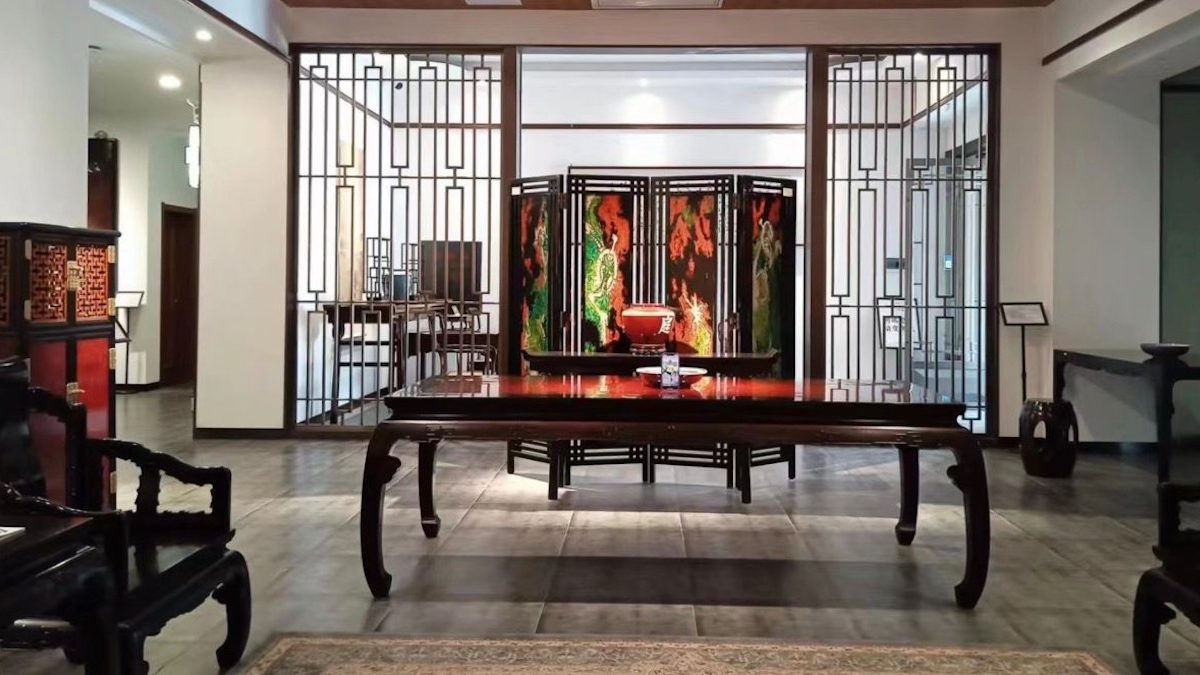
Today, institutions like the 2,000-square-meter Donghu Rosewood Museum, which holds more than 400 pieces of rare classical rosewood furniture, are working to preserve and revitalize this lost material knowledge. In collaboration with expert teams from the Palace Museum and Shanghai Museum, the museum revives traditional Suzhou craftsmanship to bring the quiet elegance of Ming furniture back to contemporary audiences. This work extends far beyond a single institution: it signals that Ming-style furniture is no longer merely a collectible category for antique markets. It has reclaimed its place in academic material studies, craft history, museum research, and modern public aesthetic education.
### The Hidden Genius: Structure and Proportion
After material, the defining strength of Chinese classical furniture lies in its hidden structural mastery, most visible in its iconic mortise-and-tenon joinery. This technique is far more than the romantic idea of “furniture built without nails.” It is a sophisticated structural system designed to accommodate the natural expansion and contraction of wood with changes in humidity, distribute weight evenly, and guarantee long-term stability. Metal nails would damage the wood’s natural integrity, but mortise-and-tenon joints allow the wood to “breathe” within controlled limits—a key reason so many Ming pieces have remained intact for more than 500 years.
To truly understand a Ming horseshoe-back armchair, one must look beyond its graceful outer silhouette. You have to examine how the arms extend seamlessly from the backrest, how the curved splat is shaped to fit the human spine, how the legs splay just enough to balance stability and lightness, how the stretchers distribute weight across the frame, and how aprons and open spaces balance structural support with visual rhythm. Terms like luoguo stretchers, ba wang stretchers, mitered floating panels, waisted construction, and foot supports are not just jargon for antique dealers—they are the grammatical building blocks of Ming furniture design.
Proportion is everything to the spirit of a Ming piece. If proportions are off, the entire object loses its soul. An armrest set too high feels uncomfortable to the body; a backrest too straight makes sitting uninviting; legs too thick erase the signature lightness of Ming design. Ming furniture is not simply “minimalist”—it is precise, intentional simplicity earned through centuries of refinement. A stripped-back appearance is only surface deep; precision is its true essence.
In traditional Chinese craft, dimensions were never arbitrary. Ming carpenters, particularly in Jiangnan, relied on the Luban ruler (also called the menguang or bazi ruler) to set measurements for all furniture, doors, and structural elements. Named for Gongshu Ban (better known as Luban), the legendary 5th-century BCE craftsman from the Spring and Autumn period, this tool wove together technical measurement and traditional symbolic order centuries before modern design standards emerged.
The Luban ruler divides all measurements into auspicious and inausicious categories, with favorable markers for wealth, status, righteousness, and good fortune, and unfavorable markers tied to illness, loss, and calamity. A traditional saying from the *Luban Jing Jiangjia Jing*, Luban’s classic text on craft, holds: “Beds do not leave seven, tables do not leave nine, stools do not leave three, doors do not leave five”—a rule that held that final dimensions should not only serve functional use, but also align with auspicious symbolism.
From a modern perspective, this belongs to traditional feng shui and cultural belief. Within the context of pre-modern Chinese society, it reveals that furniture making was never just manual labor. It integrated human scale, domestic harmony, and psychological order into a single craft discipline. Imperial architecture and court furniture took this commitment to measured, symbolic proportion even further: the Qing Dynasty’s official building standards, the *Gongbu Gongcheng Zuofa Zeli*, devotes entire sections to door dimensions aligned with auspicious Luban positions, categorized by names like “wealth-increasing doors” and “fortune and virtue doors.”
For traditional Chinese craftsmen, a table, chair, or bed was never just shaped timber. It carried expectations of household stability, intergenerational good fortune, and maintained social order. The balanced proportions of classical Chinese furniture come not just from the trained eye and hand of the carpenter, but from thousands of years of inherited measurement culture. This design logic is exactly why Ming furniture fits so seamlessly into modern 21st-century spaces. Modernist design prioritizes structural honesty, respect for material, functional clarity, and formal restraint—and Ming furniture achieved all of these principles centuries earlier. It lacks the cold rigidity of mass-produced industrial design, but it holds the core of modern design spirit at its center: it does not hide its structure, it does not overindulge in unnecessary decoration, and it does not use bulk to signal authority.
A well-preserved Ming chair sits naturally in a modern apartment, contemporary gallery, or private study alongside stone accents, concrete walls, abstract painting, and modern lighting without feeling out of place. Its outline is clean, its scale controlled, its material unobscured, its structure obvious.
### Furniture as Spatial and Social Order
Even so, Ming furniture is far more than just timeless design. In the elite literati culture of the late Ming, furniture shaped the entire spatial and social order of the home. A painting table was not merely a surface to work on—it was the central gathering point for reading, writing, appreciating art, burning incense, and receiving guests. A horseshoe-back armchair dictated posture, line of sight, the ritual distance between host and guest, and even the bearing of the person sitting in it. A small incense stand might hold nothing more than a burner, a small vase, or a scholar’s rock, but it gave an entire room room to breathe. A luohan bed functioned as a cross between a bed, couch, and seating piece, used for reclining, conversing, drinking tea, reading, or resting, occupying the gentle space between private leisure and social interaction.
Furniture for entrance halls prioritized order and ritual; furniture for studies prioritized solitude and self-cultivation; beds and couches connected the daily needs of the body to the inner life of the mind. The placement, scale, and grouping of furniture formed a quiet social language, and Ming design placed unique value on empty space. Emptiness here is not absence—it is intentional control. It creates distance between objects, leaving room for light, air, and movement. A sophisticated Ming-style room is never cluttered with valuable objects; it is a space where every object knows its place.
### Value, Authenticity, and the Market
This holistic framework also shapes how collectors judge the value of classical Chinese furniture. The market price of a piece is never determined by the type of wood alone—wood is only the starting threshold for value. What gives a piece its scholarly and market worth is a combination of age, form, proportion, craftsmanship, condition, provenance, publication history, exhibition record, and collecting pedigree.
The international auction market has long recognized the value of top-tier classical Chinese furniture. Christie’s has recorded landmark sales: a 16th–17th century huanghuali circular incense stand sold for $5.8475 million, while an 18th-century zitan luohan bed fetched $3.6075 million. These results confirm that top-tier Chinese classical furniture is no longer categorized internationally as mere decorative antique. It is a high-value fine art asset that combines material rarity, technical refinement, aesthetic distinction, and centuries of collecting history.
When evaluating a huanghuali piece, experts ask a series of critical questions: Is the timber authentic old-growth material? Does the form align with period conventions? Are the mortise-and-tenon joints original, or have components been replaced? Is the patina natural, or has the surface been over-polished, re-waxed, or re-colored? Has the structure undergone major structural alteration? Have dimensions been changed? Is the provenance clearly documented? Has the piece been previously held in significant collections, included in exhibitions, or listed in scholarly catalogues?
Provenance is particularly critical for high-end pieces. Without a clear documented history, even a piece with beautiful timber will have limited market value. With a verified collecting record, publication history, and scholarly provenance, an old piece of furniture becomes a tested cultural asset, vetted by time, connoisseurship, and the market.
Authenticity is the skill that demands the most hands-on experience. Classical Chinese furniture cannot be judged by a quick glance at how old it looks: old timber can be used to make new forgeries, new furniture can be artificially aged, old components can be reassembled into fake period pieces, and partial restoration can completely alter the value of an intact original. True authentication depends on verifying that all elements of the piece—wood, structure, proportion, tool marks, patina, wear patterns, and functional logic—align with each other.
Naturally aged furniture wears unevenly, in patterns shaped by use: armrests grow smooth where generations of hands have rested, seats develop subtle wear from constant body contact, lower legs hold faint traces of centuries of contact with the floor, and drawer edges round softly from repeated opening and closing. Natural wear is never uniform; if a piece looks evenly aged from top to bottom, it is almost certainly a forgery.
Patina, too, is often misunderstood: it is not just a shiny surface. It is a complex surface condition built up over centuries from contact with hands, air, light, dust, and daily use. Good patina is calm, warm, and layered. Over-polishing erases the evidence of time, while artificial aging fabricates a false history. Old furniture faces two great risks: being over-restored to look like new, or being artificially treated to look falsely old. One destroys authentic historical evidence; the other invents a fake history.
### The Imperial Footnote: The Carpenter Emperor of Late Ming
No discussion of late Ming furniture culture is complete without mentioning the Tianqi Emperor Zhu Youxiao, who reigned from 1620 to 1627 CE. So deeply devoted was he to woodworking that he is widely remembered as the “carpenter emperor”—the most hands-on imperial craftsman in Chinese history. This title is far more than a trivial historical anecdote: it places the extraordinary refinement and popularity of late Ming woodworking alongside the accelerating political decay of the Ming court, creating one of the most haunting contradictions in Chinese dynastic history.
According to the *Ming Shi* (the official History of the Ming Dynasty) and *Zhuozhong zhi*, a detailed first-person account of late Ming court life by eunuch Liu Ruoyu, Zhu Youxiao was obsessed with carpentry. He personally crafted miniature palace models, folding beds, small screens, lacquered objects, and even mechanical wooden contraptions, often forgetting to eat or sleep when absorbed in his work. Even the most skilled court craftsmen acknowledged the exceptional refinement of his work. Histories even record that he had eunuchs sell his handmade pieces outside the palace, adding an oddly mundane layer to his story: an emperor who did not just admire woodworking, but personally sawed, planed, carved, and shaped timber into finished objects.
The story quickly takes a dark turn. The emperor’s total absorption in carpentry created a power vacuum that was filled by the powerful, corrupt eunuch Wei Zhongxian, who held key positions including head of the imperial secret police. When Wei would bring state memorials to the emperor for approval while Zhu Youxiao was working on wood, the emperor would repeatedly reply: “I understand the matter fully, handle it as you see fit.” All state affairs quickly fell into the hands of Wei and his faction, leading to widespread court corruption, unpaid military salaries, growing frontier threats, and spreading popular unrest across the empire.
On one side lay sawdust, shavings, precise mortise-and-tenon joints, lacquer, and exquisitely crafted furniture. On the other lay court corruption, eunuch tyranny, and the slow collapse of the Ming dynasty. The Tianqi Emperor did not create Ming-style furniture, but he became the most extraordinary historical footnote to late Ming wood culture. The fact that an emperor could master woodworking well enough to earn the admiration of professional craftsmen proves how mature and advanced the Ming craft system had become by the early 17th century. The fact that the same emperor abandoned all state affairs to pursue his obsession casts an unavoidable shadow of political contradiction over this chapter of furniture history.
The maturity of Ming furniture did not come from the Tianqi Emperor alone. It emerged from the growing wealth of Jiangnan, maritime trade that brought precious hardwoods to China, the refined taste of literati elites, imperial demand, and a centuries-old developed craft system. Zhu Youxiao’s legacy lies in the contradiction he embodies: woodworking had become so refined that it could capture the full attention of an emperor, while the dynasty he ruled had become so fragile that it could be undone by abandoned authority. Behind every folding bed, miniature palace, and lacquered mechanism crafted in his era lies not just extraordinary skill, but the deep imbalance of a dying age.
### Conclusion
Chinese classical furniture deserves to be understood through this broad, holistic lens. It is not merely a category of collectible antiques. It is a complete cross-section of Chinese civilization. Its materials come from nature and centuries of trade; its structure from generations of craft experience; its proportion from human scale and traditional measurement culture; its spatial logic from literati social life; its value from centuries of collecting history; its authenticity from trained connoisseurship. It sits at the intersection of technical history, aesthetic history, the global art market, and the larger narrative of dynastic rise and fall in China.
Truly exceptional classical Chinese furniture does not rely on massive size to intimidate, nor on gold and jewels to seduce. It hides the entire structure of a civilization in its joinery, social status in its balanced proportion, and thousands of years of history in its wood grain. It gives a simple everyday object layers of practical, aesthetic, ritual, and spiritual meaning. Beauty does not need to shout to be felt. Power does not always need to sit on a gilded throne. Sometimes, a single piece of wood, shaped by careful eyes, precise hands, symbolic measurement, and centuries of time, is enough to preserve an entire civilization’s core wisdom.