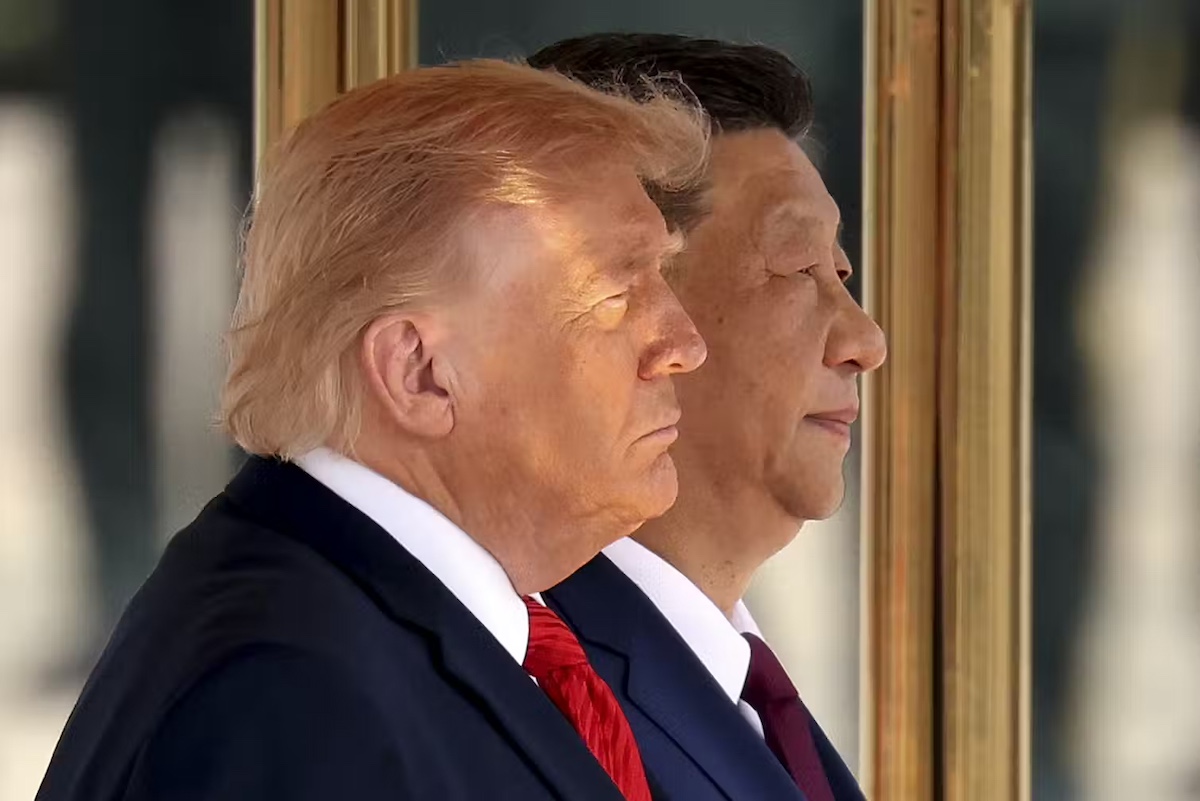
Looking back at Britain’s first official diplomatic expedition to Qing Dynasty China in 1793, expedition participant Peter Auber left behind a telling observation: the delegation had been “received with the utmost politeness, treated with the utmost hospitality, watched with the utmost vigilance and dismissed with the utmost civility.” That centuries-old line came to mind as international relations expert Kerry Brown watched Donald Trump’s two-day 2025 state visit to China unfold, drawing clear parallels between two landmark diplomatic engagements separated by more than 200 years.
Just like the 1793 British mission that sought to open new trade routes and establish a permanent diplomatic outpost in Beijing, Trump’s 2025 visit opened with elaborate ceremony and warm public gestures from both sides. Chinese President Xi Jinping opened the summit by welcoming his U.S. counterpart with conciliatory remarks, framing the bilateral relationship as “the most consequential in the world.” He even drew a connection between Trump’s signature political slogan, “Make America Great Again,” noting that U.S. growth aligned with China’s own development goals. Trump returned the praise in kind: in a social media post during his flight to Beijing, he wrote that President Xi commanded “respect from all,” and opened direct talks by telling Xi “You’re a great leader.”
Beyond these carefully calibrated diplomatic niceties and mutual compliments, however, the visit produced far fewer concrete breakthroughs than many observers anticipated. Correcting the persistent bilateral trade imbalance has been a core policy goal for Trump across both of his presidential terms. 2025 trade data underscores the scale of the gap: the U.S. exported just $106 billion in goods to China, while importing $308 billion in Chinese products, leaving a roughly $200 billion trade deficit. During Trump’s 2017 state visit to China, Beijing agreed to expand purchases of U.S. soybeans as a major confidence-building measure. On this 2025 visit, the only high-profile trade deal announced was an agreement for China to purchase 200 Boeing aircraft. Even that announcement fell short of market expectations: Boeing’s share price dropped 4% immediately after the deal was made public, as analysts had projected a far larger order. Trump also confirmed that China had agreed in principle to purchase U.S. crude oil, but no concrete timeline or volume commitments were released.
For the cohort of top U.S. tech CEOs that accompanied Trump on the trip—including Tesla’s Elon Musk, Nvidia’s Jensen Huang, and Apple’s Tim Cook—the visit delivered no major policy wins. China has long pursued a clear strategy of building up domestic indigenous technology capacity, a priority formalized in its latest 15th Five-Year Plan that reaffirms government support for homegrown innovation and domestic tech firms. With this strategic commitment in place, China made no major concessions to open its market further to U.S. tech firms during the summit.
While tangible economic outcomes were limited, the visit produced more meaningful, if less visible, progress in geopolitical management and great power dialogue. President Xi emphasized that even when the two powers disagree on core issues, global stability depends on their ability to engage pragmatically. The Taiwan issue, long the most sensitive flashpoint in bilateral relations, saw both sides reaffirm their core red lines without escalating tensions. Xi repeated China’s longstanding demand for U.S. non-interference in the Taiwan issue, a clear implicit warning against planned U.S. arms sales to the island, which Beijing considers an inalienable part of its territory. For his part, Trump told reporters he had not yet made a final decision on moving forward with the proposed arms package, and the U.S. delegation reaffirmed the longstanding U.S. policy position, in place since the 1970s, that the issue must be resolved peacefully through cross-strait dialogue. In the context of widespread global geopolitical turbulence, maintaining the status quo on Taiwan, while unremarkable, counts as a constructive outcome. On the ongoing Iran conflict, Xi offered Chinese mediation assistance to help de-escalate tensions between the U.S. and Iran. China has little interest in taking on a high-profile frontline mediation role, given the risk of being drawn into the region’s persistent instability. Instead, Beijing’s core goal is a long-term truce that allows both Washington and Tehran to claim victory without a decisive, disruptive war—an outcome that aligns with China’s interest in avoiding prolonged economic disruption from regional conflict, hence its offer of limited diplomatic support.
Looking back, history will likely frame this visit as another milestone in the gradual global shift toward a system where China holds greater international influence, while still acknowledging and respecting the U.S.’s current position as the world’s leading economic and military power. While Trump returned to Washington without a landmark policy win, it is a well-established truth of diplomacy that avoiding conflict and keeping dialogue open can be a positive outcome in itself. That the two leaders met, built a constructive personal rapport, avoided public clashes, and agreed to continue high-level talks may not be a transformative achievement, but in an era of unprecedented global instability, it is still a net positive for bilateral relations and global order.