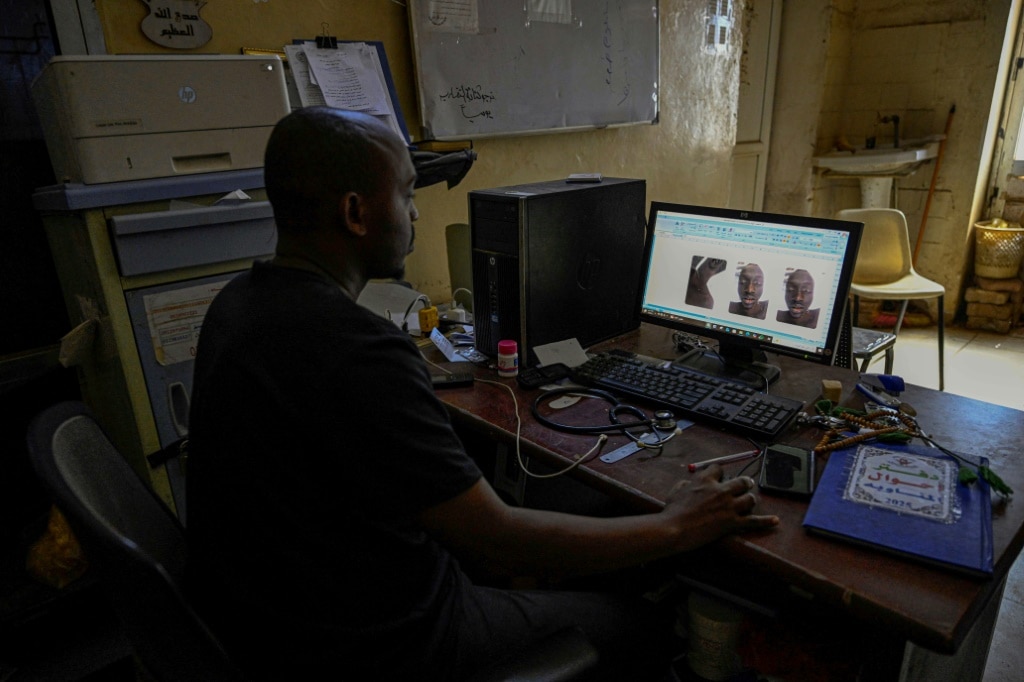
As Sudan’s brutal civil war between the national army and the Rapid Support Forces (RSF) paramilitary group enters its fourth year, the full scale of human loss remains uncounted – but ordinary citizens and humanitarian teams are working against overwhelming odds to give the war’s victims a dignified final resting place.
Ali Gebbai, an engineer who switched careers to become a volunteer mortician, keeps a meticulous spreadsheet of every person his team has laid to rest in Khartoum. With more than 7,000 entries, each marked with a photograph of the deceased and a note of their burial location, the document stands as one of the few unoffical, accurate records of the capital’s mounting death toll. When his crew recovers an unclaimed body, they first share the victim’s photo on social media, waiting a full 72 hours to allow grieving relatives a chance to come forward and claim their loved one.
“We photograph every body. We check if there’s anything in their pockets to help us identify them, and we mark the spot where we buried them,” Gebbai explained to Agence France-Presse during an interview at the team’s makeshift Khartoum morgue, where an unidentifed woman lay wrapped in a speckled brown thobe, awaiting burial. If no family claims her, Gebbai’s team will wash her body in accordance with Muslim tradition, wrap her in a clean white shroud, and bury her locally – a far more dignified end than the majority of Sudan’s war victims receive, many of whom are left in unmarked, shallow graves dug in the dirt where they fell.
No official, confirmed death toll exists for the conflict that broke out in April 2023. While conservative estimates count at least tens of thousands of fatalities, aid workers suggest the real number could surpass 200,000. The uncertainty around the death toll itself inflicts lasting trauma on millions of Sudanese who remain separated from their families, unsure if their loved ones are alive or dead. “It’s disheartening, all these estimations. When you have a population not knowing what has happened, that trauma and the impact cannot be overlooked,” said Jose Luis Pozo Gil, deputy head of the International Committee of the Red Cross (ICRC) in Sudan.
One year after Sudan’s army retook control of Khartoum, government forensic teams have exhumed and reburied roughly 28,000 bodies recovered from across the capital – and they have only cleared just over half of the city’s territory. Beyond Khartoum, the violence has been even more catastrophic: ethnic massacres in the Darfur region have killed thousands in single events, and at least 700 civilians have been killed by drone strikes in Kordofan this year alone.
Across the entire country, the existing morgue infrastructure has collapsed completely. Even before the war, Khartoum’s morgues were operating at full capacity, and all four of the capital’s main mortuary facilities were knocked out of service during the height of fighting. Many were left abandoned with bodies still trapped inside, with no power to preserve remains. The Omdurman morgue, one of Khartoum’s largest, was completely destroyed in an airstrike; its cooling compressors were looted, and bodies were left to rot throughout the building.
Trapped by crossfire and artillery barrages, civilians trapped in Khartoum during the worst fighting were unable to reach public cemeteries to bury their loved ones. Instead, they dug graves in residential courtyards, public playgrounds, street corners, and even along the banks of the Nile and in city sewers. Over three years of conflict, this turned the entire capital into an sprawling open-air graveyard. “That leaves a mark on society, it destroys human dignity and it normalises death,” said Hisham Zein al-Abdeen, head of forensic medicine at Sudan’s health ministry and one of only two forensic doctors still working in Khartoum. The same crisis has played out across the country: in Darfur, satellite imagery has captured widespread scenes of mass killing; in al-Jazira, bodies have been dumped in irrigation canals; and in Kordofan, drone strikes continue to claim civilian lives with no infrastructure to recover the dead.
Most of the bodies exhumed by government teams in Khartoum are identified by families who buried their loved ones themselves during the fighting, but are now seeking a permanent, proper resting place. But hundreds of others remain anonymous. For these unidentifed remains, forensic teams collect small bone and hair samples for future DNA testing – but Sudan has no fully operational DNA laboratories to process the samples, and no secure storage facility to hold them for future testing. For now, the samples are buried separately in marked plots, to be exhumed and tested at a later date.
The ICRC estimates that at least 11,000 people are currently listed as missing across Sudan. “We know that the lack of closure for families leaves an open wound. In any kind of recovery in the future, in order to find closure, to rebuild trust, the issue of the missing has to be addressed,” Pozo Gil noted.
For Gebbai, the work is relentlessly grim, but it offers a small measure of closure to grieving families. He recalled one young man who spent more than a year searching for his father and uncle, only to learn from the volunteer team that both men had been shot dead on a Khartoum street in the first weeks of the war. Though the news shattered the man, leaving him collapsed in tears, it also gave him something he had been denied for a year: the chance to visit his relatives’ marked graves and grieve properly.