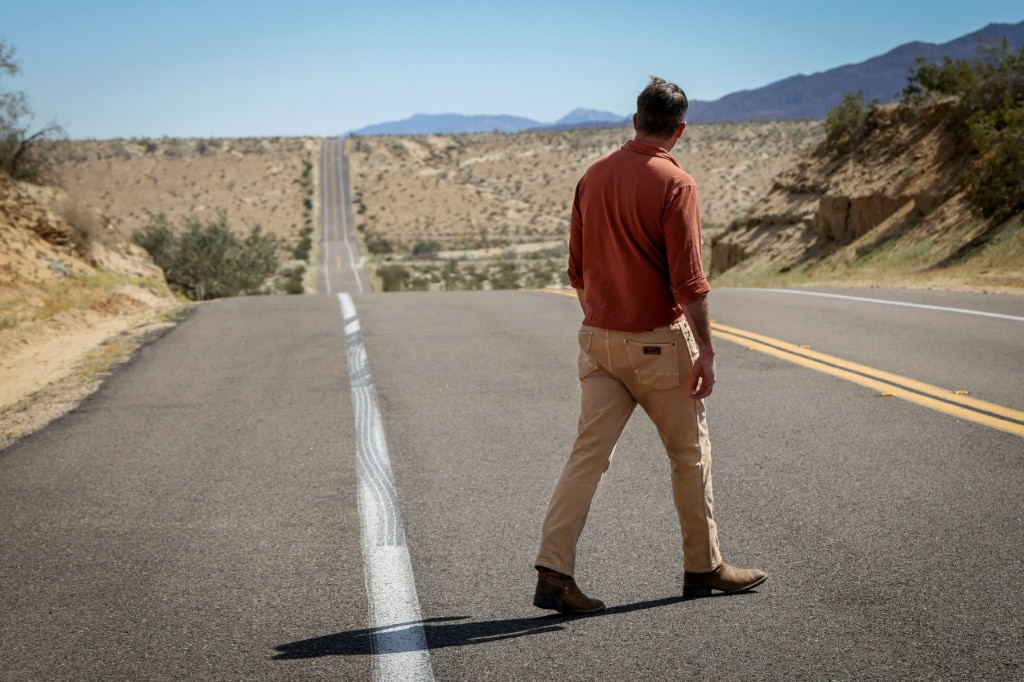
While conventional Hollywood car chases typically feature urban environments with screeching tires and vehicular collisions, Paul Thomas Anderson’s Oscar-nominated masterpiece “One Battle After Another” pursued an entirely different vision. Location manager Michael Glaser revealed to AFP how the film’s climactic desert pursuit emerged from an unconventional setting: Southern California’s undulating Highway 78, poetically dubbed the “River of Hills.”
This serpentine asphalt ribbon with its blind peaks and hidden troughs created a uniquely visceral chase sequence that stands apart in cinematic history. Anderson’s signature low-angle cinematography places audiences directly inside the roaring vehicles—a Ford Mustang, Dodge Charger, and modified purple Nissan Sentra—creating an immersive, palm-sweating experience.
The location itself functions as a metaphorical landscape reflecting the psychological struggle of protagonist Bob Ferguson (Leonardo DiCaprio), a faded revolutionary forced back into action when his daughter (Chase Infiniti) disappears. As Ferguson battles through decades of drug-induced haze to recall passwords and safe houses, he must outmaneuver the deranged Colonel Lockjaw (Sean Penn), hired by wealthy right-wing extremists.
Glaser, who guided AFP through the actual filming locations in Imperial County, described the road as embodying the characters’ dynamic: “It’s the characters pulling and pushing each other through something.” The production utilized multiple desert locations including Borrego Springs’ “The Texas Dip” among approximately 200 sites Glaser proposed.
Editor Andy Jurgensen detailed the meticulous filming process: “We shot over multiple days, capturing all necessary angles from front and rear perspectives while maintaining spatial consistency before assembling the final sequence.”
Glaser, whose role begins early in pre-production and continues through filming completion, emphasized how locations serve as “subconscious characters” that establish mood, visual palette, and emotional context. The film’s geographical journey mirrors its narrative arc—transitioning from Eureka’s lush greenery through central California’s winery country to the desert’s stark bleakness where the story culminates.
The location scouting process evolved organically, with Glaser comparing it to tree growth: “Some branches would die off, and others would sprout up.” The desert’s isolation particularly shaped the film’s third act, creating an environment where characters exist beyond societal constraints or assistance.
As “One Battle After Another” enters the Academy Awards with 13 nominations, Glaser reflects that while location managers don’t fit traditional award categories, their contribution remains fundamental: “Everyone’s DNA is in the film. We’re not directing it. We’re not in front of the camera. But there’s a little piece of us.”