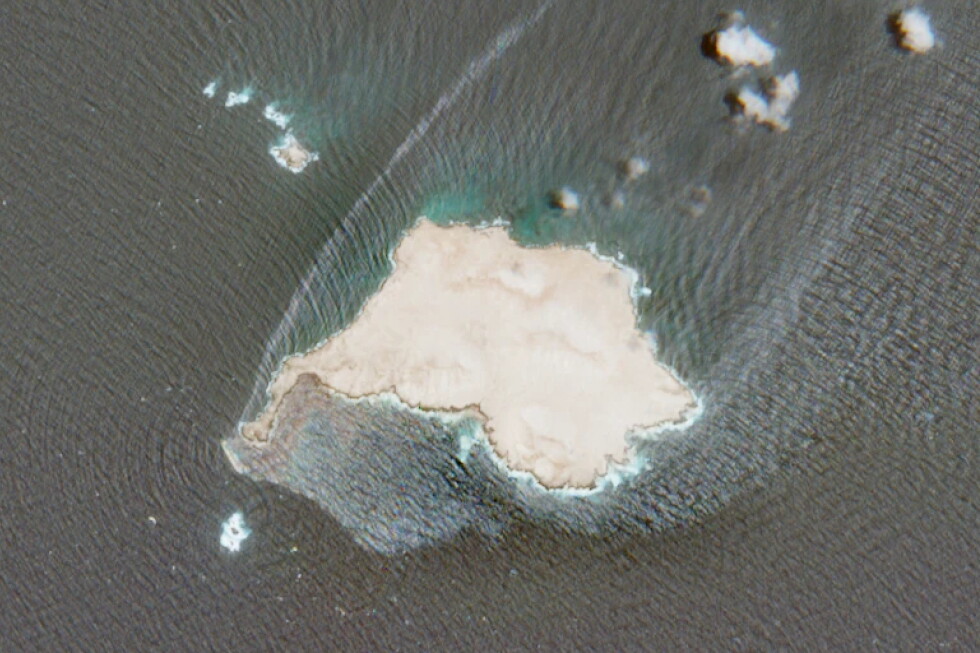
BEIRUT – A growing environmental crisis is unfolding off the southern coast of Oman, where a massive oil leak from a UK-sanctioned grounded tanker has expanded 7.5 times in just one week, pushing crude oil onto protected shorelines and far into the Arabian Sea, according to expert analysis of new satellite imagery reviewed by the Associated Press.
The vessel at the center of the disaster is the 274-meter Suezmax tanker *Caroline Bezengi*, a Cameroon-flagged ship that carries Russian crude oil. It has been sanctioned by the United Kingdom, European Union, Canada and Switzerland for its role in what Western authorities describe as evading price caps on Russian oil exports, activity the UK says “has been or is likely to be involved in activity whose object or effect is to destabilize Ukraine” in support of the Russian government.
The tanker has been stranded off Oman’s Dhofar governorate since June, after its crew reported an onboard explosion, according to maritime industry reports that the AP has not independently verified. Geospatial tracking firm SynMax Maritime previously confirmed via social media platform X that the vessel was docked at Russia’s Novorossiysk Black Sea port in May before starting its final voyage. It remains unclear what destination the tanker was heading to when it ran aground.
New satellite imagery captured on Sunday shows the spill has ballooned to an estimated 150 square kilometers (58 square miles), up from just 20 square kilometers a week earlier, Greenpeace Germany announced in a statement released Monday. The thick crude and spreading oil sheen now stretches roughly 90 kilometers (56 miles) along the coast – nearly double its length from seven days prior – and has already contaminated large sections of Qibliyah Island, located just offshore.
“It is a drastic increase,” explained Nina Noelle, a climate and ocean campaigner with Greenpeace Germany. “Clearly a large amount of crude oil is continuing to leak from the vessel. It is not yet clear what has caused the leak to accelerate at this rate.”
Wim Zwijnenburg, an environmental specialist with Dutch conflict and environment advocacy group PAX, confirmed that while much of the spread consists of thin evaporable oil sheen, thick sticky black crude patches have already reached the southern and western shorelines of Qibliyah Island. The entire affected area falls within the Arabian Sea Reserve, a protected marine habitat that hosts some of the rarest marine wildlife on Earth, including endangered petrel seabirds and the critically small, unique population of Arabian Sea humpback whales.
Greenpeace Germany’s statement warned that the rapid expansion of the spill highlights severe unaddressed risks tied to what experts call Russia’s “shadow fleet” – a network of unregulated, aging vessels that evade Western sanctions to ship Russian oil to global markets. “This dramatic expansion underscores the serious and continuing environmental threat posed by the stranded tanker — and exemplifies the dangers associated with the practices of Russia’s shadow fleet,” the organization said.
Oman’s Ministry of Transport, Communications and Information Technology ordered the tanker’s owners to remove the vessel and its remaining cargo – estimated to hold more than 800,000 barrels of crude – by a July 23 deadline, local newspaper *Muscat Daily* reported. As of Tuesday, there is no public information confirming whether the vessel’s owners have responded to the order or begun mitigation work to contain the expanding spill.