BANGKOK – Global financial markets kicked off mid-week with widespread gains on Wednesday, as a record-breaking rally on Wall Street fueled investor optimism across Asia, paired with sliding oil prices lifted by growing hopes for diplomatic progress that could de-escalate conflict tensions in the Middle East and reopen a critical global oil chokepoint.
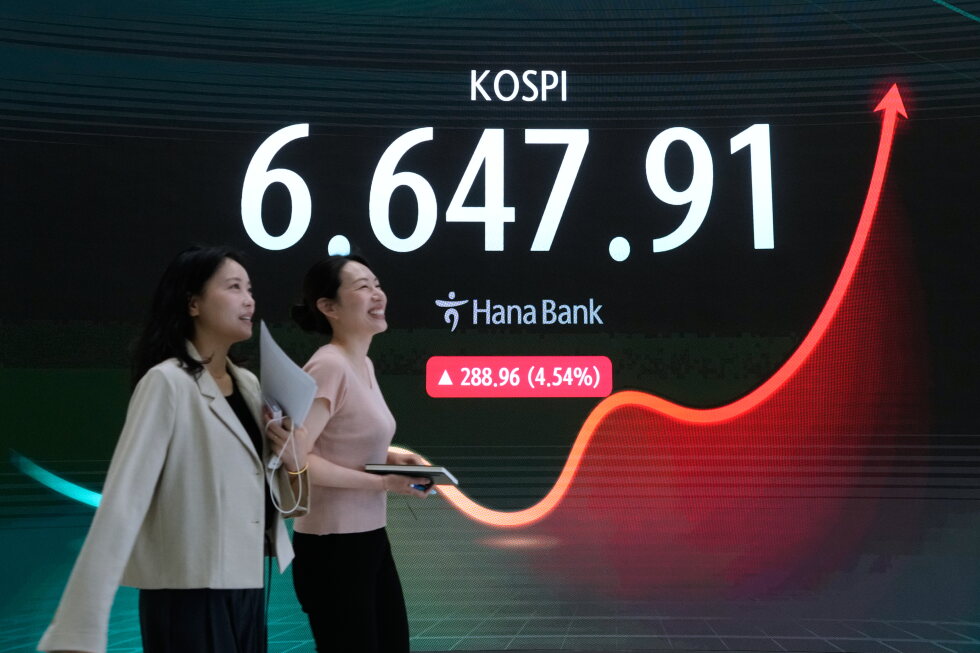
The wave of buying swept across major East Asian benchmarks, with all three top regional indexes posting gains exceeding 3%, led by a powerful resurgence in semiconductor and artificial intelligence (AI)-focused companies that have dominated market momentum this year. Japan’s Nikkei 225 climbed 3.3% to close at 66,068.24, with memory chip manufacturer Kioxia jumping 6.3% and chip testing gear producer Advantest soaring 6.9% by the closing bell. In South Korea, the Kospi notched an even steeper 4.4% gain to reach 6,642.02, led by a 6.7% increase for top memory chipmaker SK Hynix, while tech conglomerate Samsung Electronics added 4.1% to its value. Taiwan’s Taiex advanced 3.1%, with world-leading contract chip manufacturer Taiwan Semiconductor Manufacturing Company (TSMC) rising 3.5% to support the broader index.
Neil Newman, head of strategy at Astris Advisory Japan, noted that AI-linked stocks are the clear engine behind the day’s rally. “Clearly today the market is rallying on the back of AI stocks. You look across the other sectors, there’s a bit of activity here and there but really the focus has been back on semiconductors, technology and AI,” he explained.
Gains extended across other regional markets as well, though at a more moderate pace. China’s Shanghai Composite Index picked up 1.3% to finish at 3,873.56, while Hong Kong’s Hang Seng Index edged up just 0.1% to 25,881.20. Australia’s S&P/ASX 200 added 0.7% to close at 9,209.00.
Alongside the AI boom, sliding crude oil prices also gave markets a broad boost, as growing diplomatic hopes for a resolution to tensions blocking the Strait of Hormuz eased concerns about global energy supplies. The international benchmark Brent crude fell 1.2% to $78.43 per barrel in early Wednesday trading, following a 5.3% plunge on Tuesday that came as reports emerged of progress toward a deal between Iran and Oman to reopen the strategic strait – a passage through which roughly 20% of the world’s daily oil supply transits. That deal is reportedly contingent on the United States lifting its current blockade on Iranian ports. Through July, oil prices swung wildly between $72 and $102 per barrel, driven by persistent uncertainty over when Middle East tensions would ease to allow unimpeded crude exports from the Persian Gulf. U.S. benchmark West Texas Intermediate crude also slipped 1.1% to $74.96 per barrel on Wednesday.
The positive momentum in Asia followed a record-setting session on U.S. markets Tuesday, where stronger-than-expected corporate earnings across a wide range of sectors helped ease investor jitters. The broad S&P 500 jumped 1.8% to surpass its previous all-time high set in June, while the Dow Jones Industrial Average added 1.7% to extend its own record high set a day earlier. The tech-heavy Nasdaq composite led the U.S. rally with a 2.6% gain.
Strong second-quarter earnings reports have helped reassure investors that sky-high valuations for AI-focused companies are grounded in actual growing profits, easing fears of an overinflated stock bubble driven by AI hype. Data analysis and AI firm Palantir Technologies led the earnings winners, surging 29.5% after the company reported a 93% year-over-year revenue jump that CEO Alex Karp described as an “otherworldly” quarter. Heavy equipment manufacturer Caterpillar also outperformed analyst expectations for both profit and revenue, climbing 5.6% – the company is also benefiting from the AI boom via rising orders for turbines that power energy-hungry AI data centers. Top U.S. semiconductor stocks also notched broad gains: Nvidia added 2.6%, Broadcom jumped 6.6% and Micron Technology rose 7.6%.
Not all U.S. stocks moved higher, however: Chipotle Mexican Grill shares tumbled 9.7% after the chain removed jalapeño peppers from a number of locations following a linked salmonella outbreak, sparking investor concerns over near-term profit impacts. The company noted that Minnesota public health officials no longer have active concerns related to its operations.
New economic data released this week also reinforced the resilience of the U.S. economy, even as inflation remains above policymakers’ target levels. The U.S. Labor Department reported that employers posted nearly 7.4 million open job positions at the end of June, a small slowdown from May’s level but broadly in line with economist forecasts, signaling ongoing labor market stability.
In currency trading early Wednesday, the U.S. dollar edged slightly lower to 157.48 Japanese yen, down from 157.74 yen in the prior session. The euro inched up to $1.1540 from $1.1532 against the U.S. dollar.
Summarizing the market mood, Newman noted that while risks remain, the outlook has brightened considerably: “All in all, it’s looking much brighter. We’re still not completely out of the woods yet, but I think we’re seeing some route out of this now and it’s been reflected in the markets.”
Reporting contributions came from Matt Ott in Washington, Stan Choe in New York, and Mayuko Ono in Tokyo.