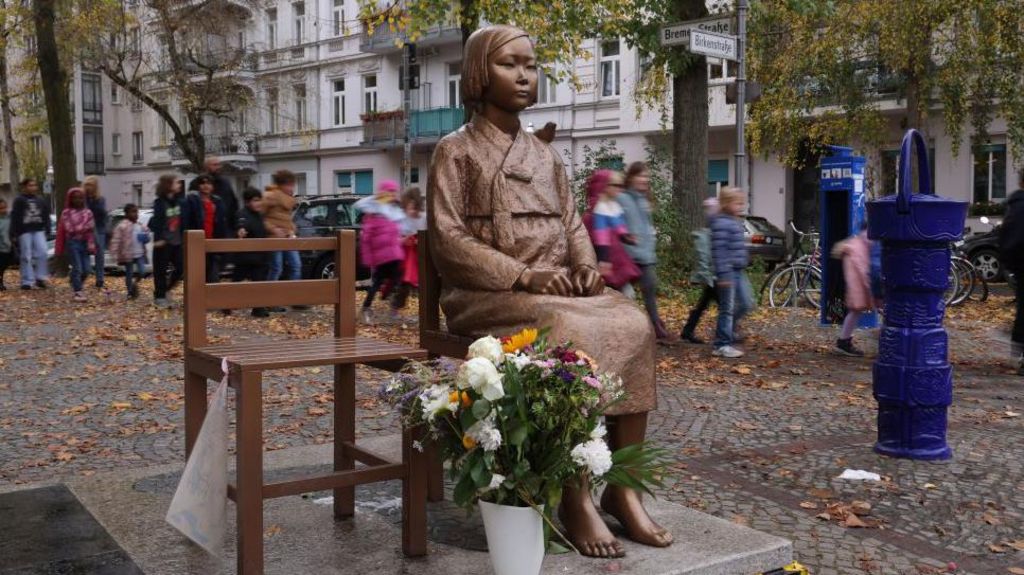
A highly contentious proposal to install a bronze memorial honoring World War II-era ‘comfort women’ — the systemic victims of Japanese military sexual slavery — has been struck down by local authorities in Auckland, New Zealand, following direct diplomatic pushback from Tokyo.
The planned monument, which would have mirrored the design of dozens of similar memorials across the globe by depicting a seated young girl beside an empty chair to represent all unrecognized victims, was a gift to New Zealand from the Korean Council for Justice and Remembrance, a South Korean non-profit that has spent decades advocating for acknowledgement and redress for the surviving comfort women and the legacy of the atrocity.
Historians estimate that between 1932 and 1945, more than 200,000 women and girls from across occupied East and Southeast Asia were forced into sexual servitude in Japanese military brothels. The majority of those victims were Korean, with additional large groups hailing from mainland China, the Philippines, Indonesia, and Taiwan. Only a handful of survivors are still alive today, and the movement to erect public memorials is framed by advocates as a way to preserve the historical record of the atrocity for future generations.
Japan’s Embassy in Wellington had publicly warned Auckland Council that installing the statue in a public municipal garden would risk severe damage to bilateral diplomatic relations between Japan and New Zealand. In a formal letter to council leadership, Japanese Ambassador Makoto Osawa argued that the memorial would deepen social rifts in New Zealand’s diverse, multiethnic society, particularly between the country’s resident Japanese and Korean communities, who currently coexist peacefully.
Osawa emphasized that Tokyo does not seek to deny or minimize the history of military sexual slavery during World War II, noting that successive Japanese governments have engaged in sustained diplomatic efforts to address the issue with South Korea over the decades. The ambassador’s pushback echoed a longstanding Japanese policy of opposing public comfort woman memorials in allied countries, a stance that has already triggered diplomatic friction in other parts of the world. In 2018, Osaka cut official sister-city ties with San Francisco after the US city installed a permanent comfort woman memorial in a public park, a move that reflected the depth of Tokyo’s opposition to such monuments.
In its official explanation for the rejection, Auckland Council’s Land and Property Advisory head Kim O’Neill told the BBC that the recommendation to turn down the proposal grew out of public consultation, which showed a clear lack of broad community support for the project. The rejection was later formalized in a vote by the Devonport-Takapuna Local Board, the local governing body with jurisdiction over the proposed site.
New Zealand’s national government previously confirmed that Japan had submitted formal diplomatic representations on the statue proposal, but emphasized that decisions around public monuments and memorials fall entirely under the purview of local government and community stakeholders, rather than the national executive. The outcome has reignited debate around the balance of diplomatic courtesy, historical memory, and grassroots advocacy, as activists vow to continue pushing for a public memorial to honor the victims of Japanese military sexual slavery in New Zealand.