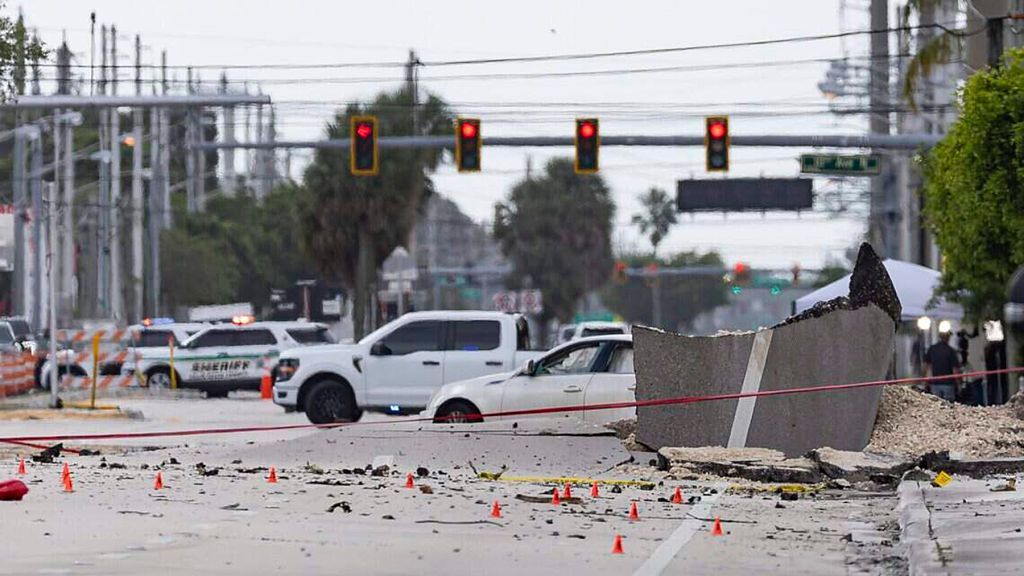
National Transportation Safety Board (NTSB) officials revealed key new findings Tuesday in their probe of a catastrophic Sunday private jet crash in Palm Beach, Florida, that claimed the lives of all nine people on board. Investigators confirmed that major segments of the Learjet 60’s left elevator — the tail-mounted control surface that regulates the aircraft’s nose pitch and vertical movement — were recovered scattered 1.3 to 3.8 miles away from the main impact site, broken into three distinct fragments. NTSB board member Tom Chapman emphasized that the significant distance between the recovered parts and the crash debris field provides compelling evidence that the components separated from the aircraft before it slammed into a multi-lane highway, not as a result of the collision itself. The twin-engine Learjet was en route from Austin, Texas, to the Bahamas when it suddenly entered a steep, uncontrolled nosedive, exploding on contact with the pavement and carving out a massive crater that has complicated recovery efforts for the badly mangled main wreckage. Released air traffic control audio captures the crew’s final, frantic communications: the pilots first reported moderate turbulence, active ice accumulation on the airframe, and unexpected precipitation buildup before requesting an immediate altitude climb. Within moments, their tone shifted to urgent distress, alerting controllers that the jet was losing altitude at a rate of 10,000 feet per minute, then declaring a full emergency as the descent accelerated to 20,000 feet per minute amid a dangerous overspeed condition, with the final transmission acknowledging the aircraft was seconds from ground impact. The nine victims have been identified as 55-year-old veteran pilot Jeffrey Gregory, 20-year-old co-pilot Nathalia Filgueiras — who had earned her pilot’s licence at age 17, three years prior to the disaster — tech entrepreneur Adam Robinson, his wife Helen Sharp, their two young children (four-year-old Emma and two-year-old Charlie), family friends Rachael Reed and Charmi Fehr, and family nanny Anita Maria Cetina. Chapman noted that the investigation has not yet determined a causal sequence, with two leading hypotheses under review: that the unexpected loss of the left elevator triggered the catastrophic loss of control, or that extreme aerodynamic forces generated by a prior in-flight emergency tore the control surface loose. He added that the elevator would likely have been functionally ineffective at the extreme speeds the aircraft reached during its steep descent. The NTSB has confirmed that weather factors, including icing conditions and turbulence, will be a central line of inquiry as the full, multi-phase investigation proceeds to pinpoint the root cause of the tragedy.