Amid one of the most active wildfire seasons in Canada’s modern history, a growing divide has emerged over how to protect remote, fire-prone communities — as longer, more intense blazes driven by climate change stretch national firefighting resources dangerously thin. As of August 2026, more than 750 active wildfires are burning across the country, following 2023’s record-breaking season that destroyed an expanse of boreal forest roughly equivalent to the entire nation of Syria. The smoke from these blazes has drifted as far south as the U.S. Midwest, choking urban airspace and even drawing a hostile tariff threat from former U.S. President Donald Trump, who attacked Canada for allowing “filthy, polluted” air to cross the border.
For Hubert Wigwas, a 58-year-old councillor with Gull Bay First Nation in northern Ontario, the choice to stay when a wildfire approached his community in mid-2026 was not an act of defiance for defiance’s sake — it was a decision to protect the life he spent decades building. As regional officials ordered all residents to evacuate and deployed firefighting resources to higher-priority populated areas, Wigwas stayed behind. He installed sprinklers on his roof to douse falling embers, checked on isolated elders who also refused to leave, and fueled four docked boats to have a quick escape route ready if the blaze advanced. Now, he faces a C$800 fine for violating the evacuation order, a penalty he plans to fight in court. “This is everything I’ve built in my 58 years,” Wigwas told reporters. “I’m just not going to run away and let it burn.”
Wigwas’s experience laid bare a gaping flaw in Canada’s national wildfire response strategy, he argued: remote First Nations communities, which sit adjacent to vast swathes of flammable boreal forest, are often left waiting for outside support that never arrives in time. That realization has pushed him to call for a new model: self-organized, community-led wildfire response teams trained to protect homes and elders before provincial crews can reach remote areas. “Everybody talks about climate change, but nobody is doing something to unite the (First Nations) reserves and have a system like that set up,” he said.
Provincial officials say their resource allocation follows strict protocols based on fire activity, weather conditions and risk to populated areas, and that they maintain constant communication with First Nations leadership. But thousands of kilometers away in northeast British Columbia, long Canada’s wildfire response front line, that community-led model Wigwas envisions is already a reality.
Over the past three years, wildfire researcher Sonja Leverkus has trained more than 400 local residents — most of them Indigenous — through her volunteer group, the Northeast BC Rural Incident Management Team. Leverkus launched the initiative after concluding that Canada’s traditional response system cannot keep up with the growing frequency and intensity of blazes driven by climate change. “There are not enough human beings in Canada, with the appropriate training, to fight the fires that we have currently, especially over the last five years,” she explained.
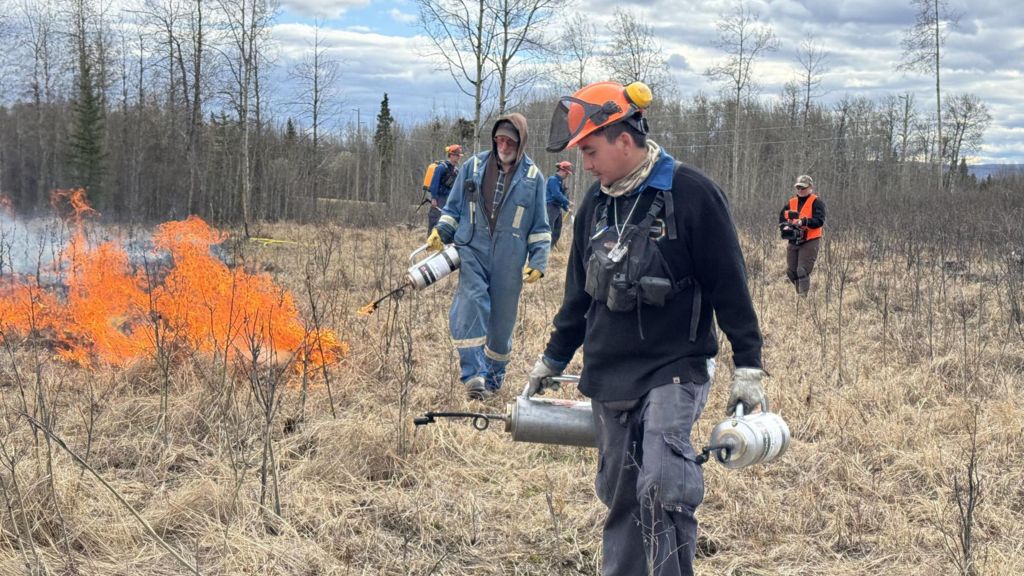
Remote communities in British Columbia are often deprioritized for provincial firefighting crews when major blazes threaten heavily populated areas, Leverkus noted, with the nearest backup support sometimes hundreds of kilometers away. Her team has addressed this gap by carrying out controlled prescribed burns to reduce excess fuel that can turn small blazes into catastrophic infernos, and has even purchased its own fire wagons through community fundraising and grants to extinguish small fires before they spread, often arriving ahead of provincial crews. During the 2024 Fort Nelson wildfire, Leverkus and 40 team members stayed behind and were contracted by the provincial government to clear flammable vegetation and support large-scale fire suppression efforts. She has also organized structural protection training to teach locals how to shield buildings from flying embers, the leading cause of home destruction during wildfire events.
Leverkus’s model has drawn support from local residents like 70-year-old former helicopter pilot Cam Allen, who took her training course to learn ground-based fire suppression after seeing the viral story of John Carr, a California man who saved his home from the 2025 Palisades Fire by defending it with a garden hose after most residents evacuated. “It makes you wonder, if 100 people had stayed or 1,000 people had stayed behind and actually did what he did, how much more could have been saved?” Allen asked.
But the push for community-led wildfire defense has sparked fierce debate among emergency management experts and government officials, who warn that allowing residents to defy evacuation orders puts both civilians and first responders at unnecessary risk. Last month, British Columbia wildfire crews were forced to stage a dangerous rescue operation after a man who refused to evacuate became trapped by flames surrounding his home in Clinton. British Columbia Emergency Management Minister Kelly Greene reiterated this month that all residents under evacuation orders must leave, noting that evacuation orders are only issued as a last resort to protect public safety, and that emergency teams may not be able to reach residents who stay behind if conditions worsen.
Paul Kovacs, director of the Catastrophic Loss Institute at the University of Western Ontario, explained that Canada’s low wildfire fatality rate is directly tied to its strict evacuation-first policy, a stance that contrasts with approaches in other fire-prone nations like Australia that allow for “stay and defend” strategies. “In the hierarchy of what is it that you do to manage a wildfire, preservation of life is first,” Kovacs said. While he agreed that local communities can play a critical role in fireproofing homes and structures ahead of fire season, he argued that that work should never take place while an active blaze is approaching.
Provincial officials note that British Columbia has expanded its full-time wildfire staff by 56% in recent years to match growing fire risk, and that self-organized rural groups can be temporarily contracted during major blazes when no provincial crews are available. But Leverkus’s group still lacks official government recognition, leaving trained volunteers at risk of penalties for staying behind to defend their communities. Leverkus is currently working to change that, emphasizing that her training program prioritizes safety above all else: all trainees learn to map multiple escape routes, read fire behavior, and follow orders from trained commanders who will order an evacuation if conditions become too dangerous. Not all trainees choose to stay and defend during active blazes, she added — only those who understand the risks are selected to remain.
“If people want to stay and defend, they need to understand what that means for themselves, what that means for their family,” Leverkus said. Her long-term goal is to turn her program into a national blueprint that can be adopted by remote and rural communities across Canada, creating a network of trained local teams that can fill gaps left by strained provincial response resources. For Wigwas, the fight is just beginning: as he prepares to contest his C$800 fine in court, he says he has no regrets about his choice to stay and protect his community.