Less than a week after inaugurating its most advanced naval warship to date, North Korea has carried out a series of high-stakes weapons tests that have underscored leader Kim Jong Un’s accelerating push to expand both nuclear and conventional military capabilities, according to state-run media reports from Pyongyang.
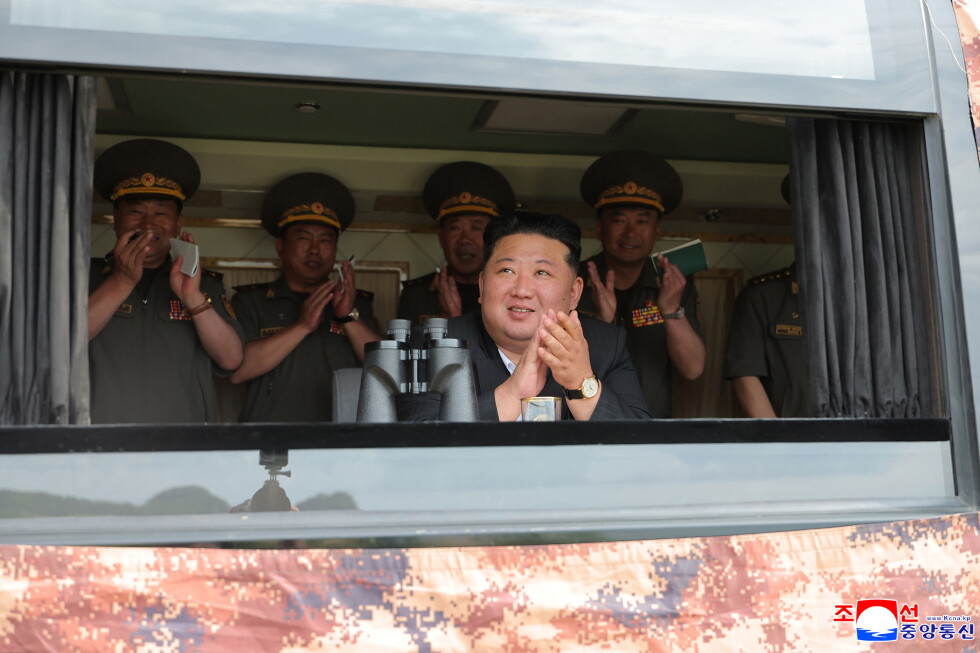
State media KCNA confirmed Friday that Kim personally observed four separate weapons trials held Thursday, which were designed to validate key technical upgrades for multiple frontline weapons systems targeting potential enemy positions along the inter-Korean border. The tests included a new “special mission” warhead for tactical ballistic missiles, an updated multiple rocket launcher system, and extended-range artillery rounds for self-propelled howitzers.
Kim stated that the successful trials confirm significant technological advances that will allow North Korea to revise its combat fire posture along the southern border, a statement widely interpreted as confirmation that all tested systems are engineered to strike critical targets in South Korea, including major U.S. military installations located across the country. The special-purpose tactical warhead, KCNA added, is explicitly designed to inflict catastrophic damage on high-priority enemy targets including military airfields, commercial ports, and key national power infrastructure.
Under Kim’s current national defense doctrine, Pyongyang’s self-defense strategy now centers on building a “deadly and destructive offensive posture” that will deter potential adversaries from choosing military confrontation. “To make the enemies feel constant uneasiness and fear is just an important aspect of the exercise of war deterrent,” Kim told military observers at the test site, per KCNA.
The latest round of tests aligns with a years-long shift in Pyongyang’s security and diplomatic posture that began after high-profile denuclearization talks between Kim and former U.S. President Donald Trump collapsed in 2019. Since that breakdown, Kim has prioritized rapid expansion of the country’s nuclear and missile arsenals, while also ramping up investment in modernized conventional weapons capabilities. While Kim has left the door open to a resumption of diplomatic talks with Washington, he has made clear that negotiations will only move forward if the U.S. abandons its longstanding demand that North Korea commit to denuclearization as a precondition for any diplomatic progress.
Relations with South Korea have deteriorated even more sharply in recent years: Kim has officially labeled Seoul Pyongyang’s “principal enemy” and has overseen the construction of additional military fortifications along the heavily militarized inter-Korean border. The weapons tests come just three days after Kim presided over the commissioning of the Choe Hyon, a new 5,000-ton guided-missile destroyer that Pyongyang frames as a tangible symbol of its growing naval and nuclear-powered strike capacity. The Choe Hyon is the most advanced warship ever deployed by the North Korean Navy.
In recent years, Kim has also worked to expand North Korea’s diplomatic and military ties abroad, most notably building a much closer partnership with Moscow that has included open support for Russia’s full-scale invasion of Ukraine. Just two weeks before the latest weapons tests, Chinese President Xi Jinping made his first visit to North Korea in seven years for a high-profile summit with Kim, a meeting that highlighted growing alignment between the two neighboring authoritarian states amid rising regional tensions with the U.S. and its allies.