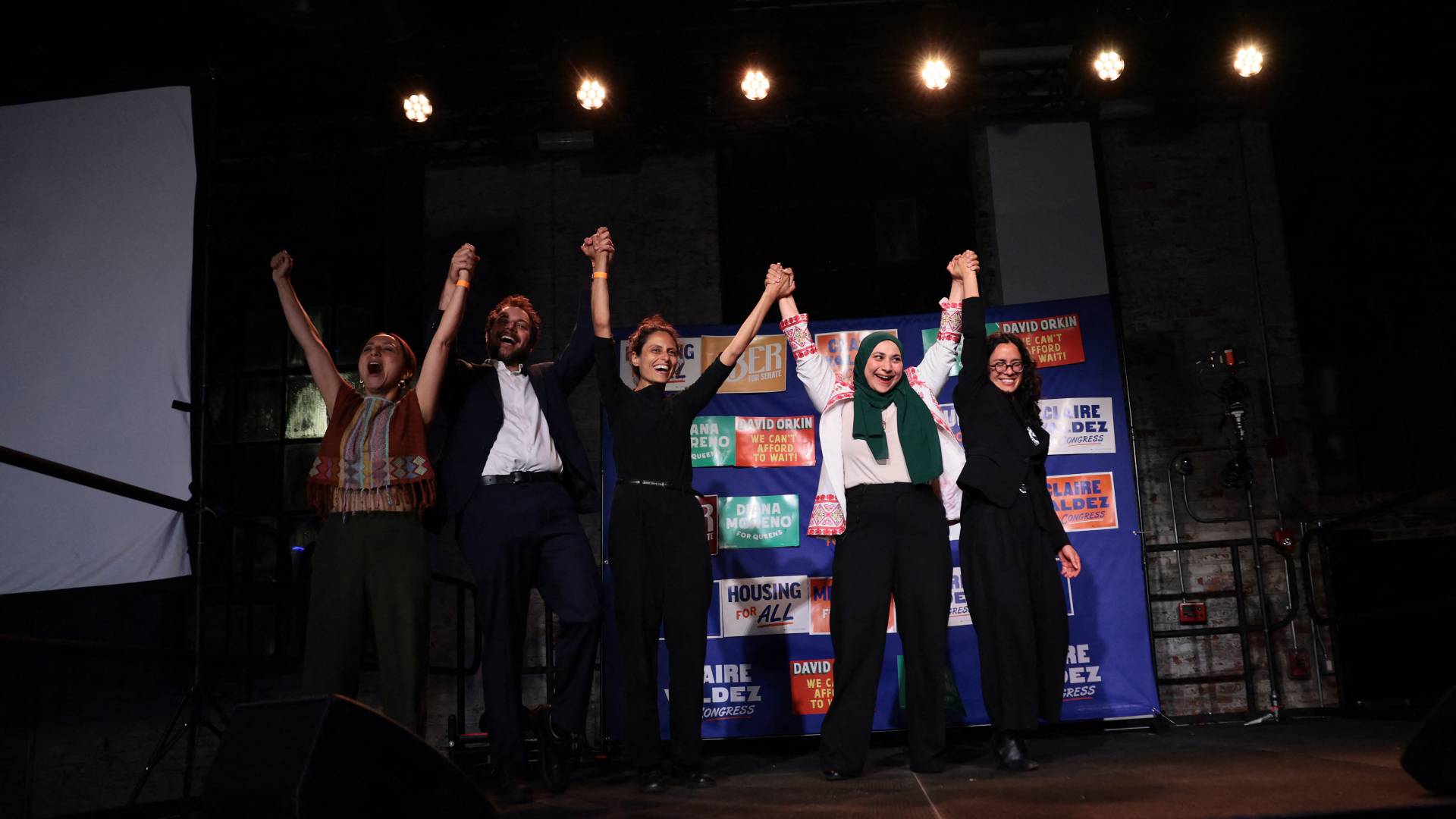
In a shocking political upset that has sent shockwaves through the U.S. Democratic Party, candidates backed by New York City Mayor Zohran Mamdani claimed major primary election wins across New York City this week, unseating three incumbent congressional Democrats and flipping five local legislative seats. The surprising results have ignited a fierce national debate over shifting party priorities, the growing influence of pro-Palestine sentiment among Democratic voters, and the future of the party’s long-standing alignment with pro-Israel interest groups.
Among the most high-profile upsets, former New York City Comptroller Brad Lander, running with Mamdani’s support, defeated two-term incumbent Congressman Dan Goldman in Brooklyn’s 10th congressional district. In another major shakeup, first-time candidate Darializa Avila Chevalier ousted long-serving veteran Congressman Adriano Espaillat, while Claire Valdez secured victory in an open congressional primary. Five additional Mamdani-backed candidates, including Palestinian-American activist Aber Kawas, won their New York State Senate primaries. If Kawas holds her seat in the November general election, she will make history as the first Palestinian-American member of the New York State Senate.
Competing narratives have quickly emerged to interpret the results. Factions of the Republican Party, alongside moderate establishment Democrats, have sounded the alarm over what they frame as a socialist takeover of the nation’s largest city and a growing anti-Jewish mobilization within New York’s political landscape. On the other side of the debate, pro-Palestine advocates and left-wing activists frame the primary sweep as clear evidence that rank-and-file Democratic voters are hungry for candidates willing to break from the party establishment’s unwavering pro-Israel stance.
Beth Miller, political director of JVP Action, the advocacy and electoral arm of Jewish Voice for Peace, called the results a clear warning to the Democratic Party establishment. She argued that the wave of wins was built on massive grassroots organizing, and hailed what she described as a pro-Palestine sweep across New York City, noting that voters are demanding candidates that back bold progressive priorities: taxing the wealthy, abolishing U.S. Immigration and Customs Enforcement (ICE), and advocating for Palestinian freedom. Miller also emphasized that the results exposed the American Israel Public Affairs Committee (AIPAC) as a toxic brand within the Democratic Party, adding that voters have grown weary of lawmakers who defend what pro-Palestine activists characterize as Israel’s ongoing genocide in Gaza.
Mainstream media outlets have echoed this framing: The New York Times framed the results as proof of a measurable leftward shift within the Democratic Party on Israel policy, while The Times of Israel argued that the primary sweep has cemented anti-Zionist politics as a permanent force in New York, home to the world’s largest Jewish diaspora community. Even some establishment figures have reacted sharply: U.S. Senator John Fetterman, a centrist Democrat, dismissed the winning candidates as part of what he called the “dirtbag left.”
Yet many political observers and even some pro-Palestine activists warn that framing the results as an outright, decisive victory for the Palestinian liberation movement overstates their significance. While three incumbents backed by AIPAC fell to candidates critical of Israel’s war in Gaza, and several pro-Palestine democratic socialists won local seats focused on bread-and-butter issues like rent stabilization, healthcare access, and eviction protections, analysts argue the results reflect a broader coalition of discontent rather than a single-issue mandate.
Critics of the dominant progressive narrative note that voter frustration with the Democratic establishment runs far beyond the Israel-Palestine issue. A 2025 Data for Progress poll confirms that New York City voters rank domestic economic concerns — particularly affordable housing and the rising cost of living — as the top issues shaping their votes, with just 27% of voters identifying U.S. foreign policy and relations with Israel as a key motivating factor for their choice. Mamdani, who rose to office on a platform of working-class economic transformation, has emphasized this coalition building, reiterating in a recent MSNBC interview that the only viable majority in American politics is a cross-ideological coalition of working-class voters united around economic justice.
“One of those tools is using your political capital to ensure that the people who will fight hardest for that same agenda are going to be there, whether it’s in Albany or whether it’s in DC,” Mamdani told host Chris Hayes, acknowledging that Palestine played a major role in the winning candidates’ support, but tying that support to his broader project of making New York affordable for working people.
Aber Kawas, the history-making primary winner, framed support for Palestine as a broader marker of a candidate’s willingness to challenge power: “Expressing support for Palestine is a signal that you are willing to speak out and speak truth to power, and I think that’s what people want out of their local politicians. What you are saying is, I’m going to fight for the most marginalised, forgotten communities that so many politicians don’t centre,” she told Middle East Eye earlier this month.
Still, critics within the pro-Palestine movement push back against framing the primary wins as a major win for Palestinian liberation. They argue that the movement’s focus has been narrowed to simply opposing AIPAC, rather than demanding a full end to U.S. complicity in Israel’s occupation and military campaign, and that many of the winning candidates fall far short of embracing full Palestinian self-determination.
The most prominent example of this tension is Lander, the winning congressional candidate who defeated Goldman. While Lander has stated he will oppose Israel’s occupation and actions in Gaza, he remains a self-identified Zionist who has previously opposed the Boycott, Divestment, Sanctions (BDS) movement, and as city comptroller oversaw an increase in New York City pension fund investments in Elbit Systems, Israel’s largest weapons manufacturer. Niaz Kazi, a professor at Stockton University and observer of U.S. Palestine politics, notes that Lander’s framing as a left-wing hero highlights the danger of diluting the Palestinian struggle into a broader economic critique.
“There’s something surreal in seeing self-identified Zionist Brad Lander’s face on schnazzy posters rendering him not the lesser evil, but a legitimate hero for the left,” Kazi told Middle East Eye. “At a time when those in the Palestine solidarity movement who disrupted the operations of Elbit Systems face the harshest of state crackdowns, it’s a sucker punch to see elements of the same movement celebrate Lander, given his own involvement with the arms manufacturer Elbit.”
Kazi added that the results ultimately prove that “Zionism can absolutely flourish without AIPAC,” arguing that the Democratic establishment is adapting to shifting public opinion by allowing a veneer of Palestine solidarity that does little to change on-the-ground policy for Palestinians. Local pro-Palestine group Within our Lifetime echoed this criticism, noting that Lander “proudly defended investing in genocide just last year,” casting doubt on his recent shift in rhetoric.
For its part, AIPAC pushed back on narratives of defeat, noting Wednesday that 180 of its endorsees across the country won their primaries and will advance to the November general election. The mayor’s office had not responded to requests for comment as of publication. As parties continue to battle over what the New York primary results mean for the future of the Democratic Party, one thing remains clear: the battle for the soul of the Democratic majority is just getting started.