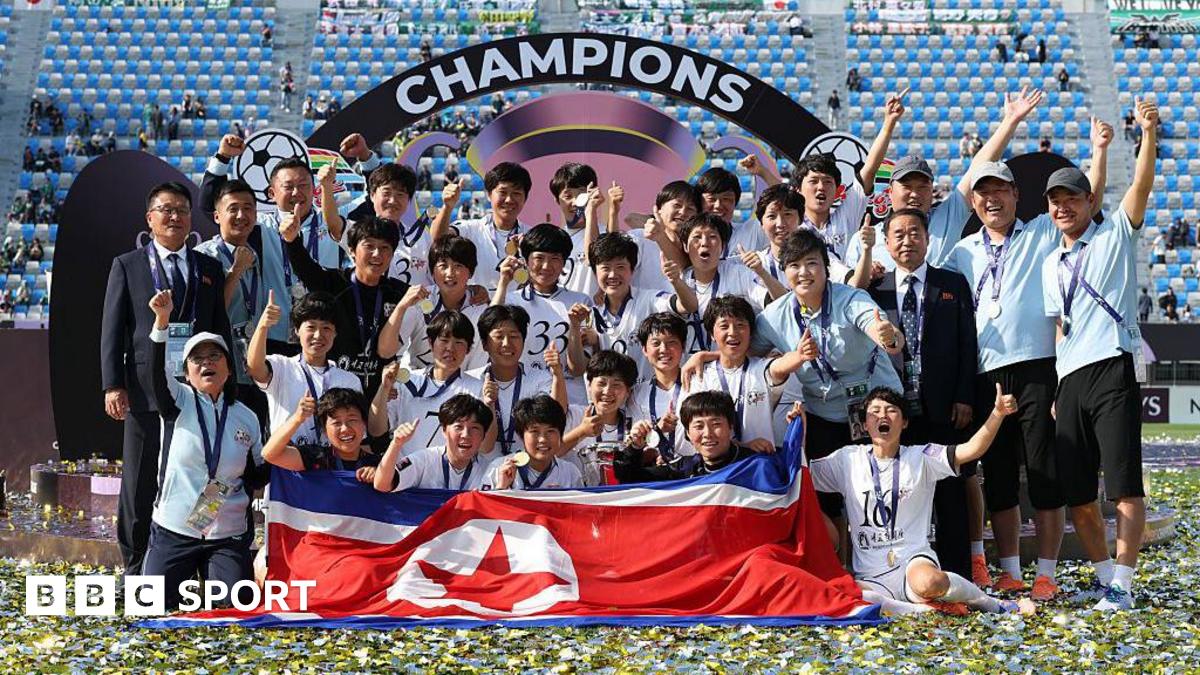
In a groundbreaking moment for both inter-Korean relations and women’s Asian football, North Korean club side Naegohyang has captured the 2025 Asian Women’s Champions League crown, securing a 1-0 victory over Japan’s Tokyo Verdy Beleza in the final held in Suwon, South Korea.
Founded in 2012 with a name translating to “My Hometown”, Naegohyang made history long before the final whistle even blew: this tournament marks the club’s first appearance in the continental competition, and their entry required a landmark border crossing from North Korea into the South, a rare occurrence amid long-strained relations between the two nations.
The winning goal came just before the halftime break from captain Kim Kyong Yong, whose strike proved enough to hold off the Japanese side and claim the trophy. After the final whistle, the team celebrated their victory by parading the North Korean national flag — a display that is normally classified as taboo under South Korea’s National Security Act, though exceptions are granted for specific international sporting events.
Following the win, Naegohyang head coach Ri Yu Il expressed the overwhelming emotion of the squad’s historic achievement. “Today, as we face a historic moment advancing into the world as the top team in Asia, the emotions and passion we feel are simply indescribable,” Ri said. “The trophy ceremony has already concluded and now we face the task of confronting various new challenges ahead of us.”
With their continental title secured, Naegohyang has qualified for the 2026 FIFA Women’s Champions Cup, the global tournament that brings together the top club champions from each of football’s six continental confederations.
Due to longstanding travel restrictions between North and South Korea, no official traveling supporters from North Korea were able to attend the Saturday final. Even so, roughly 1,200 members of South Korean civic groups, with backing from Seoul’s Unification Ministry, turned out to watch the match.
A small controversy emerged after the match, when Ri and goal scorer Kim walked out of the post-match press conference after a South Korean reporter referred to their country as the “north side” in a question. Ri later pushed back on the incident, noting that the squad had remained laser-focused on the competition throughout their stay. “All of our players focused solely on winning today’s match, putting in the effort while cherishing every minute and second,” Ri explained. “I did not have the time or room to concern myself with various other issues.”
Ahead of the tournament, South Korea’s Unification Minister Choo Dong-young framed the club’s participation as a potential turning point for cross-border ties, saying the match would set a “positive precedent” for future inter-Korean engagement.
Context around the event stretches back decades: the Korean War concluded in 1953 without a formal peace treaty, leaving the two nations technically still at war. While multiple efforts have been made to warm relations over the years, ties have deteriorated sharply in recent years. North Korea has repeatedly labeled South Korea its “most hostile state” and announced it would no longer pursue formal reunification. Current South Korean President Lee Jae Myung has made improving inter-Korean relations a core policy priority of his administration.