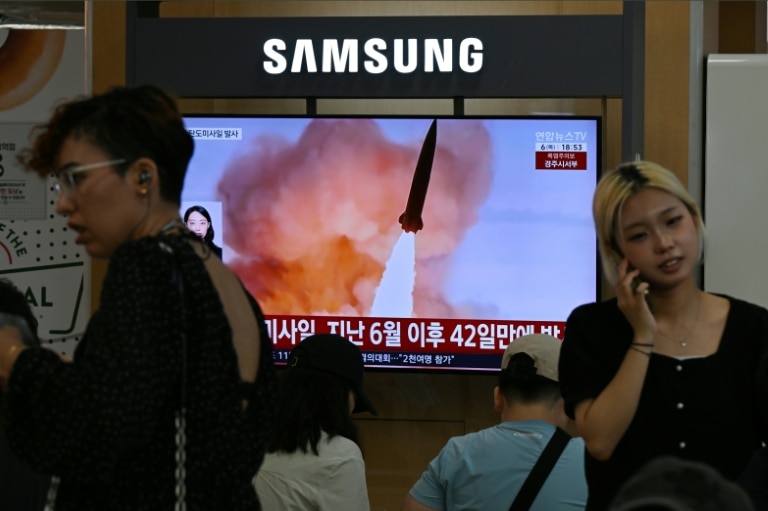
In a move that has stoked already simmered tensions across Northeast Asia, North Korea test-fired a short-range ballistic missile toward the Sea of Japan on Thursday, according to South Korea’s Joint Chiefs of Staff (JCS). The launch came just one day after a senior North Korean official issued a sharp rebuke of Japan’s accelerating military buildup in the Pacific region.
South Korea’s top military body confirmed that the missile was launched around 5:00 p.m. local time from the coastal Wonsan region of North Korea, with the projectile heading toward the body of water known as the East Sea in Seoul and the Sea of Japan in Tokyo. Officials from both Seoul and Washington are currently conducting detailed analysis to determine the missile’s exact specifications and capabilities, the JCS added in an official briefing to media outlets.
Japan’s defense ministry first reported the launch via social media platform X, noting that an object suspected to be a ballistic missile had been fired from North Korean territory, before later confirming that no debris or damage had been recorded in Japanese territorial areas. In response to the launch, South Korea has bolstered its surveillance activities and raised its military readiness posture to prepare for potential additional launches, while coordinating real-time intelligence sharing with its key security allies, the United States and Japan.
This latest missile test comes amid a rapidly shifting regional security landscape. In a recent Japanese government security assessment, North Korea — which has repeatedly labeled itself an “irreversible” nuclear power since 2019 — was flagged as one of the fastest growing threats to Japanese national security. This week, Japanese Defense Minister Shinjiro Koizumi argued that Tokyo must accelerate military expansion with a urgent sense of crisis to address regional risks.
On Wednesday, Kim Yo Jong, the influential sister of North Korean leader Kim Jong Un, released a statement through North Korean state media warning that Pyongyang would adopt new military countermeasures in direct response to Japan’s military transformation. “Japan’s push for remilitarization leaves us no choice but to strengthen our own defense capabilities,” the statement implied.
Later this month, South Korea and the United States are set to hold their annual Ulchi Freedom Shield joint military exercises, a drill long framed by Washington and Seoul as a defensive training exercise to deter North Korean aggression. Pyongyang has consistently condemned these joint drills, labeling them offensive invasion rehearsals that justify its own weapons development programs.
On Thursday, the JCS reaffirmed that the combined South Korea-U.S. defense posture remains fully prepared to deliver an overwhelming response to any form of North Korean provocation.
Analysts have linked Thursday’s launch to a number of ongoing geopolitical shifts, most notably North Korea’s deepening military and economic alignment with Russia. Experts widely believe North Korea has supplied troops and ammunition to support Russia’s campaign in Ukraine, in exchange for Russian financial aid, food supplies, energy resources, and advanced military technology.
Several regional security experts suggest the test could be a pre-demonstration of North Korea’s missile capabilities ahead of a widely anticipated visit by Kim Jong Un to Russia later this year. “Before heading to Moscow, Kim may want to prove that these new missile systems have completed successful testing and meet performance requirements,” said Ahn Chan-il, a North Korean defector and senior researcher based in Seoul. “If the visit goes forward, Kim will almost certainly showcase these systems to Russian officials and could even open talks for exports.”
Tokyo has pushed back against criticism of its military expansion, with defense officials declining to directly respond to Kim Yo Jong’s remarks but reiterating that Japan’s increased defense capabilities are a minimal necessary deterrent and “do not pose a threat to any other country.” Even so, Tokyo’s 2025 defense budget saw a 9.7 percent increase to $62.2 billion, equal to 1.4 percent of Japan’s GDP — the highest share of GDP allocated to defense since 1958.
Even China, North Korea’s long-standing key ally, has recently raised alarms over what it describes as Japan’s “new militarism,” adding another layer of complexity to regional tensions. The launch also comes as South Korea’s new political leadership has shifted its approach to Pyongyang: Dovish President Lee Jae Myung, who took office in June 2025 after defeating his hawkish predecessor, has repeatedly offered Pyongyang open denuclearization talks without preconditions, but North Korea’s closed leadership has yet to respond to any of the offers.
Notably, the two Koreas have remained technically in a state of war for more than 70 years. The 1950-1953 Korean War ended with an armistice agreement rather than a formal peace treaty, leaving the divided peninsula in a perpetual state of Cold War-style tension that continues to shape regional security dynamics today.