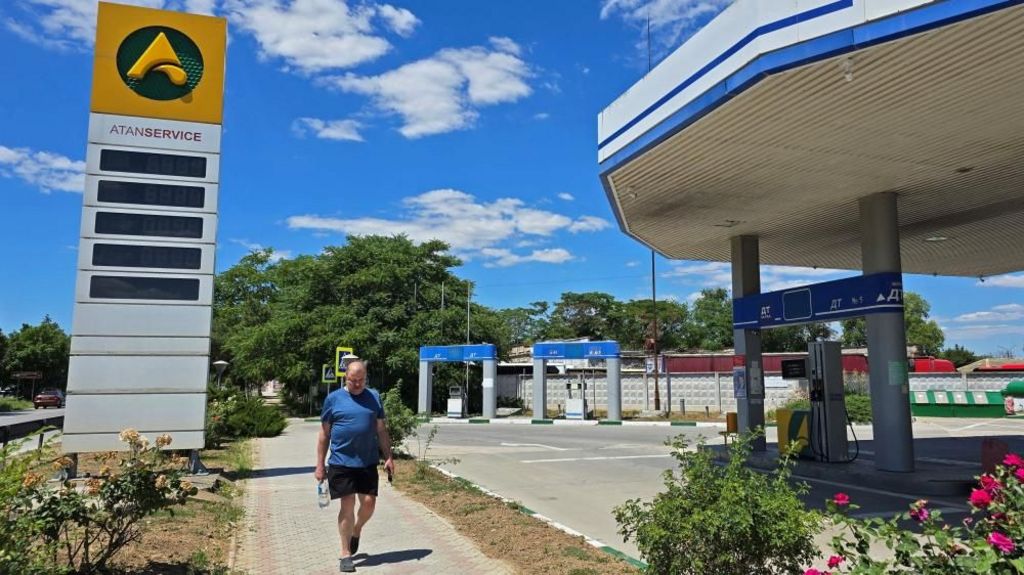
As Ukraine ramps up its targeted campaign to cut off supply lines to the Russian-annexed Crimean Peninsula, the occupied region is sliding into a deepening crisis marked by full suspensions of public fuel sales and spreading power blackouts that have upended daily life for local residents. The peninsula, which Moscow illegally annexed from Ukraine in 2014 and remains internationally recognized as Ukrainian sovereign territory, has seen its critical transport and logistics links steadily degraded by Kyiv’s ongoing military operations.
Sergei Aksyonov, the Russian-appointed head of Crimea’s occupation administration, announced a sweeping suspension of all public petrol station sales on Sunday, reallocating the peninsula’s remaining fuel stockpiles exclusively for official government and military use. Local residents have already documented the harsh impact of the new restrictions: one local told reporters he has switched to bicycle travel for most trips, only using his car when completely unavoidable. He explained that while fresh fuel deliveries arrived overnight ahead of the order, all sales were immediately halted after Aksyonov’s decree went into effect.
In Sevastopol, Crimea’s largest city and a key strategic Black Sea port, one resident told the BBC he had purchased a backup generator to cope with rolling blackouts only to find himself without fuel to run it. Local authorities have expanded restrictions beyond fuel access to cut non-essential energy use: public transit, retail shops, and food service venues now only operate during daylight hours, and all street lighting has been turned off overnight to conserve power. Even before the full sales suspension went into effect, the Sevastopol resident noted fuel prices had skyrocketed, with filling a tank costing 50 percent more than the average price across mainland Russia.
“It’s unclear how long this will last, and as for getting to work, I honestly have no idea what I’m going to do,” he said. The growing uncertainty has also sparked panic buying across local grocery stores, with multiple residents confirming widespread shortages of staple goods including sugar.
The crisis in Crimea is part of a broader fuel shortage crisis that has spread across parts of Russia in recent weeks, driven by repeated Ukrainian drone strikes on Russian oil refineries in multiple regions, including the Moscow area. Russian President Vladimir Putin acknowledged the scope of the challenges facing his administration on Tuesday, while Deputy Prime Minister Alexander Novak framed the situation as challenging but manageable, adding that Moscow was prioritizing supplies to Crimea and occupied border regions. The Kremlin has already suspended exports of petrol and jet fuel, and is currently considering a full ban on diesel exports to shore up domestic stockpiles.
In Crimea, the acute fuel shortage has been severely exacerbated by Kyiv’s targeted campaign to destroy key bridges connecting the peninsula to occupied southern Ukraine, part of what Ukrainian Defense Minister Mykhailo Fedorov has dubbed a “logistics lockdown” that uses AI-enhanced drones to disrupt Russian military supply lines. Before the 2022 full-scale invasion, Crimea relied on two main connections to Russia: the 2018 Kerch Strait road-rail bridge, and a land corridor of road and rail links through occupied southern Ukraine. After Ukraine damaged the Kerch Strait bridge in a 2022 strike, the M14 highway through occupied southern Ukraine became the primary route for fuel deliveries to the peninsula.
BBC Verify has confirmed that at least six key bridges across the region have been targeted by Ukrainian strikes in June alone, most notably multiple attacks on the critical Chonhar road and rail bridges connecting northeastern Crimea to the mainland. Satellite imagery shows Russian forces rushed to install temporary pontoon bridges to restore crossings, but these temporary structures created massive truck bottlenecks that have since been targeted by follow-up Ukrainian strikes, verified drone footage confirms.
In the weeks leading up to the full fuel sales suspension, social media videos from Crimea showed massive queues of cars stretching for kilometers at filling stations, with residents complaining of repeated inability to top up their tanks. Some Russian tourists posted videos showing completely dry stations, with one visitor who traveled from mainland Russia recommending other tourists bring their own fuel supplies to avoid being stranded. The occupation administration has also taken the unusual step of shutting down all popular children’s summer camps across the peninsula, including the iconic Artek camp on Crimea’s southern coast. Multiple trains carrying children to the camps were halted mid-journey, with passengers reporting groups of children disembarking and leaving behind all their food and supplies.
Ukraine’s long-range “middle-strike” drones, capable of hitting targets up to 200 kilometers behind the front line, have successfully disrupted the M14 highway route and other key supply corridors. In recent months, Kyiv has expanded the logistics lockdown campaign to target additional transport links, including the highway running north from Mariupol to Donetsk and key routes in Luhansk Oblast. This expansion has spread the fuel crisis into Russian-occupied eastern Ukraine, a region already reeling from a two-year-long water shortage caused by the destruction of the Siverskyi Donets river water pipeline during the 2022 Russian offensive.
One resident of occupied Donetsk told the BBC that running water is only available once every three days, fuel is the most expensive in the entire country, and residents have to purchase bottled water for drinking. Most cars have disappeared from city streets, he added, and there has been no large new wave of displacement because “everyone who could and did want to leave has already done so.” He warned that the growing scarcity is creating a life-or-death situation for vulnerable groups: “A shrinking range of goods and rising prices are not such a serious problem for people who are mobile and economically active, but for the elderly, children, and people living in refugee accommodation centres it becomes a matter of life and death.”
While Russian supply routes into Crimea have become increasingly dangerous and costly to maintain, they have not yet been fully cut off. Military analysts note that Ukraine’s persistent targeting of key fixed bridges poses a greater long-term threat to Russian supply capabilities than strikes on roadway corridors, as permanent crossing replacements are far more difficult to execute than temporary repairs to damaged roads.
No fuel for sale as Ukraine’s blockade of Russian-occupied Crimea takes effect