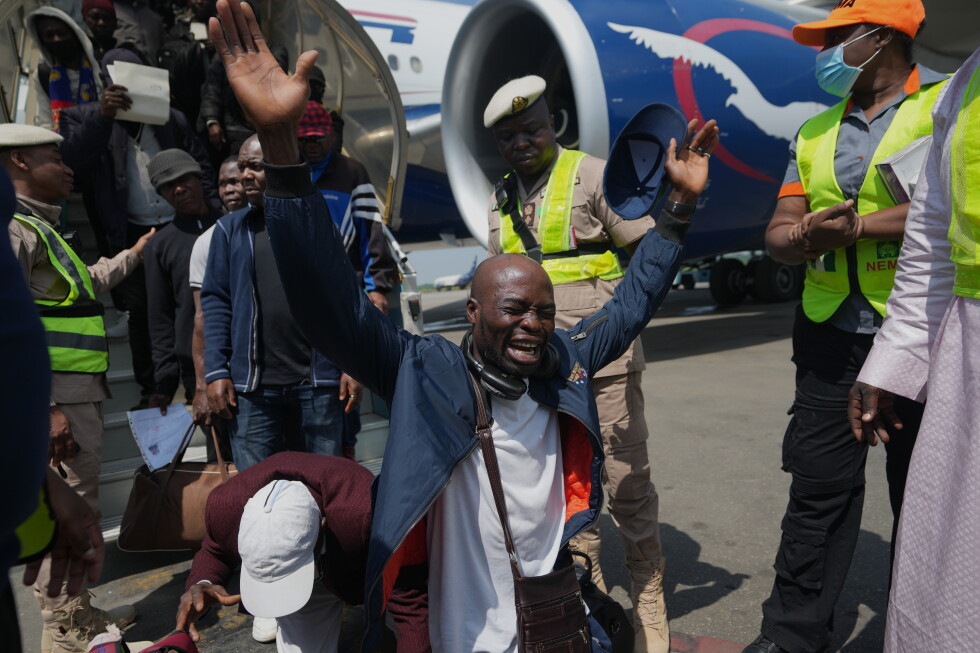
LAGOS, Nigeria — For 52-year-old Iniebong James, the rush of relief after his repatriation flight touched down in Lagos last week quickly gave way to quiet anxiety. Nearly two weeks back on Nigerian soil, he is still struggling to rebuild a life he walked away from a decade earlier, when he first left for South Africa on a six-month visitor visa that he would ultimately overstay.
After overstaying his visa, James carved out a living as a car mechanic in South Africa’s Eastern Cape Province, a quiet existence that unraveled in May when he was assaulted by anti-immigrant demonstrators, leaving him with a severe head injury, he told the Associated Press. His attack is far from an isolated incident: in recent months, South Africa has seen a sharp escalation of anti-migrant sentiment, with public marches demanding the expulsion of undocumented migrants and widespread reports of targeted violence against foreign nationals.
In response to the rising threats and growing tension, several African governments have organized large-scale repatriation efforts to bring their citizens home from South Africa, with hundreds of Nigerians among the first groups evacuated. For decades, South Africa has drawn millions of migrants from across the continent, pulled by its relatively robust economy and greater access to economic opportunity compared to many neighboring nations. But this steady influx of migrants has been repeatedly punctuated by sporadic outbreaks of xenophobic violence, as many South Africans blame undocumented foreigners for the country’s persistently high unemployment rates, widespread poverty, strained public services and rising crime.
For James, the decision to leave Nigeria back in 2014 was driven by economic collapse. Before his move, he worked as a truck driver for a Lagos-based haulage company, which shut down in 2016 when Nigeria entered its first economic recession in 20 years. Persistent job insecurity paired with crippling, days-long national power outages pushed him to seek opportunity abroad. During his years living in South Africa with an expired visa, James says he paid regular bribes to local police and immigration officials to keep operating his small mechanic shop, claims the AP has not been able to independently verify.
James is among the first group of Nigerians repatriated on the government-organized flight that departed South Africa on June 11. While he says he values the freedom of being back in his home country, he faces a far grimmer economic reality than the one he left. Over the past decade, Nigeria’s economy has contracted significantly, prompting sweeping economic reforms from new President Bola Tinubu in 2023. Those reforms included eliminating long-standing national fuel subsidies that had kept fuel prices artificially low for decades, as well as allowing the Nigerian naira to float on the open market. These policy changes, compounded by global market volatility stemming from U.S.-Iran tensions, have sent inflation soaring across the country. When James left Nigeria in 2016, fuel cost roughly $0.10 per liter; on the day he returned, that same liter cost $1.03. “Everything is too expensive,” James noted. He says he is willing to take any available work, but is pinning his hopes on government support to secure stable employment.
Nigerian authorities have stated that repatriated citizens will receive appropriate support before reuniting with their families, but the Ministry of Foreign Affairs has not responded to questions about long-term support plans for returning migrants. Migration expert Margaret Monyani, founder of the Johannesburg-based OLAM Africa Research Institute, emphasizes that restarting life after repatriation is far from simple. “Reparation is not transformation,” Monyani explained. “Returning is not always as straightforward as it sounds. People just think, go back home and start again. No, what is home?”
Twenty-year-old Omotola Adeniyi echoes that sense of disorientation. She moved to South Africa to join her mother in 2015, when she was just 8 years old. After finishing high school, she found herself locked out of formal employment and higher education entirely. “After I finished high school, that’s when I saw real life because everywhere I looked for a job, all I could get was, ‘No, we don’t want to employ foreigners,’” Adeniyi said. She began saving for a return flight last year, but airfare was out of reach, so she accepted the Nigerian government’s offer of a free flight home. After 11 years away, she says Nigeria now feels like a foreign country.
The recent wave of anti-immigrant violence and protests has sparked widespread diplomatic backlash across the African continent. In addition to Nigeria, governments including Ghana, Malawi and others have organized repatriations for their citizens, and both Nigeria and Ghana summoned South Africa’s top diplomatic representatives to issue formal protest over the violence. “The price of your peace, and the safety of your children, is worth any sacrifices you have to make, or any assets you have to leave behind when fleeing a conflict zone or hate-infested environment. Survival is the noblest form of vengeance,” Nigerian Foreign Minister Bianca Odumegwu-Ojukwu told returning migrants in a statement delivered by her representatives upon their arrival in Lagos.
Even amid the ongoing outbreaks of xenophobic violence, migration experts note that South Africa remains a top destination for most African migrants due to its more advanced economy and developed infrastructure. “It doesn’t mean South Africa has the perfect institutions, but they’re working to a large extent,” Monyani added.
This coverage is supported by the Gates Foundation as part of the AP’s global Africa development reporting, with the AP retaining full editorial control over all content.