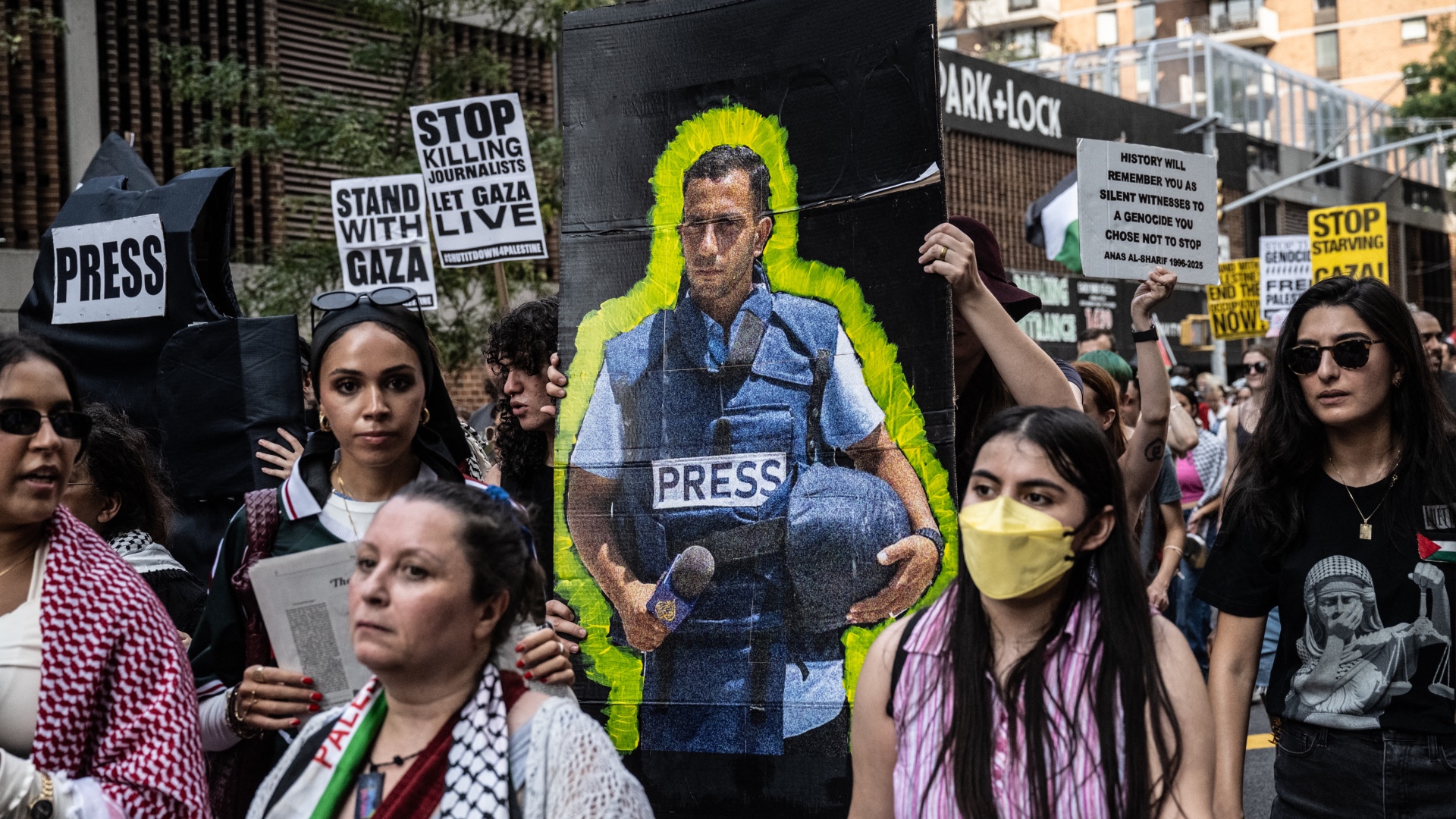
One year ago, 28-year-old Palestinian journalist Anas al-Sharif was killed in an Israeli airstrike in Gaza. When his death was announced, Reuters framed the killing around Israel’s unsubstantiated claim that Sharif was a Hamas leader, echoing a pattern that has played out for more than 200 Palestinian journalists killed in Gaza since the outbreak of the Israel-Gaza war in October 2023. Now, a new initiative launched by activist collective Writers Against The War On Gaza (Wawog) aims to correct this erasure and distortion by centering the personal stories of slain Palestinian journalists, told by the colleagues who worked alongside them.
Named *The Living Record*, the oral history project launched Wednesday with intimate voice-note eulogies for 50 fallen Palestinian journalists, with dozens more profiles set to be added throughout the year. Eventually, the project’s organizers plan to expand the archive beyond Gaza to include journalists killed in southern Lebanon.
In an anonymous interview with Middle East Eye, a member of the New York War Crimes editorial collective — an initiative overseen by Wawog — described the project as a large-scale documentation of systemic failure. “This is a record of failure of mainstream media, of western media, of international institutions to protect individuals [as governed] by international law,” the collective member said.
Unlike the formal, depersonalized profiles that often characterize obituaries of Palestinian journalists in international media, *The Living Record* prioritizes intimate, unscripted storytelling. Colleagues who contributed to the project were encouraged to speak like they were talking to a friend, rather than performing for a skeptical global audience that often demands Palestinian journalists prove their objectivity before their work is deemed credible.
“Often when we spoke to these [Palestinian] journalists, there’s a tendency for them to speak in a very formal register because they’re accustomed to that being the only way that people would be willing to listen, whether on a live broadcast or in a formal interview where they’re anticipating a critique or a challenge — that they must present themselves as sort of indefatigable, impossible to move,” the collective member explained. “We didn’t want that.”
The result is a deeply moving collection of testimonies. Contributors range from grieving colleagues who are broken by loss but unshaken in their work, to speakers who address their fallen friends directly, letting audiences listen in on what feels like a private conversation. For many Palestinian journalists still working in Gaza, the expectation of becoming the next victim is a constant, unspoken part of daily life.
Disputes over the death toll of Palestinian journalists have underscored the gaps between local and international institutional accounting. The Palestinian Journalists Syndicate puts the number of media workers killed by Israeli forces in Gaza at no less than 270. However, the New York-based Committee to Protect Journalists (CPJ), whose figures are routinely cited as the official count by most mainstream media outlets in the U.S. and Canada, currently counts 209 dead Palestinian journalists after removing 20 names from its database earlier this year.
The removal came after Hamas and Palestinian Islamic Jihad published obituaries that listed some of the deceased as combatants, prompting CPJ to launch a full review of its Gaza casualty database. CPJ has defended its actions, stating that it has not altered its longstanding methodology for counting journalist deaths that applies to all conflict zones globally. But Wawog organizers push back on the rigid classification, noting that modern journalism is increasingly porous, particularly amid the rise of the creator economy that has pushed thousands of journalists worldwide to leave legacy outlets for independent work. *The Living Record* lets contributors define who counts as a journalist, rather than enforcing external, rigid criteria.
Wawog, a collective of writers and creative professionals, formed in the weeks after Israel began its bombardment of Gaza following the October 7, 2023 Hamas-led attacks on southern Israel. The group has become a prominent critic of major U.S. media coverage of the war, holding repeated protests outside and inside the New York Times Manhattan headquarters and publishing a zine called *The New York War Crimes* that calls out what organizers see as the outlet’s longstanding hypocrisy in its coverage of Palestine.
Media analysts and human rights groups have repeatedly echoed this criticism, arguing that mainstream Western coverage has contributed to the erasure and distortion of alleged Israeli war crimes in Gaza. Many observers have gone further, noting that coverage of what multiple United Nations officials and Holocaust scholars have labeled a genocide, as well as coverage of pro-Palestine student movements across the U.S., has not just been inaccurate, but amounts to near-journalistic malpractice.
Anas al-Sharif, the journalist whose death opened conversations about biased framing, is one of the profiles featured in the new archive. His killing in August 2025 followed a familiar pattern: just hours after Israeli Prime Minister Benjamin Netanyahu rejected international condemnation of his plan to permanently occupy the Gaza Strip, Israeli forces targeted the media tent where Sharif and four colleagues were stationed outside Gaza City’s al-Shifa hospital, killing all five.
Before his death, Sharif — a father of two who had contributed footage that helped Reuters win a 2024 Pulitzer Prize for breaking news photography — posted a final video on X showing intense Israeli missile strikes on eastern and southern Gaza City, capturing the deafening sound of explosions close to his position. As it has done with dozens of other killed Palestinian journalists, the Israeli military claimed without presenting public evidence that Sharif was the head of a Hamas terrorist cell. Rights groups say these unsubstantiated accusations are a deliberate tactic to discredit reporting that documents Israeli abuses against Palestinian civilians.
Four months before he was killed, Sharif pre-wrote a social media message to be published if he was killed, a common precaution for journalists working in Gaza. “I have lived through pain in all its details, tasted suffering and loss many times, yet I never once hesitated to convey the truth as it is, without distortion or falsification — so that Allah may bear witness against those who stayed silent, those who accepted our killing, those who choked our breath, and whose hearts were unmoved by the scattered remains of our children and women,” he wrote.
He entrusted the future of Palestine to his audience: “I entrust you with Palestine — the jewel in the crown of the Muslim world, the heartbeat of every free person in this world. I entrust you with its people, with its wronged and innocent children who never had the time to dream or live in safety and peace. Their pure bodies were crushed under thousands of tons of Israeli bombs and missiles, torn apart and scattered across the walls.” He closed with a plea: “I urge you not to let chains silence you.”