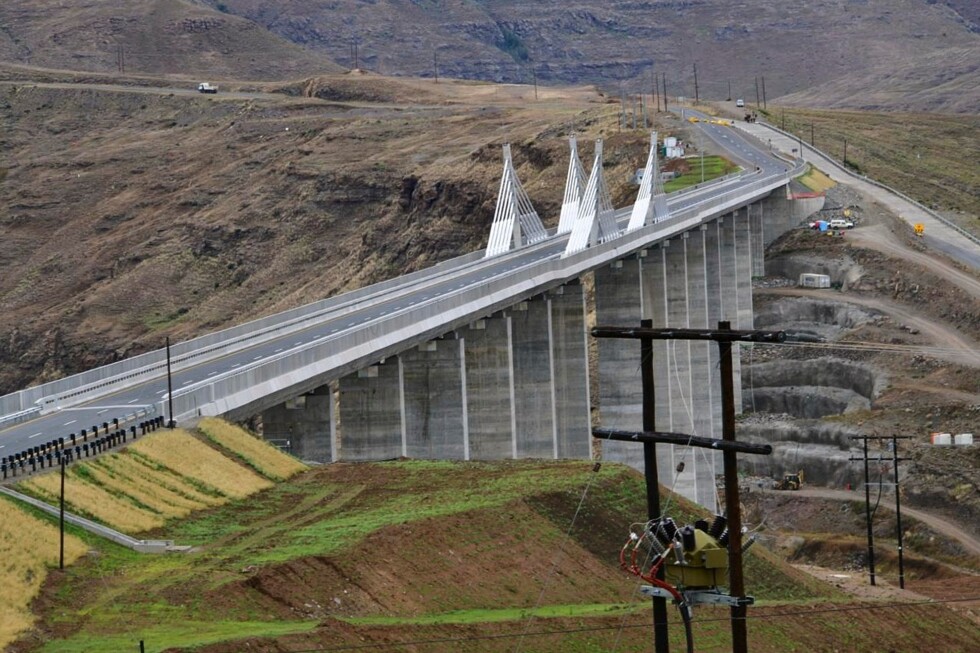
In southern Africa, a landmark infrastructure milestone has been reached this week with the official launch of the 825-meter Senqu Bridge, a key component of the massive Lesotho Highlands Water Project that is set to reshape cross-border water cooperation and economic development for two neighboring nations. Sitting 90 meters above the reservoir of the under-construction Polihali Dam at an elevation of over 2,500 meters above sea level, the bridge is the largest of three purpose-built crossings supporting the project’s second phase, designed to keep supply routes open once the dam’s water levels rise to full capacity.
For context, South Africa’s most densely populated province, Gauteng – home to the country’s economic hub Johannesburg – already relies on Lesotho for 60% of its public water supply. The completed project will nearly double annual water exports from the small mountainous, landlocked kingdom to South Africa, boosting current output from 780 million cubic meters to more than 1.27 billion cubic meters per year. This expansion will secure a critical water lifeline for one of Africa’s largest industrial and commercial centers, addressing long-running water scarcity challenges that have plagued South Africa for decades.
Rooted in a 1986 bilateral treaty between the two nations, the Lesotho Highlands Water Project stands as the largest foreign investment South Africa has ever undertaken, and ranks among the world’s biggest transboundary water infrastructure initiatives. With a total current estimated cost of 53 billion South African rand ($3.2 billion), the project includes a 120-kilometer network of tunnels that divert water from Lesotho’s high-altitude river systems into South Africa’s inland water grid. First launched in 1990, the first phase of the project is already operational, while the ongoing second phase is scheduled for completion between 2028 and 2029. Beyond expanding water exports, the project also increases Lesotho’s domestic hydropower generation, strengthening the country’s energy security and cutting its dependence on costly imported electricity.
The $144-million Senqu Bridge itself is already being celebrated as a major engineering achievement for Lesotho, and it has delivered immediate economic benefits to local communities: approximately 1,200 construction jobs were created for Lesotho workers during its buildout, a critical boost for a country that declared a national economic emergency last year after unemployment surged to nearly 30%.
At the bridge’s launch ceremony, South African President Cyril Ramaphosa emphasized the outsized importance of the project to his water-scarce nation. “South Africa is a water-scarce country and the waters of Lesotho’s highlands are vital to our country’s development. We remain forever grateful to the great Basotho nation for making water resources available to us,” Ramaphosa said.
For Lesotho, a country classified by the World Bank as one of the poorest in the world, where half of the population lives below the national poverty line, the project delivers transformative long-term economic gains through increased water royalties and sustained revenue. Lesotho Prime Minister Sam Matekane framed the initiative as a core pillar of the country’s national development strategy, noting that the benefits are intended to reach everyday citizens rather than remain abstract policy wins. “The royalties and infrastructure that flow from this project are not incidental benefits. They are central to our development finance strategy,” Matekane said. “The project must deepen impact on the people, strengthen accountability in delivery and ensure that its benefits are not abstract but are felt in the daily lives of the people affected.”
Several key construction milestones remain before the project is fully completed, including a 38-kilometer tunnel that will connect the new Polihali Reservoir to the existing Katse Reservoir, the primary holding facility from the project’s first phase. Lesotho, which is currently grappling with deepening economic strain caused by 50% U.S. tariffs on its key textile and mining exports and major cuts to U.S. foreign aid that previously supported most of the country’s public health programs, stands to see significant economic relief from the increased revenue the expanded project will generate.